
When AI Does the Thinking, What Are Students Actually Learning?

Why academic integrity must go beyond lockdown browsers.
For years, educators have fought an ongoing battle against cheating. We’ve blocked websites, restricted browsers, monitored screens, and designed assessments to make it harder for students to find answers they weren’t supposed to have.
Then artificial intelligence changed the rules.
Today, a student can ask AI to solve a math problem, explain a scientific concept, or write an entire essay in seconds. The finished work might look impressive. The answers might even be correct.
But here’s the question educators must confront:
If a student submits the right answer without doing the thinking, what have they actually learned?
This isn’t simply a cheating problem anymore. It’s a learning problem. And it may be one of the most consequential challenges facing education today.
The Rise of Cognitive Offloading
There’s a term for what happens when we delegate mental work to an external tool: cognitive offloading.
Cognitive offloading isn’t inherently bad. We’ve always used tools to make thinking more efficient, from calculators and dictionaries to search engines and spreadsheets.
AI takes that capability to an entirely new level.
A student can now offload not just calculations or information retrieval, but the reasoning, analysis, writing, and problem-solving that education is designed to develop.
And that’s where the concern begins.
A 2026 review published in Educational Psychology Review examined how generative AI can either strengthen or undermine learning. Its central finding was that the impact depends on which cognitive tasks students delegate to AI. When technology supports the learning process, it can be beneficial. When it replaces the very thinking students need to practice, learning may suffer.
Research on AI-assisted writing has also found that improvements in work completed with AI support don’t necessarily translate into stronger independent performance.
In other words, better-looking student work doesn’t always mean better student learning.
The distinction matters enormously for teachers trying to understand student mastery.
AI and the Tom Sawyer Syndrome
Tom Sawyer found a clever way to finish Aunt Polly’s fence: convince other boys that whitewashing was a privilege. They even traded their treasures for a turn with the brush. By the end, the fence had three coats of whitewash, and Tom had avoided most of the work.
The job was finished. But who had done the work?

Consider two students completing the same assignment.
One struggles with a difficult question, rereads the material, works through possible answers, and eventually reaches a conclusion.
The other copies the question into an AI tool, pastes the generated answer into the assignment, and moves on.
Both might earn the same score.
But their learning experiences couldn’t be more different.
The first student has practiced the skills necessary to develop understanding. The second may have practiced something else entirely: finding the fastest path to a completed assignment.
Like Tom, the second student has found a way to get the work done by handing it off. But an assignment has a purpose beyond completion. The thinking students do along the way is how they build understanding.
Repeated often enough, this creates a troubling possibility.
Students may become increasingly proficient at producing correct answers from LLMs while missing the practice they need to generate those answers independently.
A finished assignment can look just as impressive as Aunt Polly’s freshly whitewashed fence.
But when teachers see only the finished product, how are they supposed to know who did the thinking? Today, we have technology Aunt Polly didn’t have. We can identify behaviors that suggest students may be handing off the thinking—and intervene before those patterns become habits.
A finished fence didn’t prove Tom had done the work. A correct answer doesn’t prove a student has done the thinking.
Why Traditional Lockdown Browsers Aren't Enough
Traditional lockdown browsers were designed around a straightforward premise: restrict access to outside resources during an assessment.
That approach still has value. There are times when students need a controlled testing environment.
But restrictions alone don’t tell the full story.
Did a student leave the assignment repeatedly? Did they spend significant time away from their work? Was outside text brought into their response? Are there patterns that suggest a student might be relying on resources when independent work was expected?
A restrictive environment can help prevent certain behaviors, but educators also need visibility into the behaviors that may undermine the integrity of student work.
This isn’t about assuming every student is dishonest.
It’s about recognizing that teachers need more than a completed assignment and a score to understand what happened during the learning process.
Academic integrity should be about more than preventing misconduct. It should help protect the conditions necessary for authentic learning.
AI Belongs in Education. So Does Independent Thinking.
None of this means AI should be removed from education.
Quite the opposite.
AI can be an extraordinary learning companion. It can offer feedback, explain unfamiliar concepts, generate practice opportunities, and help students explore ideas in ways that weren’t previously possible.
The challenge is teaching students when to use it—and when to think for themselves.
UNESCO’s guidance on generative AI in education emphasizes preserving human agency and ensuring that technology serves meaningful learning.
That principle should guide how schools approach both instruction and assessment.
There should absolutely be opportunities for students to learn with AI.
But there must also be opportunities for students to demonstrate what they know without AI doing the work for them.
After all, the purpose of education isn’t simply to produce correct answers.
It’s to develop people who can think, reason, question, solve problems, and apply what they’ve learned.
And educators need reliable evidence that those skills are developing.
Moving From Cheating Prevention to Learning Integrity
What if academic integrity tools did more than attempt to stop students from accessing outside information?
What if they helped teachers identify patterns that deserve a closer look?
That’s the thinking behind the new Academic Integrity features in Classwork.com.
Rather than relying solely on restrictions, Classwork provides teachers with greater visibility into student activity during digital assignments.
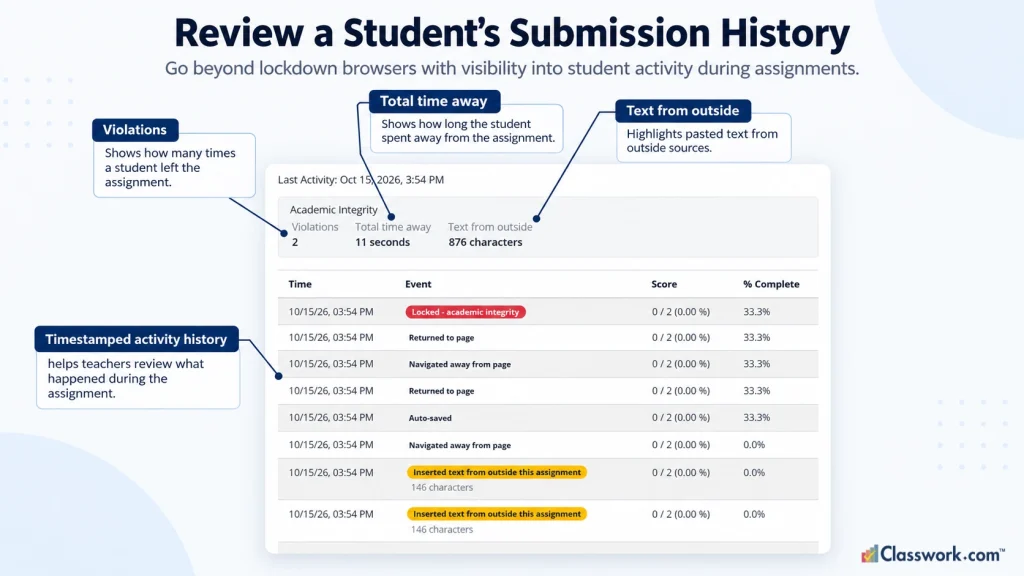
Teachers can:
- Record when students navigate away from an assignment and how long they remain away.
- Review the amount of text pasted from outside sources.
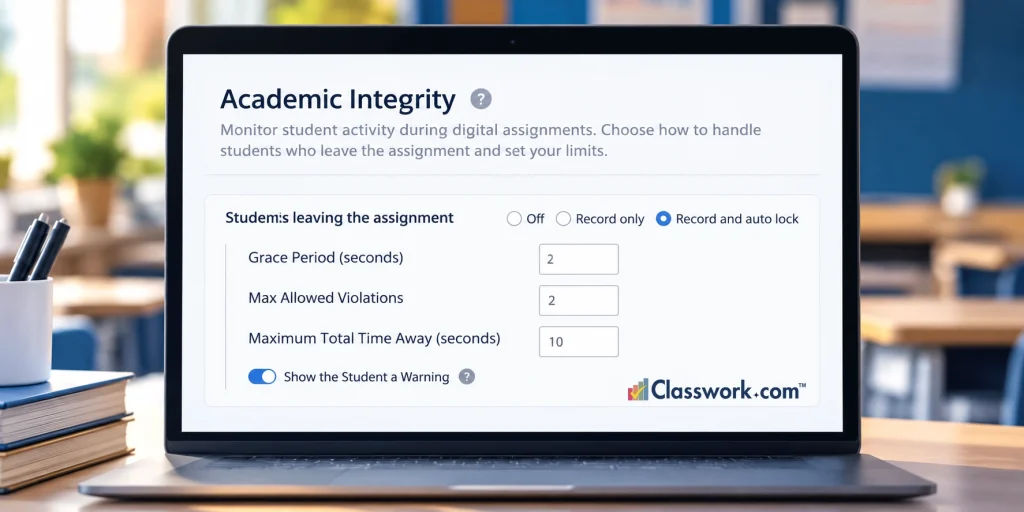
- Control whether copying and pasting is permitted.
- Establish thresholds that automatically lock an assignment when students exceed allowed navigation or time-away limits.
- Review timestamped activity histories alongside assignment progress and performance.
Teachers can choose to simply record student activity or establish limits that automatically lock an assignment when those limits are reached. If an assignment is locked, teachers can review the activity and unlock it so the student can continue.
Importantly, leaving an assignment or pasting text doesn’t automatically indicate academic dishonesty. Students may have legitimate reasons for these actions, including accessibility needs or teacher-approved resources. However, these behaviors provide valuable context that helps teachers recognize potential concerns, ask questions, and determine when intervention is needed.
A conversation with a student might reveal confusion, disengagement, inappropriate use of AI, or simply a misunderstanding of assignment expectations.
That conversation is an opportunity to teach.
The goal isn’t to catch students cheating. It’s to keep students from cheating themselves out of an education.
Learn more about Classwork.com’s Academic Integrity settings and features.
The Future of Assessment Must Protect the Learning Process
As AI becomes more capable and accessible, schools will face increasing pressure to distinguish between work students can produce with assistance and knowledge they can demonstrate independently.
That distinction is essential for meaningful assessment data.
Teachers need to know who understands a concept, who needs additional support, and who may be completing assignments without engaging in the thinking required.
School leaders need confidence that classroom performance reflects authentic student understanding.
And students deserve an education that develops their abilities rather than simply rewarding their ability to obtain answers.
Technology cannot determine a student’s intent, and no single digital signal can prove learning or cheating. But thoughtfully designed academic integrity tools can provide additional evidence that supports teacher judgment and timely intervention.
The question is no longer just how we prevent students from cheating.
It’s how we ensure students are still doing the learning… painting their own fences.
Because in a world where AI can generate almost any answer, the ability to think independently may be more important than ever.
Protect the Process. Reveal the Learning.
Classwork.com’s Academic Integrity features give teachers greater control over digital assignments and greater visibility into student activity—helping schools protect independent learning and make classroom assessment data more meaningful.
Frequently Asked Questions About Academic Integrity and AI
What is academic integrity in the age of AI?
Academic integrity means ensuring students demonstrate their own knowledge, skills, and understanding while using technology responsibly. With generative AI making answers readily available, schools must distinguish between AI-assisted learning and assignments intended to measure independent student mastery.
How does AI affect academic integrity in schools?
AI can support learning through explanations, feedback, and guided practice. However, when students rely on AI to complete assignments without engaging in the thinking required, teachers may receive an inaccurate picture of student understanding. This makes it increasingly important to establish clear expectations for appropriate AI use.
What is cognitive offloading, and why does it matter for students?
Cognitive offloading happens when people delegate mental tasks to tools or technology. Although this can be useful, excessive reliance on AI for reasoning, writing, and problem-solving may reduce opportunities for students to practice essential cognitive skills. The concern is not simply using AI, but allowing it to replace the learning process.
How are academic integrity tools different from traditional lockdown browsers?
Traditional lockdown browsers primarily restrict access to outside resources during assessments. Academic integrity tools can also provide information about student activity, such as navigating away from assignments, time spent away, and externally pasted text. These insights help teachers identify behaviors that may warrant further investigation or intervention.
Can teachers tell if students are using AI to complete assignments?
No single digital behavior can reliably prove that a student used AI or cheated. However, tools such as Classwork.com’s Academic Integrity features can show patterns of activity, including time away from assignments and pasted text. Teachers can use this information alongside student work and classroom observations to make informed instructional decisions.
Research and Further Reading
- Nakamura, D. (2026). Augmentation or Erosion? Regulating Cognitive Offloading in Generative AI-Supported STEM Learning. Educational Psychology Review.
- Chen, X. (2026). Layer-sensitive cognitive offloading in generative AI-assisted writing: Supported performance and independent no-AI outcomes. Frontiers in Psychology.
- UNESCO. (2023, updated 2026). Guidance for Generative AI in Education and Research.