
AI Use in K12:
Strong Critical Thinking Skills Are More Important Than Ever
Why Is “Critical Thinking” So Hard to Teach?
“Critical thinking” appears everywhere in education: standards, curriculum guides, rubrics, and mission statements. Yet it often feels pretty hard to define in practice. Teachers are told to teach it, students are expected to demonstrate it, and assessments are supposedly designed to measure it. Yet the term itself remains vague in practice.
The problem isn’t that critical thinking is unknowable. It’s that the phrase is too broad to guide day-to-day instruction. Without a clearer definition, it’s hard to know:
- what to teach explicitly
- what to look for in student work
- how to design assessments that genuinely measure it
This lack of precision is where many well-intentioned curricular approaches fall apart.
A More Useful Way to Teach Critical Thinking
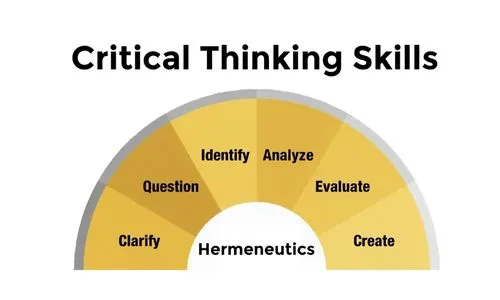
In the advanced academic disciplines of literary studies, philosophy, and rhetoric, the skills commonly labeled as “critical thinking” are taught with more specific terms: interpretation, analysis, evaluation, and reasoning. These higher education practices are often grouped under the concept of “hermeneutics,” which is the study of how meaning is constructed, examined, and revised through close reading.
To put it simply:
Critical thinking is the ability to interpret text, evaluate evidence and conclusions, and analyze reasoning
That shift matters. It turns critical thinking from an abstract goal into a set of observable behaviors that can be taught, practiced, and assessed, even at the K12 level.
Students working hermeneutically learn to:
- ask what a text actually says
- interpret what the author is claiming
- examine how evidence is used
- notice logical fallacies or overreach
- revise their understanding when evidence doesn’t support the conclusio
This is critical thinking defined in such a way that’s actionable for teachers.
What a Hermeneutical Approach Looks Like in Practice
A hermeneutical approach changes the kinds of questions students encounter. Instead of focusing on recall or summary, questions are designed to surface how students interpret and evaluate meaning.
The example below shows how this works in a typical middle-school reading passage and question set activity.
📘 Sample Informational Passage (8th Grade, Nonfiction)
Title: Can Community Gardens Reduce City Heat?
Many cities are searching for ways to reduce “urban heat islands,” areas where temperatures rise higher than surrounding neighborhoods because of concrete, traffic, and lack of shade. A recent study by the Urban Climate Initiative (UCI) examined whether building small community gardens could help reduce local temperatures.
The study tracked 40 community gardens built over the past two years. According to the report, neighborhoods with new gardens experienced an average temperature drop of 1.2°F during the summer. In contrast, similar neighborhoods without gardens showed an average drop of only 0.4°F. At first glance, this seems to suggest that community gardens help cool cities.
However, the report also notes several factors that make the findings uncertain. First, 22 of the 40 garden sites were paired with new tree-planting programs, which are known to reduce heat but were not measured separately. Second, seven garden neighborhoods also received reflective roofing on nearby public buildings, another factor that lowers temperatures. Because these improvements overlapped, the study could not isolate which change caused the cooling effect.
Timing was another limitation. The study collected data for only one summer, even though gardens were completed at different times—some only weeks before measurements began. Weather patterns shift year to year, so a single season of data may not reveal consistent trends.
Even with these uncertainties, the final report declares, “Community gardens are a proven solution for lowering city temperatures.” Given the overlapping variables and short timeline, more research is needed to determine whether gardens themselves reduced heat.
🧠 Hermeneutic Approach to Questions (with TEKS + VSOL Standards)
(Correct answers marked with *.)
1. (TEKS 8.8E, 8.9D; VSOL 8.5, 8.6)
Which detail BEST explains why the study’s conclusion may not be fully reliable?
A. The study measured cooling for a single summer. *
B. The report used confident wording in the conclusion.
C. The researchers studied 40 community gardens in total.
D. Temperature drops were recorded only in garden neighborhoods.
2. (TEKS 8.8F, 7G; VSOL 8.5, 8.6i)
Why is it flawed to claim that community gardens alone caused the temperature decrease?
A. The researchers collected temperature data in the summer.
B. Many garden sites also had new tree-planting programs. *
C. Gardens do not attract much traffic in the area.
D. Many cities do not track heat data.
3. (TEKS 8.8E, 7E; VSOL 8.5, 8.6h)
Which factor MOST weakens the claim that the gardens were the primary cause of cooling?
A. Some neighborhoods cooled by 1.2°F.
B. Non-garden neighborhoods cooled by only 0.4°F.
- Neighborhoods from many different parts of the city were included.
D. Some garden neighborhoods also received reflective roofing on buildings. *
4. (TEKS 7G, 8.8F; VSOL 8.6i)
What reasoning error is present in the report’s statement that gardens are “a proven solution”?
A. The report uses too much scientific vocabulary.
B. The researchers overgeneralize from limited data. *
C. The study included too many variables.
D. The report compared cities in different climates.
5. (TEKS 8.1D, 8.8E; VSOL 8.5)
Which question would a critical reader MOST need to ask before accepting the reported temperature drops?
A. How many volunteers worked in each garden?
B. Did weather patterns contribute to the temperature changes? *
C. How much did the gardens cost to build?
D. Were the gardens used more frequently than usual?
6. MULTIPLE SELECT (TEKS 8.8E, 8.8F; VSOL 8.6i)
Which factors make it difficult to know whether gardens caused the cooling effect? Select ALL that apply.
A. New trees planted at 22 of the garden sites. *
B. Reflective roofing added to buildings in several neighborhoods. *
C. The study lasted for only one summer. *
D. Some gardens were completed only weeks before temperature measurements. *
E. Neighborhood residents reported enjoying the gardening activities.
7. MULTIPLE SELECT (TEKS 7G, 8.8F; VSOL 8.6h, 8.6i)
Which details show that the researchers may have confused correlation with causation? Select ALL that apply.
A. Gardens were built over a two-year span.
B. Garden neighborhoods also received other heat-reducing improvements. *
C. The report concludes that gardens “are a proven solution.” *
D. The study did not separate the effects of different cooling projects. *
E. The researchers collected temperature data carefully.
8. (TEKS 8.8E, 8.9D; VSOL 8.5, 8.6h)
Why does the limited study period weaken the conclusion?
A. Summers in cities always have identical weather conditions.
B. A single summer cannot show long-term temperature trends. *
C. Gardens only affect temperatures after several decades.
D. Temperature tools malfunction in hot weather.
9. MULTIPLE SELECT (TEKS 8.8E, 1D; VSOL 8.6h, 8.6i)
Which steps would MOST improve future studies on the effect of community gardens on temperature? Select ALL that apply.
A. Collecting temperature data for several years. *
B. Measuring the separate effects of gardens, trees, and reflective roofs. *
C. Building gardens only in cooler regions.
D. Ensuring all gardens are completed before data collection begins. *
E. Interviewing residents about how much they like gardens.
10. (TEKS 7E, 8.8F; VSOL 8.6i, 8.6h)
If a city based its policies only on this study, what is the main risk it would face?
A. It would eliminate all other cooling strategies.
B. It would guarantee lower temperatures across the city.
C. It would increase heat because gardens require lots of water.
D. It would invest without knowing whether gardens actually reduce heat. *
A Practical Path Forward
As the passage set above illustrates, hermeneutics offers educators a practical way to make “critical thinking” concrete. It clarifies what students should actually do with texts and how teachers can design questions that reveal real understanding.
In the age of AI, the most important literacy skill isn’t producing more text; it’s knowing how to interpret it.
The growing interest in hermeneutics in K–12 education has been highlighted recently in Michael Maring’s LinkedIn article, “AI Didn’t Break School. It Exposed What Matters.”
The article points out that AI doesn’t eliminate the need for strong literacy skills. He successfully argues that AI makes these skills more visible and more necessary. When AI can generate information on just about any topic effortlessly, the real focus for teachers and their students shifts to interpretation, evaluation, and judgment.
How AI Use Can Help The Teacher
AI can be a useful partner for the teacher, especially when it comes to generating activities and questions. The key is to prompt AI with specific interpretive actions, not broad goals.
Instead of asking AI to “write critical thinking questions,” try prompts like:
- “Write questions that ask students to evaluate whether the evidence supports the author’s conclusion.”
- “Generate multiple-choice questions that test correlation versus causation.”
- “Create questions that require identifying overgeneralization or faulty reasoning.”
- “Ask students to interpret how limitations in the data affect the author’s claim.”
Naming the thinking type—interpret, analyze, evaluate—helps AI produce questions that align with hermeneutical reading rather than just surface-level comprehension.
From Example to Assignment in Less Than Two Minutes with Classwork.com
One practical question teachers often ask after seeing an example like the one above is:
How long would it take to actually turn this into an assignment students can complete?
This is where tools like Classwork.com make a real difference.
The sample passage and hermeneutic questions above can be copied and pasted directly into Classwork.com’s AI Genie, which automatically converts plain text into a fully interactive assignment. In about one to two minutes, teachers can:
- turn the passage into a digital reading activity
- convert multiple-choice and multiple-select questions into auto-graded items
- preserve the focus on interpretation, analysis, and evaluation
- assign the work to students with instant feedback enabled
- see standards-based mastery in real-time
It saves precious time, so teachers can focus more on what matters: their students!
1. Why is teaching critical thinking challenging in K-12 education?
Critical thinking is difficult to teach because the term is often too broad for daily instruction. Without a precise definition, educators struggle to identify what to teach explicitly or how to design assessments that genuinely measure student work. Shifting to specific actions like interpretation and analysis makes these skills observable and actionable.
2. How does a hermeneutical approach improve critical thinking skills?
A hermeneutical approach defines critical thinking as the active ability to interpret text, evaluate evidence, and analyze reasoning. Instead of abstract goals, students learn to ask what a text actually says and notice logical fallacies. This turns literacy into a set of practiced behaviors focused on how meaning is constructed and revised.
3. What role does AI play in developing student critical thinking?
In the age of AI, the focus of literacy shifts from producing text to interpreting and evaluating it. AI can serve as a partner for teachers by generating complex questions that test correlation versus causation or identify faulty reasoning. This requires students to use higher-order judgment to verify AI-generated information.
4. How can teachers use AI to create more rigorous assignments?
Teachers can use AI to move assignments from surface-level comprehension to deep analysis by prompting it with specific interpretive actions. Tools like Classwork.com can instantly convert plain text into interactive activities that preserve a focus on evaluation and reasoning. This allows for real-time standards-based mastery tracking.