
Learn About Bluebonnet Learning™

Welcome to the Bluebonnet Learning™ Center
Your go-to resource for understanding Texas’s newest OER instructional materials and the legislation that made it all happen: HB 1605.
Bluebonnet Learning™ is making headlines—and shaping classrooms across Texas. You may be an educator navigating the shift to Bluebonnet Math. Or possibly a curriculum leader unpacking the instructional materials to understand if adoption is right for your schools. Or maybe a parent trying to understand how House Bill 1605 affects your student’s school district, you’re in the right place.
This section of the Digital Classroom blog is dedicated to helping Texas educators make sense of it all. Here, you’ll find in-depth articles, analysis, and commentary on:
- Bluebonnet Math for Grades K–8 and Algebra I
- Bluebonnet Reading Language Arts (RLA) for Grades K–5
- Best practices for implementation, transition planning, and compliance
- Funding insights related to HB 1605, IMTA, and OER entitlements
- Controversies and considerations around instructional content
- Tools and strategies for digital delivery, progress monitoring, and classroom adaptation
We break down the complexity, amplify what’s working, and give you honest, practical information you can use—whether your district is all-in on Bluebonnet or still weighing the options.

Bluebonnet Learning™ is the brand name for the State of Texas’ Open Educational Resources (OER) curriculum. Bluebonnet RLA K-5 and Bluebonnet Math K-5, 6-8 and Algebra were approved by the TX State Board of Education in November of 2024 and are supported by the Texas Education Association (TEA). Bluebonnet Math for the elementary grades was not written by the TEA. It was created by Great Minds®. It is the TEKS-aligned version of Eureka Math.

No. TEA did not “create” the Bluebonnet Learning Math curriculums for any grade level. HB 1605 directed TEA to make high-quality instructional materials available to Texas schools via open educational resources. TEA contracted with curriculum providers to fulfill the requirements of the law.
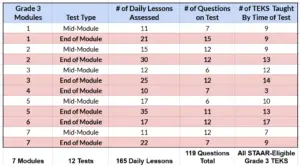
Effective progress monitoring is the backbone of high‑quality math instruction in Texas. When done right, it gives teachers the real-time insight they need to guide instruction, target interventions, and ensure students truly master each TEKS standard before moving on. Without it, we’re left guessing—and so are our students.
Districts report that Bluebonnet Math creates huge progress monitoring and STAAR® prep headaches. Very few tests are included and they’re not like the problems atudents face on the STAAR®. Read on to discover solutions to the worst Bluebonnet Math problems.

It seems that the push back from community stakeholders regarding religion in the Bluebonnet Learning K-5 Reading Language Arts curriculum has piqued interest in Bluebonnet Learning, HB 1605, the Texas State Board of Education, and the Texas Education Agency. We’ll answer your questions with more information than you probably wanted. Why? When it comes to Bluebonnet Learning, you have to know a lot to be truly informed.

From the teacher’s perspective, data collection is burdensome. From the administrator’s viewpoint, visibility into student performance is limited. And for families, there’s often little to see in terms of progress reporting. Here are seven common Bluebonnet Math problems—and how Texas districts can solve them.
Q: What is Bluebonnet Learning? A: Bluebonnet Learning is the brand name for the State of Texas’ Open Educational Resources (OER) curriculum. Developed under House Bill 1605 (HB 1605), it provides 100% TEKS-aligned instructional materials for K–5 Reading Language Arts (RLA) and K–Algebra Math.
Q: Is Bluebonnet Learning a digital or print curriculum? A: The state-provided materials are primarily designed to be printed as physical workbooks and teacher guides. While PDFs are available online, the standard implementation relies heavily on paper-based instruction and manual grading.
The Role of Classwork.com
Q: How does Classwork.com interact with Bluebonnet Learning? A: Classwork.com is a digital platform provider that facilitates the interactive delivery of the Bluebonnet curriculum. It “digitizes” the static materials, allowing teachers to assign them online, collect real-time data, and use auto-grading features.
Q: What is the “Texas OER Math Companion” on Classwork? A: This is a specialized resource suite on Classwork.com designed to work alongside the Bluebonnet Math curriculum. It includes an item bank of STAAR-style questions that are directly aligned with Bluebonnet lessons, enabling daily checks for understanding.
Addressing Challenges (The “Data Desert”)
Q: What is the “Data Desert” mentioned by Classwork? A: Classwork uses this term to describe the gap in data collection when using the standard Bluebonnet curriculum. Because the state materials only include assessments every 20–30 days (mid-module and end-of-module), teachers may go weeks without knowing if students have truly mastered specific TEKS.
Q: How does Classwork fix the lack of frequent assessments? A: Classwork provides daily lesson-level assessments (6–12 questions each) that are auto-graded. This allows teachers to catch misconceptions immediately rather than waiting for a module test.
Q: How does Classwork help with STAAR preparation? A: Standard Bluebonnet assessments often lack the variety of digital item types found on the STAAR test. Classwork’s platform delivers daily practice using STAAR-style formats like multi-select, drag-and-drop, and equation editors, helping students build “assessment fluency.”
Implementation & Compliance
Q: Does using Classwork ensure HB 1605 compliance? A: Yes. Classwork includes administrative approval workflows that allow districts to review and approve materials, satisfying the local review requirements set by HB 1605 and HB 8.
Q: Can teachers track individual student mastery of TEKS? A: Yes. Through Classwork’s Student Mastery and Student Growth Reports, teachers can see real-time performance data tied to specific TEKS trajectories, which is difficult to do with manual grading in paper workbooks.
Q: Can districts use IMTA/EMAT funds for Classwork? A: Yes. Classwork positions its “Texas Edition” as a fiscally sound path that can be funded using state instructional materials allotments, often resulting in a surplus by reducing recurring paper workbook costs.
Legal Disclaimer
Classwork.com is a digital platform provider that facilitates the interactive delivery, approval, and reporting of instructional materials, including state-adopted High-Quality Instructional Materials (HQIM) such as the Bluebonnet Learning (BBL) curriculum.
Classwork.com does not own, modify, or sell the Bluebonnet Learning curriculum or any other State of Texas Open Educational Resource (OER) materials. All BBL content remains under the State of Texas OER license, and its use within the Classwork.com platform is subject to district compliance with applicable licensing requirements.
Intellectual Property & Proprietary Rights
Classwork.com’s software, interactive overlays, item banks and activities, AI and auto-scoring technology, approval workflows, and reporting tools are proprietary intellectual property, protected under U.S. copyright law (17 U.S.C. § 102), trade secret protections, and the Digital Millennium Copyright Act (DMCA, 17 U.S.C. § 512). The use of these features within the Classwork.com platform is governed by our Terms of Service, and no aspect of our proprietary technology may be copied, distributed, or reverse-engineered without explicit authorization.
DMCA Compliance & Safe Harbor Protection
Classwork.com acts as a service provider under the DMCA and is not responsible for district or teacher-created content uploaded to the platform. If you believe that any content hosted within Classwork.com violates copyright or licensing agreements, please submit a formal DMCA takedown request.
By using Classwork.com, users acknowledge that:
– All instructional materials remain under the control of the respective copyright or OER license holders.
– Classwork.com’s role is to provide a technology infrastructure for digital instructional material delivery, not to modify or resell OER curriculum content.
– Districts are responsible for ensuring their use of OER materials complies with Texas Education Agency (TEA) guidelines and licensing terms.
For more information, please review our Terms of Service, Privacy Policy, and DMCA Compliance Procedures accessed via the footer on this page.