
Bluebonnet Learning™ RLA Readiness Checks: Connecting Daily Instruction to STAAR©, SST and LIFT Success
Texas classrooms are changing.
Districts across the state are implementing Bluebonnet Learning™, strengthening instructional coaching through LIFT, and preparing for a new accountability landscape. STAAR remains in place now, and TEA says the Student Success Tool will replace STAAR beginning in the 2027–28 school year. LIFT also raises the bar for implementation by combining HQIM adoption, instructional leadership support, Texas Lesson Study and sustainable systems-level change. (Texas Education Agency)
Those expectations create a new challenge for district leaders.
Teachers generate valuable evidence every day through Bluebonnet Learning lessons, classroom discussions, writing activities, Student Activity Books and teacher observations. But much of that evidence remains on paper or inside individual classrooms. It is valuable, but it is hard to aggregate, hard to compare and difficult to use quickly across grade levels, campuses or districts.
Simply collecting more data is not the answer. Districts need better instructional evidence: evidence that is timely, TEKS-aligned, connected to the curriculum and useful before the next major assessment arrives.
That is why Classwork.com developed RLA Readiness Checks™.
Readiness Checks work alongside Bluebonnet Learning, not in place of it. They preserve the depth and richness of the curriculum while providing the digital assessment, reporting and instructional intelligence districts need to support classroom instruction, coaching cycles, LIFT implementation and long-term student growth.
Why Texas Districts Need More Than Daily Checks
Traditional exit tickets have served classrooms well for years. They help teachers see whether students understood the day’s lesson and whether a concept may need more review.
But Texas districts now need something more powerful than a quick end-of-lesson check.
Today’s instructional leaders need to know whether daily instruction is building toward future success: End-of-Unit performance, STAAR readiness, Student Success Tool readiness and accountability growth. They also need to know whether teachers, coaches and campus leaders have the evidence they need to respond while instruction is still unfolding.
That is the difference between a traditional exit ticket and a Readiness Check.
A traditional exit ticket asks: Did students understand today’s lesson?
A Readiness Check asks: Is today’s learning helping students build the knowledge and skills they will need next?
Each Classwork.com Readiness Check is intentionally designed to provide consistent, TEKS-level evidence that supports instructional decision-making throughout the year while keeping students connected to the Bluebonnet Learning curriculum.
The Post-Benchmark Problem
For years, many districts relied on benchmark assessments, mock tests and vendor practice assessments to estimate progress toward STAAR.
That model is changing.
TEA guidance on HB 8 explains that Texas is moving toward the Student Success Tool beginning in 2027–28, and TEA’s preliminary 2028 A–F framework materials state that practice tests and non-curricular benchmark tests are prohibited to reduce missed instructional time. (Texas Education Agency)
That creates a practical question for every Texas district:
If benchmarks are no longer the right tool, and EOUs cannot predict accountability ratings by themselves, what replaces the old progress-monitoring model?
The answer cannot be another big testing event. It has to live closer to instruction.
Classwork.com Readiness Checks provide a daily, curriculum-connected alternative. They help districts build a continuous stream of TEKS-level evidence from the instruction already happening in Bluebonnet classrooms. That evidence supports tomorrow’s teaching, this week’s PLC, the next coaching conversation and the district’s broader view of student progress.
The throughline is simple:
Bluebonnet lesson → Daily TEKS evidence → EOU readiness → STAAR/SST readiness → accountability growth
That is the gap Classwork.com fills.
Rich Instruction. Limited Visibility.
Bluebonnet Learning RLA is rich by design. Students read complex texts, discuss ideas, build vocabulary, write about evidence and complete Student Activity Book assignments throughout each unit.
That kind of instruction matters. It builds knowledge over time.
But rich instruction does not automatically produce usable data.
A teacher may see students struggling during discussion. A coach may notice patterns during a walkthrough. A principal may see evidence of strong curriculum use in Activity Books. Yet unless selected evidence is captured digitally and consistently, it is difficult to use for progress monitoring, coaching, intervention documentation or districtwide decision-making.
The challenge is not a lack of evidence. The challenge is turning everyday classroom learning into information that can guide action.
Readiness Checks help bridge that visibility gap by transforming selected moments of daily learning into consistent, searchable, TEKS-aligned instructional evidence. They do not replace teacher judgment. They amplify it.
What the Classwork.com Curriculum Audit Revealed
To better understand how daily instructional evidence accumulates throughout a Bluebonnet Learning RLA unit, Classwork.com conducted a curriculum audit of Grade 3 Units 1 and 2.
The audit examined Teacher Guide instructional touchpoints, Student Activity Book assignments, formative learning opportunities and End-of-Unit assessments. The purpose was not to criticize Bluebonnet Learning. It was to identify where rich paper-based instruction does not automatically become digital, comparable, TEKS-level evidence.
The results were both encouraging and revealing.
Bluebonnet Learning gives students many opportunities to read, write, discuss, analyze and apply new learning. That depth is one of the curriculum’s greatest strengths. It also means that a significant amount of student learning occurs long before an EOU assessment is administered.
In Unit 1, Classic Tales: The Wind in the Willows, teachers face 54 distinct gradable Activity Book tasks. In a standard classroom of 22 students, that creates 1,188 pages of paper-based student work.
In Unit 2, Scales, Feathers, and Fur: Animal Classification, the number rises to 70 gradable tasks, including 63 in the core lessons and seven in the Pausing Point. For the same classroom of 22 students, that creates 1,540 more pages of student work.
Together, the first two Grade 3 RLA units generate 2,728 pages of paper-based evidence crossing a single teacher’s desk before the first report cards go out.
Those numbers do not mean teachers should formally grade every page. They show the operational reality of rich, paper-based HQIM. The learning is there. The evidence is there. But without a digital layer, much of it becomes difficult to organize, analyze and use beyond the individual classroom.
What the Bluebonnet™ RLA Audit Found in Grade 3 Units 1 and 2
| Audit Finding | Unit 1: Classic Tales | Unit 2: Animal Class | Why It Matters | ||
|---|---|---|---|---|---|
Instructional lessons reviewed | 15 | 15 | Shows the scope of the audit | ||
Teacher Guide instructional touchpoints | 84 | 146 | Shows how much teaching and learning is taking place | ||
EOU assessment items | 20 | 20 | Shows the narrow sampling of TEKS taught | ||
Instruction not measured by the EOU | 82.1% | 88.8% | Illustrates the dark-data problem | ||
Gradable Activity Book tasks | 54 | 70 | Shows the volume of paper-based work teachers must process | ||
Students in standard classroom example | 22 | 22 | Establishes the workload calculation | ||
Manual grading burden | 1,188 pages | 1,540 pages | Shows how quickly paper-based evidence becomes unmanageable | ||
Six-week grading burden | 1,188 + 1,540 = 2,728 pages in 1 subject over 6 weeks | ||||
Example of EOU mismatch | TEKS 3.3.B: 2 paper formative opportunities vs. 5 Unit 1 EOU items | Central Idea ignored on EOU despite its importance as a Readiness TEKS | Shows that EOUs and lessons are not aligned | ||
Figure 1: Workload analysis demonstrating the time impact of manual tracking versus automated processing of Bluebonnet Learning™ RLA exit tickets.
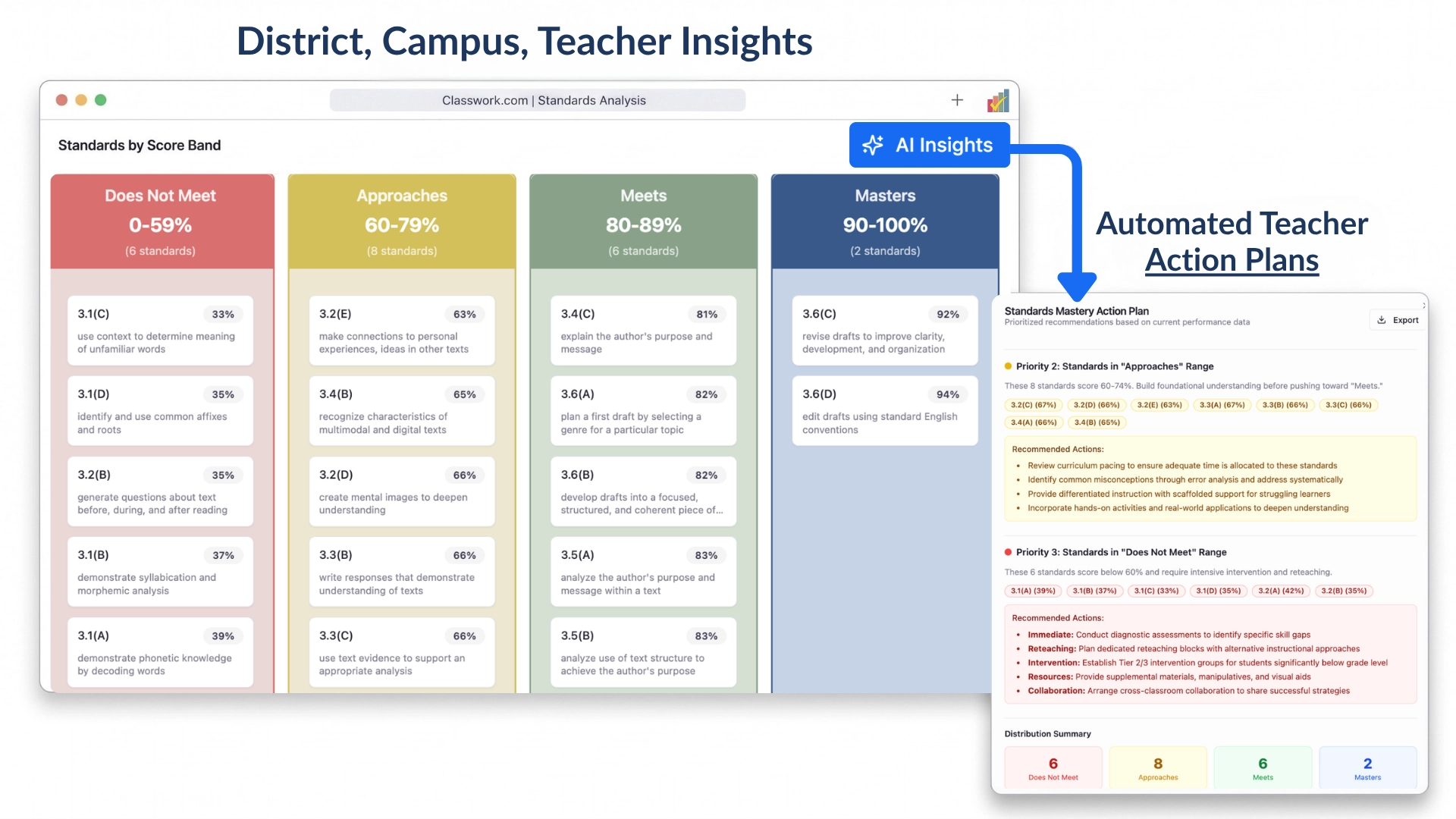
*All data and TEKS examples are illustrative and subject to final district verification. Designed for District Leaders and Texas HQIM Compliance.*
Why Bluebonnet Learning RLA Readiness Checks Focus on the Standards That Matter Most
Every Bluebonnet Learning lesson introduces students to multiple concepts, skills and instructional experiences. Not every learning target, however, provides the same value when educators are making time-sensitive instructional decisions.
That is why Readiness Checks are intentionally focused.
Rather than attempting to assess every objective touched during a lesson, Classwork.com uses a proprietary design process to identify the standards and skills that provide the clearest evidence of student readiness. The goal is not to turn every lesson into a mini-test. The goal is to collect the most useful evidence in the least amount of instructional time.
Readiness Checks balance several instructional needs at once. They stay connected to the daily Bluebonnet lesson. They provide visibility into high-priority TEKS. They reinforce important supporting skills. They help students apply vocabulary, reading analysis, writing, foundational skills and higher-order thinking in ways that build toward future success.
The result is not random review. It is not generic test prep. It is not a benchmark in disguise.
It is a short, curriculum-connected, accountability-aware check for understanding that helps educators know what students are ready to do next.
Built for Instruction, Not Just Reporting
The purpose of assessment is not to generate reports. The purpose of assessment is to improve learning.
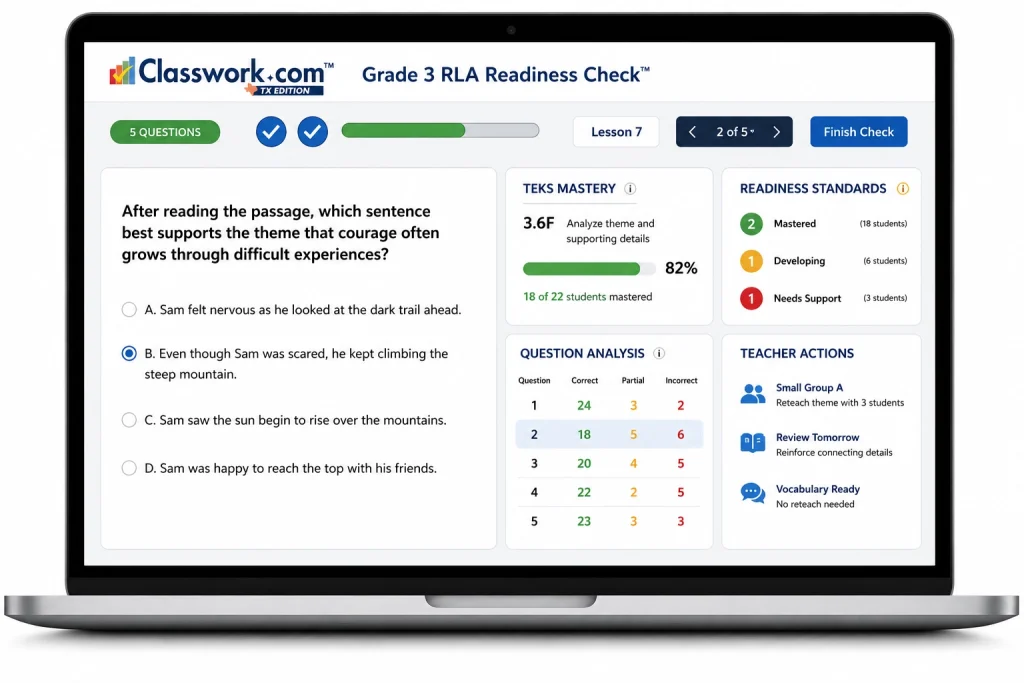
Once students complete a Readiness Check, teachers receive immediate evidence they can use while the lesson is still fresh. They can see which questions challenged the most students, which TEKS may require additional support, which students are ready to move forward and which students would benefit from small-group instruction.
That matters because intervention is most useful when it happens quickly.
A teacher who identifies a misconception tomorrow can still change the path of learning. A PLC that sees a common trend this week can coordinate reteaching before the EOU. An instructional coach who sees the same challenge across classrooms can focus support where it will matter most.
Readiness Checks shift the conversation from hindsight to action.
Instead of asking, “How did students score?”
Educators can ask, “What should we do next?”
From Daily Evidence to Predictive Insight
A single formative assessment provides a snapshot. A year of Readiness Checks tells a story.
As students complete Readiness Checks across lessons and units, Classwork.com builds a growing body of instructional evidence. Teachers can monitor whether students are progressing. Coaches can identify patterns across classrooms. Principals can see implementation trends. District leaders can better understand how daily instruction is contributing to larger academic goals.
This is especially important in the post-benchmark era.
Texas districts still need progress monitoring. They still need early warning signals. They still need a way to know whether students are moving toward state assessment readiness and accountability growth. But they need that evidence without adding more benchmark windows or pulling students away from instruction.
Readiness Checks make that possible by turning daily instruction into actionable instructional intelligence.
Supporting the Next-Day Review Cycle
One of the most valuable opportunities for intervention often occurs at the start of the next instructional day.
Students still remember the lesson. Teachers remember where misconceptions appeared. Instruction can be adjusted before misunderstandings become habits.
Readiness Checks support this natural instructional rhythm. Teachers can review class results, address common misconceptions, revisit challenging concepts and provide targeted support before moving into new learning.
Classwork.com also connects item-level results to intervention support grounded in familiar instructional coaching routines. Teachers can help students see the gap, name the strategy and apply the learning, then use follow-up evidence to determine whether performance improved.
This matters for LIFT because coaching and intervention evidence cannot stop at “support was provided.” Leaders need to know whether the support worked.
Classwork.com helps capture that evidence in a way that supports teachers, coaches, principals and district leaders.
What Teachers, Coaches and Leaders Gain
Teachers gain immediate, organized evidence without having to hand-grade stacks of paper or build spreadsheets. They can quickly identify misconceptions, group students for support and plan next steps with greater clarity.
Instructional coaches gain a stronger starting point for professional conversations. Instead of relying only on walkthrough notes or teacher reflection, they can use consistent classroom evidence to focus coaching on student learning.
Campus leaders gain visibility across classrooms and grade levels. They can use Readiness Check data to support PLCs, instructional walkthroughs, professional learning and campus improvement planning.
District leaders gain a common instructional evidence system. They can monitor curriculum implementation, identify TEKS-level trends, compare progress across campuses and make strategic decisions without waiting for the next major assessment.
The value is not more data.
The value is better evidence, organized in time to matter.
Supporting LIFT and Instructional Insights App Reporting
Successful LIFT implementation depends on more than adopting high-quality instructional materials. It depends on consistent instructional practices, ongoing coaching, meaningful professional learning and reliable evidence that those efforts are improving student outcomes.
Classwork.com supports that work by connecting Readiness Check data with instructional reporting, coaching documentation, lesson logs, pacing evidence, observation records and implementation insights.
District administrators, coaches and ESC providers also need confidence that the data they collect can support LIFT reporting expectations. Ed-Fi’s resource center states that Instructional Insights will be used across multiple TEA grant programs, including LIFT, and that data will be needed to power Instructional Insights dashboards and meet TEA LIFT program requirements. (Ed-Fi Alliance)
Classwork.com is actively integrating with the Instructional Insights App so districts can better organize Readiness Check data and implementation evidence for the reporting environment TEA expects.
That matters for peace of mind.
Districts should not have to collect evidence in one place, translate it in another and rebuild it again for grant reporting. Coaches should not have to maintain separate spreadsheets to prove that support happened. ESC providers should not have to chase documentation across campuses and districts.
Classwork.com helps bring the work into one coherent platform so districts can manage Bluebonnet Learning implementation, support coaching cycles and reduce reporting friction.
The Future of Daily Assessment
The next generation of formative assessment will not be defined by more quizzes or more testing.
It will be defined by better instructional evidence.
Students deserve assessments that inform instruction rather than interrupt it. Teachers deserve tools that reduce administrative work while increasing instructional clarity. Coaches and principals deserve evidence that strengthens professional conversations. District leaders deserve visibility that connects daily instruction to long-term student growth.
Bluebonnet Learning provides the instructional foundation.
Classwork.com Readiness Checks provide the instructional evidence.
Together, they help create classrooms where every lesson contributes to a clearer understanding of student learning, every intervention can be guided by timely evidence and every instructional decision is connected to future readiness.
Sources
Texas Education Agency. “Overview of House Bill 8.” Oct. 23, 2025.
https://tea.texas.gov/taa-letters/overview-house-bill-8
Texas Education Agency. “House Bill 8: Student Assessment.” Accessed July 21, 2026.
https://tea.texas.gov/data-reports/student-assessment-overview/house-bill-8-student-assessment
Texas Education Agency. “Leadership and Instructional Foundations for Texas | LIFT.” Accessed July 21, 2026.
https://tea.texas.gov/curriculum-and-instruction/instructional-materials/leadership-and-instructional-foundations-texas-lift
Texas Education Agency. “Preliminary 2028 A–F Refresh Framework & House Bill 8.” Sept. 18, 2025.
https://tea.texas.gov/educators/superintendents/preliminary-2028-a-f-refresh-frame-work-house-bill-8-2.pdf
Texas Education Exchange. “About The Exchange.” Accessed July 21, 2026.
https://txedexchange.net/about-the-exchange
Ed-Fi Alliance. “Texas Case Study: Unlocking Data to Strengthen Local Decision-Making in Texas.” Accessed July 21, 2026.
https://www.ed-fi.org/resources/case-studies/texas/
Ed-Fi Alliance. “Ed-Fi Resource Center: Instructional Insights.” Accessed July 21, 2026.
https://edfi.atlassian.net/wiki/spaces/rc/folder/2405793793
Classwork.com. “LIFT Grant Platform for ESCs: HQIM & Coaching Fidelity.” Accessed July 21, 2026.
https://classwork.com/lift-grant-platform-for-escs/
Classwork.com. “Classwork.com Curriculum Audit of Bluebonnet Learning Grade 3 Units 1 and 2.” Internal analysis, 2026. No public URL. Recommended public citation if table is published: “Source: Classwork.com curriculum audit of Bluebonnet Learning Grade 3 Units 1 and 2, 2026.”
What are Classwork.com RLA Readiness Checks™?
Classwork.com RLA Readiness Checks are short, TEKS-aligned digital assessments designed to complement Bluebonnet Learning RLA instruction. They provide timely instructional evidence that helps teachers monitor learning, identify misconceptions and support student growth throughout the instructional cycle.
How are Readiness Checks different from traditional exit tickets?
Traditional exit tickets usually confirm understanding of a single lesson. Readiness Checks go further by providing consistent, TEKS-level evidence that helps educators monitor trends, prioritize interventions and understand how daily instruction is contributing to long-term readiness.
Do Readiness Checks replace Bluebonnet Learning?
No. Readiness Checks complement Bluebonnet Learning. Students continue engaging with the curriculum’s lessons, discussions, writing activities and Student Activity Books while Readiness Checks provide an additional digital evidence layer for teachers and instructional leaders.
How long does a Readiness Check take?
Most Readiness Checks are designed to be completed in about 5–10 minutes. Their purpose is to fit naturally within the instructional day without reducing valuable teaching and learning time.
How do Readiness Checks support STAAR and the Student Success Tool?
Readiness Checks provide ongoing TEKS-level evidence throughout the school year rather than relying only on larger assessments. This helps teachers and leaders identify learning needs earlier, monitor growth over time and better prepare students for future state assessments.
Why do Readiness Checks emphasize the standards that matter most?
Not every TEKS provides the same value for time-sensitive instructional decisions. Readiness Checks are designed to give educators greater visibility into high-priority learning targets while still reinforcing important supporting skills from the curriculum.
How do Readiness Checks support LIFT implementation?
Readiness Checks provide consistent instructional evidence that supports coaching cycles, professional learning, curriculum implementation and intervention planning. When combined with Classwork.com’s reporting tools, they help districts monitor implementation and continuous improvement.
How does Classwork.com support Instructional Insights App reporting?
Classwork.com is actively integrating with the Instructional Insights App so districts can better organize Readiness Check data, coaching documentation, lesson logs, pacing evidence, observations and intervention evidence for LIFT reporting.
Do Readiness Checks increase testing time?
No. Readiness Checks are brief and designed to fit within the instructional flow of Bluebonnet Learning. Their purpose is to collect meaningful instructional evidence without creating additional testing windows or disrupting classroom learning.
What kind of reporting is available?
Classwork.com provides immediate classroom results along with TEKS-aligned reporting, item analysis, student performance trends and instructional insights that help teachers, coaches, campus leaders and district administrators make informed decisions throughout the school year.
Legal Disclaimer
STAAR® and BLUEBONNET LEARNING™ are trademarks owned by the Texas Education Agency and the appearance of those trademarks on this website implies no association. Classwork.com and its goods and services are not sponsored by, affiliated with, or approved by the Texas Education Agency.
For more information on the Bluebonnet Learning™ Curriculum, please visit the Texas Education Agency’s official page.
Classwork.com is a digital platform provider that facilitates the interactive delivery, approval, and reporting of instructional materials, including state-adopted High-Quality Instructional Materials (HQIM) such as the Bluebonnet Learning™ (BBL) curriculum.
Classwork.com does not own, modify, or sell the Bluebonnet Learning™ curriculum or any other State of Texas Open Educational Resource (OER) materials. All BBL content remains under the State of Texas OER license, and its use within the Classwork.com platform is subject to district compliance with applicable licensing requirements.
Intellectual Property & Proprietary Rights
Classwork.com’s software, interactive overlays, item banks and activities, AI and auto-scoring technology, approval workflows, and reporting tools are proprietary intellectual property, protected under U.S. copyright law (17 U.S.C. § 102), trade secret protections, and the Digital Millennium Copyright Act (DMCA, 17 U.S.C. § 512). The use of these features within the Classwork.com platform is governed by our Terms of Service, and no aspect of our proprietary technology may be copied, distributed, or reverse-engineered without explicit authorization.
DMCA Compliance & Safe Harbor Protection
Classwork.com acts as a service provider under the DMCA and is not responsible for district or teacher-created content uploaded to the platform. If you believe that any content hosted within Classwork.com violates copyright or licensing agreements, please submit a formal DMCA takedown request.
By using Classwork.com, users acknowledge that:
– All instructional materials remain under the control of the respective copyright or OER license holders.
– Classwork.com’s role is to provide a technology infrastructure for digital instructional material delivery, not to modify or resell OER curriculum content.
– Districts are responsible for ensuring their use of OER materials complies with Texas Education Agency (TEA) guidelines and licensing terms.
For more information, please review our Terms of Service, Privacy Policy, and DMCA Compliance Procedures accessed via the footer on this page.