
Executive Brief March 2026:
Bluebonnet™ Math Assessments
The 2026-2027 school year is the critical transition window before the Student Success Tool (SST) becomes the primary Texas accountability measure. Current data shows a significant gap between Bluebonnet™ module assessments and STAAR requirements: while Readiness TEKS account for ~65% of STAAR weight, they comprise only 49% of formal Bluebonnet™ tests.
Key Findings: The "Visibility Gap"
Data Latency: A typical Bluebonnet™ module lasts 18-23 days, leaving administrators without actionable data for weeks at a time.
Paper-Based Limitations: Thousands of data points remain “locked” in paper workbooks, requiring manual teacher review that creates a bottleneck.
Critical Omissions: High-stakes “Heavy Hitter” standards (like 3.5A) may not appear in formal assessments until the final module of the year.
Leadership Insight: Proficiency on Bluebonnet™ tests does not automatically align with STAAR proficiency. While Readiness TEKS drive your district's accountability rating, they comprise only 49% of the formal Bluebonnet™ Math tests. Identifying the Readiness Gap is just the start.
HB 8 Compliance: The Shift to Instructionally Supportive Assessment
While the assessment deficit in current curriculums is clear, solving it requires navigating the strict regulatory guardrails established by HB 8 (2025). This legislation fundamentally changes how Texas districts must address readiness gaps:
The “Benchmarking Ban”
HB 8 immediately prohibits several traditional “test-prep” practices in grades 3–8 to protect vital instructional time:
Prohibited: District-mandated benchmarks and vendor-provided practice tests.
Prohibited: “Mock STAAR” exams and predictive testing.
Prohibited: Reliance on lagging data and cohort-focused snapshots.
New Requirements for Accountability
To reclaim 15–30 hours of instructional time per student, the law shifts the focus toward continuous evidence. Starting in the 2027-2028 school year, the Student Success Tool (SST) will require:
Progress Monitoring: Daily or weekly checks to guide teacher instruction.
Embedded Testing: Assessments that are instructionally supportive rather than disruptive.
Instant Intelligence: Real-time data that identifies student struggle the moment it happens.
Leadership Insight: HB 8 essentially mandates an “early warning system.” By adopting a digital measurement layer now, districts secure a proactive growth model that provides real-time data while honoring the ban on benchmarks.
Leadership Insight: HB 8 essentially requires an 'early warning system' built on daily evidence rather than periodic snapshots. Waiting for module test data creates a 20-day blind spot. As HB 8 moves districts away from 'Mock STAARs,' the focus shifts to daily evidence. While HB 8 is a Texas-specific mandate, the shift from 'disruptive benchmarking' to 'instructional intelligence' is a national trend appearing in districts from Florida to California.
Implementation Pathways
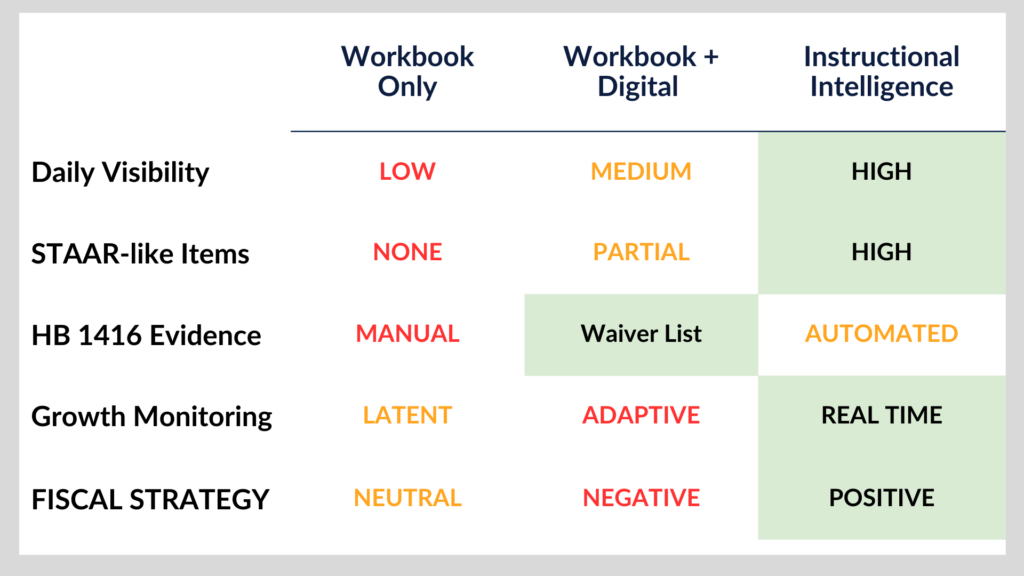
Districts have three primary ways to deliver Bluebonnet™ Math, with varying levels of fiscal and data efficiency:
Workbook Only: Low visibility; daily exit tickets remain “locked in paper”.
Workbook + Digital (e.g., Zearn/MATHia): Medium visibility; can consume the entire $40 IMRA incentive.
Instructional Intelligence (Classwork.com): High visibility; uses a low-cost digital layer to automate HB 1416 evidence and preserve IMRA surpluses.
Strategic Takeaways for 2026-2027
Prioritize Readiness: Increase sampling density to meet the 55% TEA threshold through daily digital checks.
Automate Compliance: Move from manual paper logs to automated artifacts for HB 1416 and SST auditing.
Support Teachers: Reduce workload by eliminating the manual review of 25+ workbooks per lesson.
Leadership Insight: Accountability is no longer about 'What happened?' on a benchmark; it is about 'What is happening now?' in the classroom. Digitizing the measurement layer is the only way to answer that question in real-time. As you plan for the 2026-2027 transition, consider the long-term ROI of your delivery method.
How does HB 8 impact traditional “Mock STAAR” testing?
HB 8 immediately prohibits district-mandated benchmarks, vendor-provided practice tests, and “Mock STAARs” in grades 3-8. The law seeks to reclaim 15-30 hours of instructional time by eliminating these redundant, non-instructional testing windows.
What is the “Visibility Gap” in paper-based workbooks?
A typical Bluebonnet™ module spans 18-23 instructional days. Because student data is “locked” in paper workbooks and requires manual teacher review , administrators often go weeks without actionable data, creating a “Visibility Gap” where student struggles remain hidden until the instructional window has already closed.
How does the Student Success Tool (SST) change accountability?
Beginning in the 2027-2028 school year, the SST replaces STAAR with a model focused on through-year progress monitoring. This requires an “early warning system” built on daily or weekly evidence to guide instruction in real-time.
What are the benefits of the “Instructional Intelligence” implementation path?
This path layers a digital tool over the curriculum to digitize “Dark Data” in workbooks. It provides auto-graded, STAAR-like items for daily exit tickets, preserves the $40 IMRA incentive, and automates the documentation required for HB 1416 compliance.
Is the shift away from traditional benchmarking unique to Texas?
While HB 8 is a Texas-specific law, the trend toward “Instructional Intelligence”—capturing daily student evidence rather than relying on periodic, disruptive benchmarks—is gaining national momentum. States across the country are looking for ways to reclaim instructional time while increasing data visibility for teachers and administrators.
How does HB 1416 define “Accelerated Instruction” for students using Bluebonnet™ Math?
HB 1416 requires that any student who does not achieve “Approaches Grade Level” or higher on a STAAR assessment must receive 15 to 30 hours of supplemental instruction. For districts using Bluebonnet™ Math, this instruction must be targeted to the specific TEKS gaps identified by the state, which can be difficult to track if student progress is currently “locked” in paper workbooks.