
When the Curriculum Plan Meets Classroom Reality
How instructional leaders can balance curriculum consistency, pacing, and the flexibility teachers need to respond to students.

Every district begins the school year with a plan.
Curriculum maps establish what students should learn. Curriculum pacing calendars help teachers stay on track. Assessments provide checkpoints for monitoring progress. Together, these structures create consistency across classrooms and campuses.
But instruction rarely unfolds exactly as planned.
A lesson takes longer than expected. Students struggle with a concept that seemed straightforward. An assessment reveals misconceptions that need attention before the class can move forward.
And suddenly, a teacher faces a familiar decision:
Do I stay on pace, or do I slow down to make sure students understand?
For district and school leaders, this isn’t simply a scheduling question. It’s a question about instructional quality, curriculum implementation, and how educators make decisions when the plan meets the reality of student learning.
The most effective approach isn’t choosing between consistency and flexibility. It’s creating the conditions for both.
Curriculum Fidelity Doesn't Have to Mean Rigidity
High-quality instructional materials provide an important foundation for teaching. Carefully sequenced lessons build knowledge over time, while common expectations help districts maintain consistency across classrooms and campuses.
But implementing a curriculum faithfully doesn’t mean every classroom will progress at exactly the same speed.
Consider two teachers working through the same unit.
One class demonstrates understanding quickly and is ready to advance. The other needs additional practice with a prerequisite skill before moving forward.
Should both teachers proceed to the next lesson simply because the pacing calendar says it’s time?
Not necessarily.
The goal of curriculum implementation should be to preserve the intended learning while allowing teachers to respond appropriately to evidence of student understanding.
Consistency should exist in what students are expected to learn—not necessarily in how many minutes every classroom spends getting there.
This distinction matters because districts need both a coherent instructional program and teachers who can exercise sound professional judgment.
A pacing calendar should support those decisions, not replace them.
Research-informed implementation guidance from the Education Endowment Foundation emphasizes the importance of monitoring implementation and adapting thoughtfully to context.
When Curriculum Pacing Requires an Instructional Adjustment
When a classroom falls behind the pacing calendar, the natural response is often to ask why.
But a more useful leadership question may be:
What is happening instructionally that explains the difference?
A pacing adjustment can signal several very different situations.
Perhaps students need additional instruction on an essential concept. Perhaps a teacher is struggling to manage lesson transitions. Or perhaps an unexpected interruption has affected instructional time.
Those situations don’t require the same response.
A teacher who intentionally spends an additional day addressing a widespread misconception may be making an appropriate instructional decision.
A teacher who regularly loses instructional time because of inefficient routines may need a different kind of support.
And a teacher whose students are demonstrating mastery may not need additional time at all.
Without understanding the circumstances, pacing data can easily become a measure of compliance rather than a tool for instructional improvement.
The purpose of monitoring pacing should be to identify where support is needed—not simply to determine who’s ahead or behind.
Use Classroom Evidence to Guide Pacing Decisions
For many districts, the challenge isn’t a lack of assessment information. It’s having the right information at the moment decisions need to be made.
Benchmark and interim assessments provide useful information about broader student progress. But they may not reveal the misunderstandings emerging during a particular lesson.
That’s where ongoing classroom evidence becomes essential.
Exit tickets, short checks for understanding, student responses, and daily instructional activities can help teachers determine whether students are ready to move forward.
The Institute of Education Sciences recommends using student data as part of an ongoing cycle of instructional improvement, rather than treating assessment as an isolated event.
For example, imagine a fifth-grade teacher preparing to begin the next lesson in a mathematics unit.
A short check reveals that most students understand the current concept, but several are consistently making the same error.
Instead of reteaching the entire lesson to everyone—or moving forward without addressing the issue—the teacher can provide targeted support to the students who need it.
The pacing calendar remains the instructional guide, but the evidence informs how the teacher moves through it.
For school and district leaders, patterns across classrooms can provide an additional layer of insight.
If multiple teachers are encountering the same misunderstanding at the same point in a unit, the issue may warrant a broader instructional conversation.
The question becomes less about whether teachers are following the calendar and more about whether students are learning what the curriculum intends.
Build Consistency Around Decisions, Not Just Schedules
Districtwide consistency doesn’t require every teacher to make identical instructional choices.
It requires a shared understanding of how those choices should be made.
That starts with establishing a few common expectations:
- Protect essential learning. Identify the concepts, standards, and instructional experiences that should remain central to the curriculum.
- Use evidence before adjusting. Base pacing decisions on student work, checks for understanding, and instructional observations rather than assumptions.
- Make adjustments purposeful. Clarify what students need, what instructional response will be used, and when progress will be checked again.
- Communicate changes. Ensure that teachers, instructional coaches, and campus leaders understand significant pacing adjustments and the reasons behind them.
- Revisit the results. Determine whether the adjustment improved student understanding before deciding what comes next.
These shared expectations create consistency without requiring teachers to ignore what is happening in their classrooms.
They also give instructional coaches a clearer framework for supporting teachers.
The OECD’s work on formative assessment and feedback reinforces the importance of using evidence of student learning to guide instructional decisions.
Instead of asking only, “Are you on pace?” coaches can begin asking more productive questions:
What evidence led you to adjust the lesson? What do students need next? How will you know when they’re ready to move forward?
Those conversations are much more likely to lead to meaningful instructional improvement.
Pacing Conversations Should Lead to Coaching, Not Just Corrections
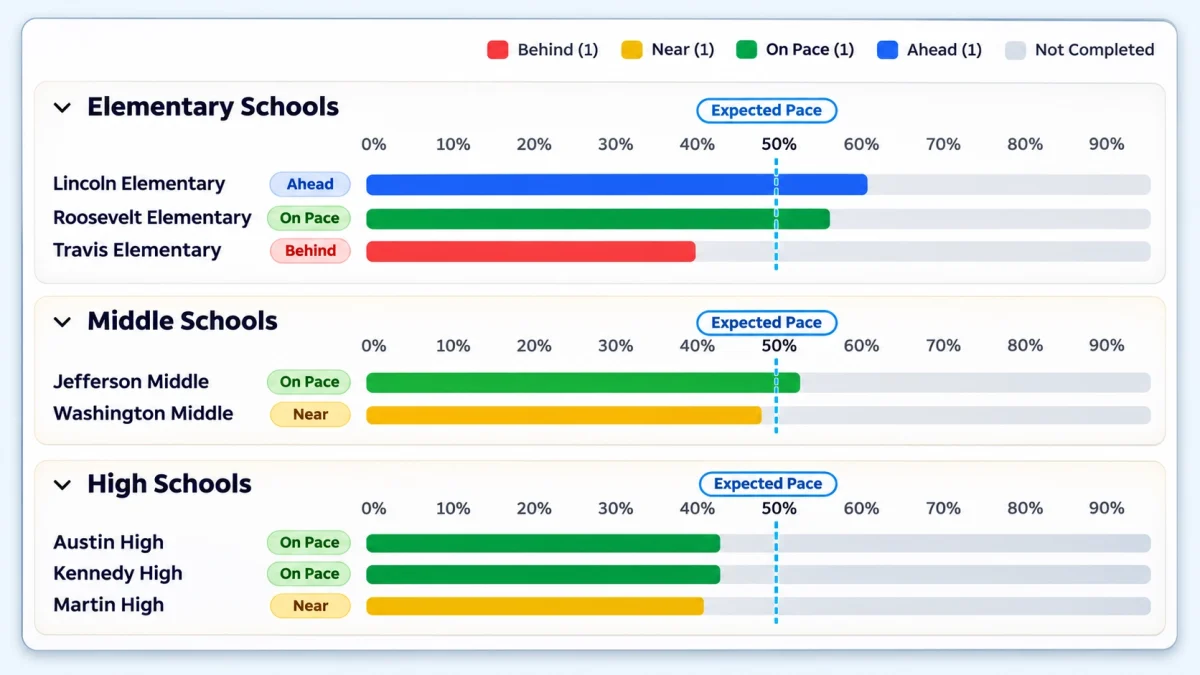
A pacing calendar can tell a leader where a classroom is expected to be.
It cannot, by itself, explain why instruction is progressing differently or what support would improve the situation.
That’s where coaching becomes essential.
Imagine a principal noticing that several fourth-grade classrooms are progressing through a reading unit at different rates.
Rather than immediately directing everyone to catch up, the principal and instructional coach examine student work, classroom evidence, and the instructional challenges teachers are experiencing.
They discover that some teachers need support with a particular lesson routine, while others are appropriately providing additional instruction based on student needs.
Now the leadership response can be more precise.
Coaching can focus on improving instructional routines where necessary, strengthening teachers’ understanding of the curriculum, and supporting appropriate differentiation.
The pacing information starts the conversation.
The coaching conversation turns that information into action.
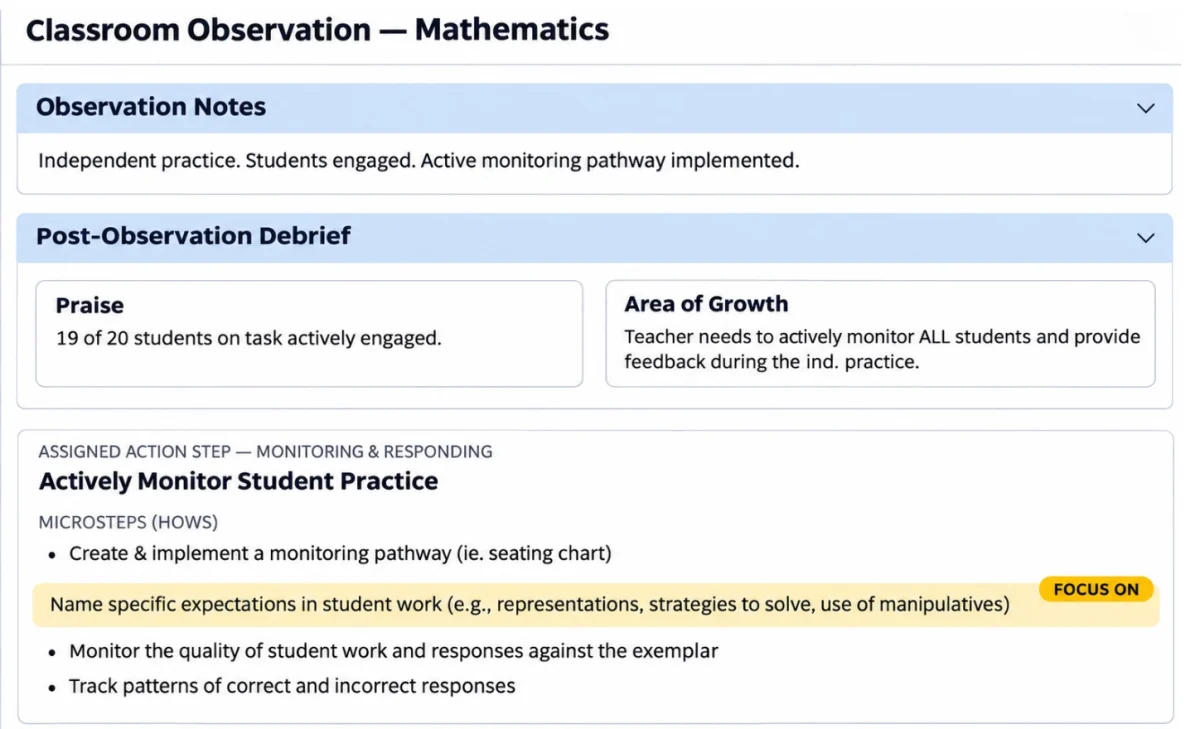
For district leaders, this is an important distinction. Monitoring implementation should help strengthen instruction, not create an environment where teachers feel pressured to move forward regardless of student readiness.
When Plans Change, Can Your Systems Keep Up?
Even well-designed curriculum plans need adjustments during the school year.
Weather closures, changes to instructional calendars, revised resources, assessment results, and evolving student needs can all require districts to rethink their pacing.
The challenge becomes greater when curriculum documents, pacing calendars, classroom activities, and instructional reports are managed in disconnected systems.
A curriculum adjustment made at the district level may not immediately reach every classroom. Teachers may be working from different versions of the same document. Campus leaders may struggle to determine whether revised expectations are being implemented consistently.
These aren’t simply technology problems. They’re communication and coordination problems.
District leaders should consider whether their curriculum processes make it easy to:
- Maintain a consistent, current version of instructional resources.
- Review and approve curriculum changes before distribution.
- Update pacing expectations when instructional plans change.
- Communicate adjustments across schools.
- Monitor implementation and student learning without creating unnecessary reporting work for teachers.
The stronger these processes are, the easier it becomes to preserve instructional coherence while responding to changing circumstances.
Technology can support that coordination, but the leadership goal remains the same: ensure that teachers have clear expectations, timely information, and the support they need to make effective instructional decisions.
Want to see how curriculum management works in practice? Explore our Classwork On-Demand Training Library, including sessions on curriculum authoring and district reporting.
Three Questions for Your Next Curriculum Leadership Meeting
As districts review curriculum implementation and pacing, three questions can help shift the conversation from simply tracking progress to improving instruction.
- Are we measuring curriculum completion or student understanding?
Knowing which lessons have been taught is important. Knowing whether students learned the intended concepts is equally important.
- Do teachers have clear expectations for when and how to adjust pacing?
Without shared guidance, teachers may feel they must choose between following the curriculum and responding to student needs.
- When pacing differences emerge, do they lead to support or simply another report?
The value of implementation data depends on the instructional decisions and coaching actions that follow.
These questions can help leadership teams examine not only whether the curriculum is being implemented, but whether their systems are supporting the kind of instruction they want to see.
The Goal Isn't Perfect Pacing. It's Stronger Learning.
Curriculum maps and pacing calendars are essential leadership tools. They help districts coordinate instruction, maintain expectations, and ensure students have access to important learning experiences.
But they are still tools.
Their value comes from how educators use them to support student learning.
A strong instructional system doesn’t require teachers to abandon the curriculum whenever students struggle. Nor does it require them to move forward simply because the calendar says it’s time.
Instead, it connects curriculum expectations, classroom evidence, coaching, and instructional decision-making.
Because ultimately, the most important question isn’t whether every classroom is on the same page.
It’s whether every classroom is moving students toward the learning that matters.
Putting Instructional Leadership into Practice with Classwork.com
Classwork.com helps districts connect curriculum management with everyday instructional evidence.
Through curriculum authoring, review workflows, adaptable pacing calendars, digital learning activities, and school and district reporting, instructional leaders can maintain shared expectations while gaining greater visibility into what is happening across classrooms.
The goal is to make curriculum implementation more manageable—and ensure that information about instruction can lead to timely, meaningful support.
See What Students Know. Every Day.
See Classwork in Action
See how Classwork supports teaching, learning, and districtwide decisions.
Frequently Asked Questions
What is the difference between curriculum fidelity and rigid pacing?
Curriculum fidelity means maintaining the essential content, instructional sequence, and learning goals of an adopted curriculum. Rigid pacing requires classrooms to follow the same schedule regardless of student understanding. Effective curriculum implementation preserves the intent of the instructional materials while allowing teachers to make purposeful, evidence-based adjustments.
How can schools maintain consistent instruction while allowing teachers flexibility?
Schools can establish common learning expectations, use shared curriculum resources, and develop clear guidelines for instructional adjustments. Teachers can then use student work, formative assessments, and classroom observations to determine when additional support or reteaching is needed without losing sight of districtwide goals.
What should teachers do when students aren’t ready to move to the next lesson?
Teachers should first identify the specific concepts students haven’t mastered. Short checks for understanding, exit tickets, and student work can help determine whether students need targeted intervention, additional practice, or broader reteaching. The goal is to address learning needs while protecting the essential sequence of instruction.
How can district leaders monitor curriculum pacing without micromanaging teachers?
District leaders can use shared pacing calendars, classroom assessment information, and instructional coaching conversations to understand implementation across schools. Rather than focusing exclusively on whether teachers are ahead or behind, leaders should examine why pacing differences exist and whether adjustments are improving student learning.
How can formative assessment support curriculum implementation?
Formative assessment provides timely evidence of what students understand during instruction. Teachers can use that information to adjust lessons, address misconceptions, and provide targeted support. School and district leaders can examine patterns across classrooms to identify opportunities for coaching, resource adjustments, and instructional improvement.
How can technology help districts manage curriculum changes?
Digital curriculum management tools can help districts organize instructional resources, review updates, communicate pacing adjustments, and monitor implementation across campuses. When curriculum management and classroom assessment information are connected, leaders can make more informed decisions while reducing unnecessary administrative work for teachers.