
The Illusion of Gamified EdTech: Why True Instructional Intelligence Must Replace Play-to-Learn Platforms in 2026

Executive Summary
Gamified edtech promised to revolutionize K-12 learning through video-game mechanics like badges and points. Instead, it has delivered shallow comprehension, rapid button-clicking, and severe app fatigue.
The solution is not to banish devices. Laptops are indispensable for 21st-century classrooms, providing the vital data infrastructure needed to capture a daily pulse on student learning. The real enemy is low-rigor gamified edtech software that isolates students from active instruction.
To fix this, school administrators must ruthlessly curate and consolidate their tech stacks. By stripping away most gamified edtech distractions, districts can transform laptops into true instructional intelligence machines that empower teachers, support the core curriculum, and restore absolute clarity to student learning.
For the past decade, K-12 education has been swept up in an unprecedented digital arms race. Under the banner of innovation and modern engagement, school districts across the nation have poured millions of capital dollars into vast software ecosystems. The foundational pitch for gamified edtech was incredibly seductive to boards and administrative teams alike. By borrowing the behavioral hooks of modern video games, developers promised we could magically reach 100% student engagement and close persistent learning gaps.
The logic was simple: if a student struggles with foundational math or reading, just turn it into a digital quest. Reward them with digital badges, experience points, leaderboards, and animated celebrations. When learning is fun, students will get it.
Today, the cracks in this gamified edtech facade are wide open, and the systemic results are anything but playful. What was promised as an engaging equalizer has instead evolved into a profound classroom distraction. This specific model of software has conditioned students to treat core education like a digital slot machine. Instead of wrestling with concepts, they optimize for the quickest click rather than actual comprehension.
As communities grow increasingly tech-weary, schools are facing a critical breaking point. However, the solution is not to banish hardware or retreat from the digital age. Laptops are essential infrastructure for 21st-century learning. The real enemy is the low-rigor, gamified software running on them. It is time for school administrators to prune their curriculum edtech stacks to protect the learning process and meaningful data collection.
Why does gamified edtech fail to create true student engagement?
The core offense of gamified edtech lies in its fundamental misunderstanding of the human learning process. True intellectual engagement is an intrinsic process. It comes from the hard-fought satisfaction of solving a complex problem, the spark of genuine curiosity about the world, or the pride of mastering a new skill through dedicated effort.
Gamification strips away this intrinsic joy and replaces it with cheap, extrinsic rewards. When a student uses platforms built entirely around video-gaming techniques, their cognitive objective completely shifts. They are no longer thinking about why a mathematical equation or a reading passage works. Instead, they are calculating the path of least resistance to clear a level, earn a digital coin, and rack up points.
Consider the baseline realities happening across elementary education today. As highlighted in a recent FAST Company/Inc. article, the growing “Screens Down, Pencils Up” movement is gaining steam; tech-weary communities are pushing back against this exact digital overload. Young students frequently rush through digital assignments to accumulate points. When teachers or parents encourage them to slow down and work methodically on paper, they actively resist. The common complaint from students is that the actual learning steps slow them down. They just want to click, level up, and win the game.
That’s not education; it is learning an algorithmic maze. We are training children to become hyper-efficient button-clickers through gamified edtech, systematically eroding their attention spans and cognitive foundations in the process. When these same students later confront a complex problem that does not flash neon lights, they check out. The dependency built by these applications backfires entirely when real critical thinking is required.
What is the difference between digital literacy and gamified software consumption?
Rejecting predatory gamified edtech is not an anti-tech stance. Understanding how to confidently navigate the digital world is a vital, non-negotiable life skill for the next generation. Gamified apps aren’t teaching those skills.
True digital literacy is an active, creative pursuit. It is about teaching students how to evaluate the validity of online sources, protect their personal data privacy, write code, build complex spreadsheets, and use technology as a blank canvas for creation. These skills require deep critical thinking and immense intellectual stamina.
Conversely, gamified software demands the exact opposite. It reduces the student’s relationship with technology to a series of passive, reactive clicks. A student who masters a gamified math app hasn’t learned digital literacy; they have simply learned how to navigate a specific vendor’s software interface to trigger a dopamine hit.
When we blur the line between video games and digital literacy, we do students a double disservice. We fail to teach them deep academic concepts, and we fail to prepare them for the actual digital demands of the future. No one enters the professional world to passively clear gamified levels; they enter it needing to analyze data, communicate clearly, and solve complex problems using technology as an active, productive tool.
How does instructional intelligence separate classroom technology from digital distraction?
To remedy this landscape, we must clearly define the role of technology in a modern school district. Devices like laptops and tablets are not the problem. In fact, they are indispensable tools for the modern classroom environment.
Laptops allow educators to gather a vital daily pulse on student learning. They provide the interactive infrastructure required for real-time feedback and immediate, data-driven adjustments during a live lesson. This active connectivity gives teachers immediate insight into who is keeping up and who needs intervention. When utilized properly, a classroom of laptops acts as a unified feedback loop, magnifying the effectiveness of human instruction.
The crisis occurs when districts inadvertently outsource the actual teaching to passive algorithms. Platforms like DreamBox, Quizizz, IXL, or iReady are often criticized because they are employed as expensive digital babysitters. They pull individual students away from the teacher’s core instruction and place them into isolated silos. When a student spends hours trapped in an isolated software loop, the collective synergy and social mechanics of the classroom are completely lost.
Technology elevates the teacher, it doesn’t replace them. The laptop must remain a tool for active response and instructional intelligence. That’s because the teacher needs these devices to efficiently capture student achievement data as the curriculum proceeds. Devices are essential to measure the real-time impact of instruction and to know when and where help is needed.
The structural metrics from LearnPlatform’s industry software usage metrics reveal the core differences across school deployments:
| Instructional Feature | Gamified EdTech Platform Model | Instructional Intelligence Framework |
|---|---|---|
| Primary Engagement Trigger | Extrinsic rewards, digital badges, video-game points, leaderboards | Intrinsic mastery, active student response, direct question feedback |
| Primary Device Purpose | Independent, self-paced algorithmic loops separate from the teacher | Capturing a live, daily pulse of learning across the whole room |
| Average Tools Interacted With | Over 2,982 unique, fragmented applications per district annually | Consolidated to streamlined, high-utility core infrastructure tools |
| Verified Research Efficacy | Only 2% meet the strongest federal research standards (ESSA Level I) | Direct integration with district-approved core curriculum guidelines |
| Cognitive Impact | Rapid button-clicking, optimized guessing, path of least resistance | Critical thinking, conceptual focus, immediate feedback adjustments |
What framework should administrators use for an educational software audit?
For years, certain edtech companies successfully exploited administrative fear of missing out. If a neighboring district bought into a platform districtwide, school boards felt immense political pressure to follow suit. This unchecked procurement led to an absurd, unmanageable proliferation of overlapping applications across school systems.
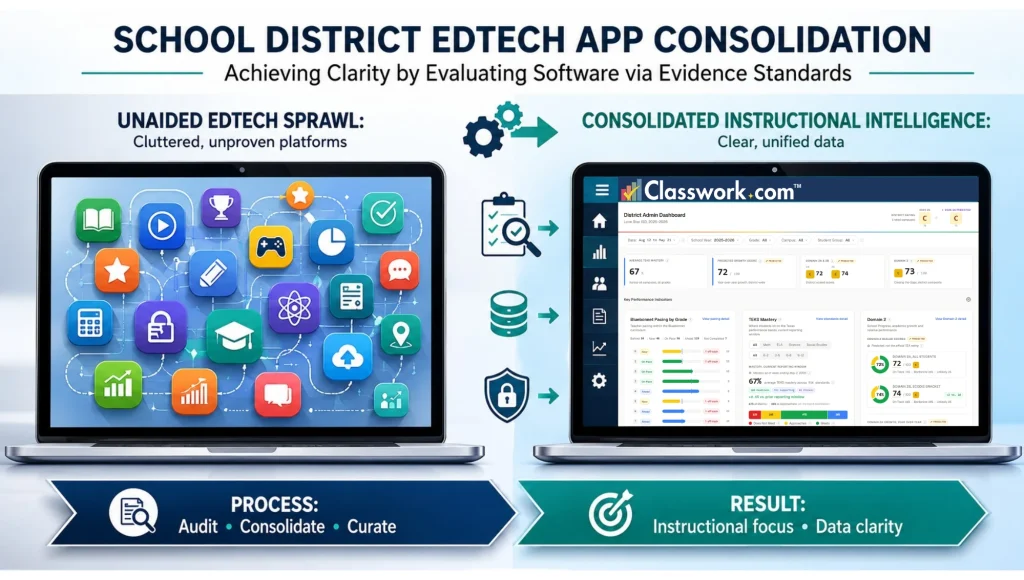
In fact, industry research on school tech stacks reveals that the average school district interacts with over 2,982 unique edtech tools every year. This chaotic, fragmented environment means both teachers and students now suffer from severe app fatigue, with instructional time lost simply trying to log in and manage disparate dashboards.
School administrators must shift their focus from software acquisition to rigorous software curation. It is time to aggressively audit the district tech stack. We must drastically reduce the volume of fragmented gamified edtech software purchased annually.
This requires a clear, actionable framework for district leadership:
- Conduct a Utilization Audit: Determine which teachers are using each platform and where. Then provide a rubric for instructional technology coordinators to classify and rate each software.
- Consolidate and Simplify: Once the surveys are completed, administrators will want to consolidate the inventory down to bare-minimum essential tools that promote active response.
- Prioritize Instructional Clarity: Ensure that chosen digital tools explicitly support the district’s core adopted curriculums. How does the software serve the teaching and learning process?
- Embrace the Power of “No”: When glossy presentations for new gamified edtech learning suites arrive on an administrator’s desk, the default answer must shift from “How do we fund this?” to “Does it improve instructional intelligence?”
How do schools reclaim the structural power of classroom teaching?
The pushback brewing across the country isn’t driven by a desire to retreat to the past or remove modern convenience from schools. It is driven by deep fatigue and frustration. Yet teachers require modern tools to measure student progress accurately and immediately without the distraction of games.
The most innovative move a school district can make right now is clearing the gamified edtech clutter out of the learning ecosystem. Devices capture the daily pulse of learning, providing data that empowers the teacher to pivot instruction in real time. By stripping away the digital noise and game mechanics, leaders give teachers room to lead and give students the space to truly think. It is time to streamline tools, elevate teachers, and reclaim the true, powerful purpose of classroom technology.
Should school districts eliminate classroom laptops to manage screen time limits?
School districts do not need to eliminate laptops or tablets because hardware serves as the essential infrastructure required to capture a daily pulse on student learning and deliver data-driven instruction.
Why do specific platforms like Quizizz, IXL, and iReady face increasing scrutiny from educators?
These platforms draw criticism because their gamified mechanics incentivize speed and optimization tricks over authentic, long-term conceptual understanding, with new evidence showing 98% of widely used tech lacks top tier research validation.
How can technology platforms provide data without creating classroom distractions?
Technology supports the classroom when it functions as an instructional intelligence platform, feeding real-time response data back to the teacher to guide district-approved curricula.
Sources & Reading
- Primary Reference: Fast Company, “Tech-weary parents call ‘screens down, pencils up’ as U.S. schools push back.” Link: https://www.fastcompany.com/91542388/tech-weary-parents-call-screens-down-pencils-up-u-s-schools-pushing-back
- Secondary Data Source: Instructure LearnPlatform, “The EdTech Top 40 Report: K-12 EdTech Engagement Insights.” Link: https://www.instructure.com/resources/research-reports/edtech-top40-2025
- Efficacy Baseline Data: Instructure & InnovateEDU, “2026 EdTech Evidence Report: How to Choose Safe and Effective Classroom Technology.” Link: https://www.instructure.com/press-release/ai-and-screen-time-scrutiny-rise-instructures-2026-evidence-report-finds-most