
Where Did My Teacher Go?
How HISD Future 2 Schools Use AI to Replace Teachers
Houston ISD’s NES model was unnecessarily disruptive for teachers, but its student-growth scores were impressive. Now, with Mike Morath’s help, HISD’s Future 2 Schools have crossed a dangerous line: transferring instruction, assessment and reteaching from teachers to the Alpha Schools AI system, with no independent research or credible public data to back the model.
By Laura Bresko , Co-Founder and CEO, Classwork.com
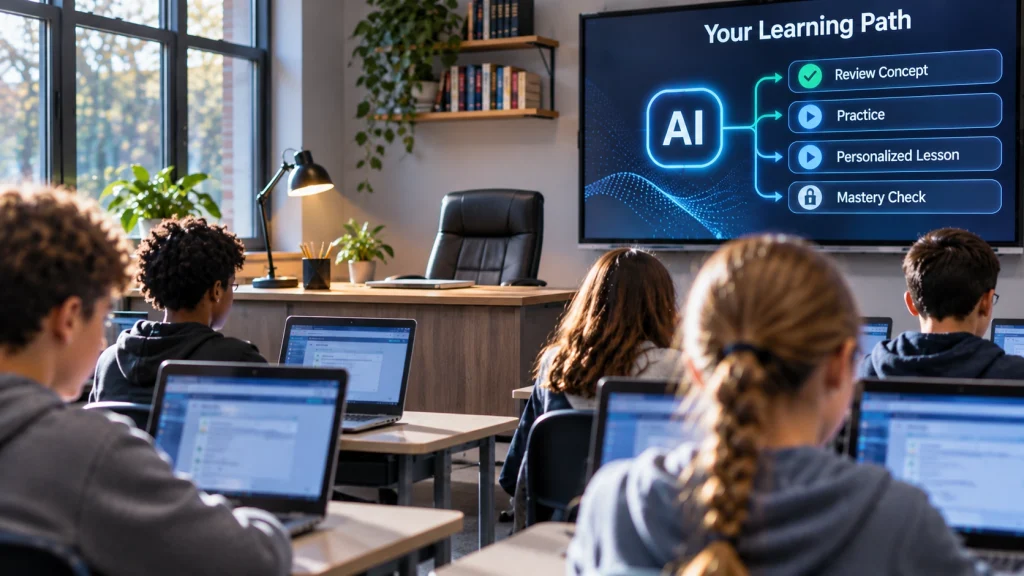
At a Glance
- Nine HISD campuses adopted the Future 2 model for 2026-27, and two K-8 campuses are piloting the Alpha Schools AI system.
- The Alpha Schools model has not produced a positive, independently verified result in a public or charter school.
- Research supports data-driven instruction led by teachers and AI tools that assist educators, not systems that replace them.
- The elected State Board of Education rejected an Alpha Schools charter, but Mike Morath and TEA helped bring the system into Texas districts through local pilots.
One year ago, I asked whether Houston ISD’s New Education System could become a model for American schools . [1] I still believe in the academic engine behind NES: strong lessons, frequent checks for understanding, fast analysis and immediate reteaching.
That is data-driven instruction. When teachers lead it well, it is one of the most effective and affordable ways to raise student achievement.
However, Mike Miles surrounded that sound academic strategy with rigid scripts, expensive staffing changes, classroom cameras and little respect for teachers or local communities.
Now, with the expansion of HISD Future 2 schools, the district is
moving beyond an unnecessarily heavy-handed teacher model toward something more dangerous: an instructional system in which software performs core teaching functions and local educators have little control.
What Are HISD Future 2 Schools?
Future 2 is Mike Miles’ next stage of NES. Nine HISD campuses adopted the Future 2 model for the 2026-27 school year. Miles plans to expand the model to 50 campuses by 2028-29 and as many as 100 by July 2031. [2]
All nine Future 2 Schools remain part of NES. They use the NES curriculum in the morning and add seminars, workshops, extracurricular programs and courses related to artificial intelligence and other “future-ready” skills.
However, two K-8 Future 2 campuses, Clemente Martinez and Gregg, are also piloting the Alpha Schools AI system. HISD says selected students with strong reading and math scores use the system for part of the morning. [3]
The Alpha Schools model turns the complete data-driven instruction cycle over to software. The system delivers academic content, tests students, identifies weaknesses, adjusts the pace and chooses what students learn next.
No HISD employee controls the Alpha Schools algorithm, its code or its decision rules. Teachers and families cannot see why the system made a particular instructional decision, much less change it.
That is not just using AI in the classroom. It is transferring responsibility for instruction, assessment and reteaching from educators to a vendor-controlled system.
Takeaway: Future 2 is not merely NES with more technology. At the two Alpha Schools pilot campuses, HISD is testing whether software can assume core instructional responsibilities that belong to teachers.
Why Does Data-Driven Instruction Work?
Effective data-driven instruction follows a simple cycle:
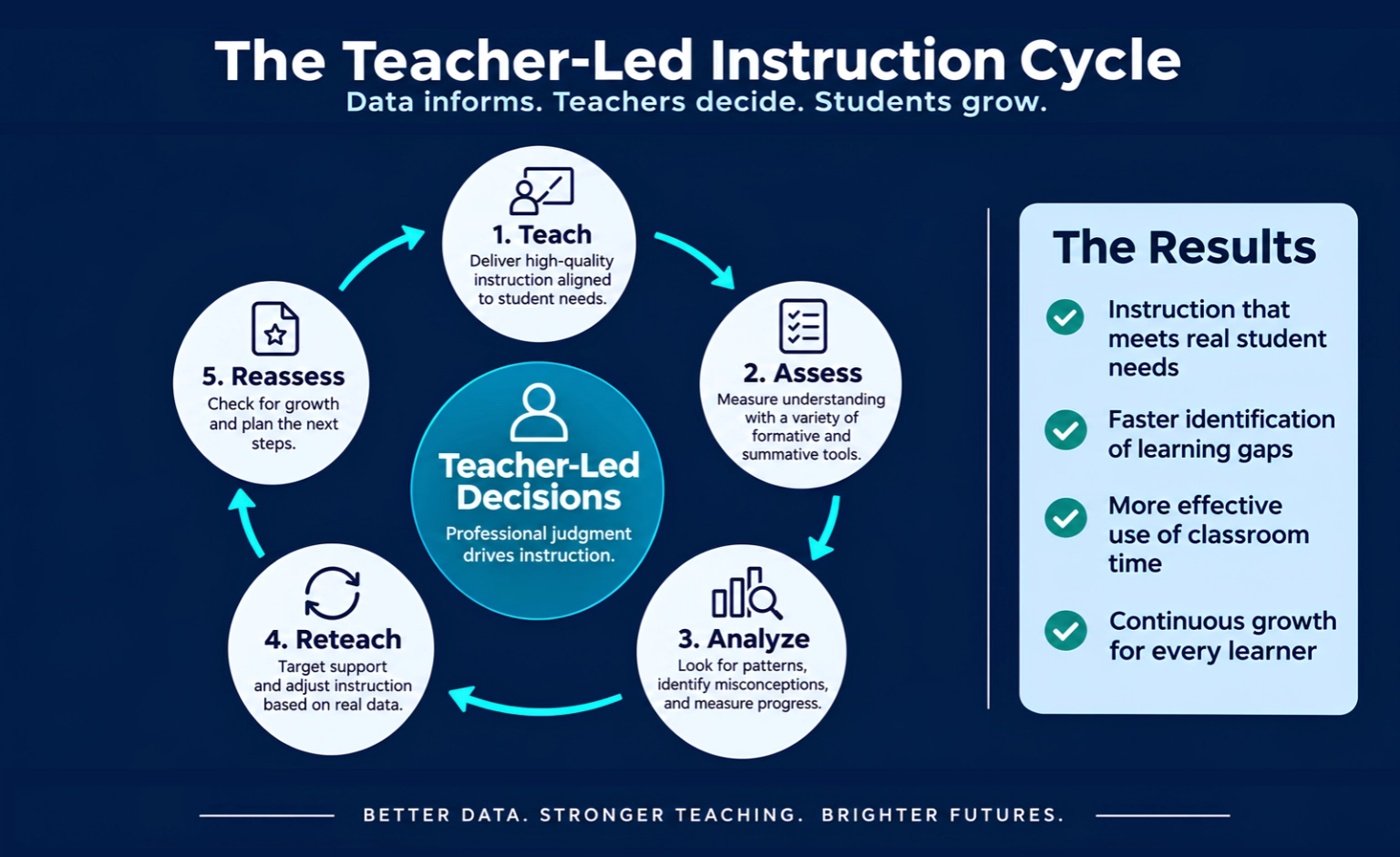
The assessment is not the intervention. The teacher’s response is.
Research supports this approach. A 2017 meta-analysis of 101 studies found that feedback and progress monitoring, the heart of data-driven instruction, produced the second-largest average effect on student achievement among the interventions examined. Only tutoring produced a larger effect, but at much greater expense. [4]
The effect size for feedback and progress monitoring was 0.32 standard deviations. In plain English, imagine a test on which one standard deviation equals 15 points. A 0.32 improvement would equal nearly five additional points across the entire group, not just a few unusually successful students.
A separate randomized trial involving 140 schools and 25,000 students found that a structured formative-assessment program produced the equivalent of two additional months of learning. [5]
However, data alone does not produce these results. Teachers must receive useful information quickly enough to act on it. School leaders must protect time for analysis and reteaching. Coaches must help teachers identify misconceptions and choose a better instructional response.
Takeaway: Data-driven instruction works because educators use evidence to change instruction while students still have time to benefit.
Where Has Data-Driven Instruction Worked in Texas?
Texas has already made a massive investment in this approach.
The Texas Instructional Leadership program trained principals and instructional leaders in data-driven instruction, observation and feedback, schoolwide culture and lesson alignment. TEA has now folded that program into Leadership and Instructional Foundations for Texas, better known as LIFT.
LIFT combines Texas Instructional Leadership, Strong Foundations and Texas Lesson Study. TEA made approximately $248.2 million available for LIFT through LASO Cycle 4, with three-year district awards ranging from $855,000 to $4.5 million. [6]
Texas is not spending nearly $250 million to teach educators how to stare at dashboards. It is investing in leadership, coaching, feedback and instructional routines that help teachers complete the cycle from teaching to assessment to immediate reteaching.
Dallas ISD
Mike Miles was instrumental in creating Dallas ISD’s Accelerating Campus Excellence program while serving as superintendent. ACE launched in 2015 with strong principals, effective teachers, extended learning time, performance incentives and data-driven instruction. [7]
The implementation was highly disruptive. Every principal and about 80 percent of the teachers at the original ACE campuses were replaced.
However, the academic results were substantial. Researchers found gains of about 0.5 standard deviations in math and 0.35 in reading during the years when the full ACE supports remained in place. [8]
Using the same 15-point example, a 0.5 standard deviation gain is about 7.5 test-score points across the school. That is a major academic shift.
When Dallas later removed the stipends and other supports, many effective teachers left and scores declined. The lesson is not that disruption causes achievement. The lesson is that strong teachers, sound leadership, coaching, instructional time and data-driven practices can produce impressive results when they are properly supported.
San Antonio ISD
San Antonio ISD has also used data-driven instruction without removing teachers from the center of instruction.
Robert B. Green Elementary at Riverside Park was named a 2024 National Blue Ribbon School. Its application described daily checks for understanding, aggressive monitoring, teacher-led instructional adjustments, weekly professional learning communities, coaching and frequent feedback. [9]
The school did not outsource those decisions to an algorithm. Teachers and administrators studied the evidence and acted on it.
San Angelo ISD
Classwork is currently working with Dr. Farrah Gomez and seven San Angelo ISD elementary schools. Their instructional cycle combines the Bluebonnet Learning lesson, a short Classwork Readiness Check and immediate teacher-led reteaching.
After the first 10 weeks, we have seen no widespread staff loss and no major operational breakdown. Teachers remain responsible for understanding their students, interpreting the evidence and deciding how to respond.
This work carries real stakes. Bradford Elementary has received four consecutive F ratings. Under current Texas law, a fifth unacceptable rating could force the commissioner to close the campus or replace San Angelo ISD’s elected board with a state-appointed board of managers. [10]
The district is pursuing rapid improvement without removing teachers from instruction or surrendering local control to a black-box system.
Takeaway: Dallas, San Antonio and San Angelo demonstrate that data-driven instruction can be rigorous, urgent and successful while keeping teachers and local leaders responsible for student learning.
Where Did the Certified Teacher Go?
The private Alpha Schools model does not use traditional classroom teachers during its academic block. Its software delivers the lessons while adults called “guides” focus on motivation, goal setting and student behavior. [11]
HISD says its Alpha School pilot within HISD Future 2 schools does not replace classroom teachers. However, the district’s broader NES staffing model relies heavily on learning coaches, teacher assistants and teacher apprentices. HISD itself classifies learning coaches, paraprofessionals and teacher assistants as classroom aides. [12]
Under Texas Education Code §25.111, a district must employ enough certified teachers to maintain an overall average of at least one certified teacher for every 20 students in average daily attendance. [13] Educational aides cannot be counted as certified teachers for that calculation.
That requirement is districtwide. It does not guarantee that every Future 2 classroom has a certified teacher.
Therefore, HISD should disclose:
- How many certified teachers are assigned to each Future 2 School?
- Which grades and subjects are led by certified teachers?
- How many students spend academic time supervised primarily by aides, apprentices or learning coaches?
- Who is legally and professionally responsible for the instruction delivered by the Alpha Schools system?
Takeaway: Calling an adult a “guide” or “learning coach” does not make that person a certified teacher. HISD should show families exactly who is responsible for teaching their children.
For district leaders, this is an important distinction. Monitoring implementation should help strengthen instruction, not create an environment where teachers feel pressured to move forward regardless of student readiness.
Why Are There Cameras in HISD Classrooms?
Many Houston families may not know that HISD installed cameras in NES classrooms.
The district spent more than $254,000 on webcams, tripods and cables for 1,580 classrooms. HISD said the cameras captured lessons so students removed from class could continue watching virtually. [14]
Those cameras existed before the Alpha Schools pilot. However, their presence matters as HISD expands software-driven instruction and digital monitoring.
Families deserve plain answers about when cameras operate, who can view the video, whether recordings are stored and how classroom video might interact with student data collected by outside vendors.
Takeaway: Cameras are already present in many HISD classrooms. That fact should be stated openly, especially as the district gives technology a larger role in instruction, student monitoring, and student data collection by an unvetted private vendor.
What Does Research Say About AI Tutoring?
Artificial intelligence may someday become a useful tool for educators. But let’s be clear: that is different from replacing educators.
A small 2025 MIT case study involving 18 fifth graders found promising results from teacher-directed Socratic AI tutoring. However, the students used the AI through the teacher’s device, and the study had no comparison group. [15]
A Stanford randomized trial found that Tutor CoPilot improved short-term student mastery by four percentage points. However, the AI supported human tutors. It did not replace them. [16]
A 2026 NBER study of Khanmigo found modest math gains, but those gains were similar to results from Khan Academy practice without the AI tutor. [17]
The strongest evidence points toward AI assisting teachers and tutors, not assuming complete responsibility for instruction.
Classwork made this position clear in “AI Is for Educators,” published January 25, 2025. AI can help educators create materials, analyze evidence, reduce administrative work and identify student needs. It should strengthen human judgment, not eliminate it.
Takeaway: Research supports carefully designed AI tutoring and educator support. It does not validate replacing certified teachers with an AI-managed academic program.
What Results Has the Alpha Schools Model Produced?
The Alpha Schools model has yet to produce a positive, independently verified result in a public or charter school.
Its two available public-school examples produced poor results.
At Texas Preparatory School in Austin, an Alpha Schools leader told state officials in May 2025 that passing rates had risen to between 50 and 60 percent after the system was introduced. TEA data did not support that claim.
The percentage of students reaching Approaches Grade Level rose only from 19 percent to 21 percent. The percentage reaching Meets Grade Level fell from 10 percent to zero. Texas Preparatory School received its third consecutive F rating. [18]
At Unbound Academy in Arizona, Alpha Schools leaders projected that 65 percent of students would become proficient in English and 60 percent would become proficient in math during the 2025-26 school year. Preliminary state results showed only 28 percent proficient in English and 10 percent in math. [18]
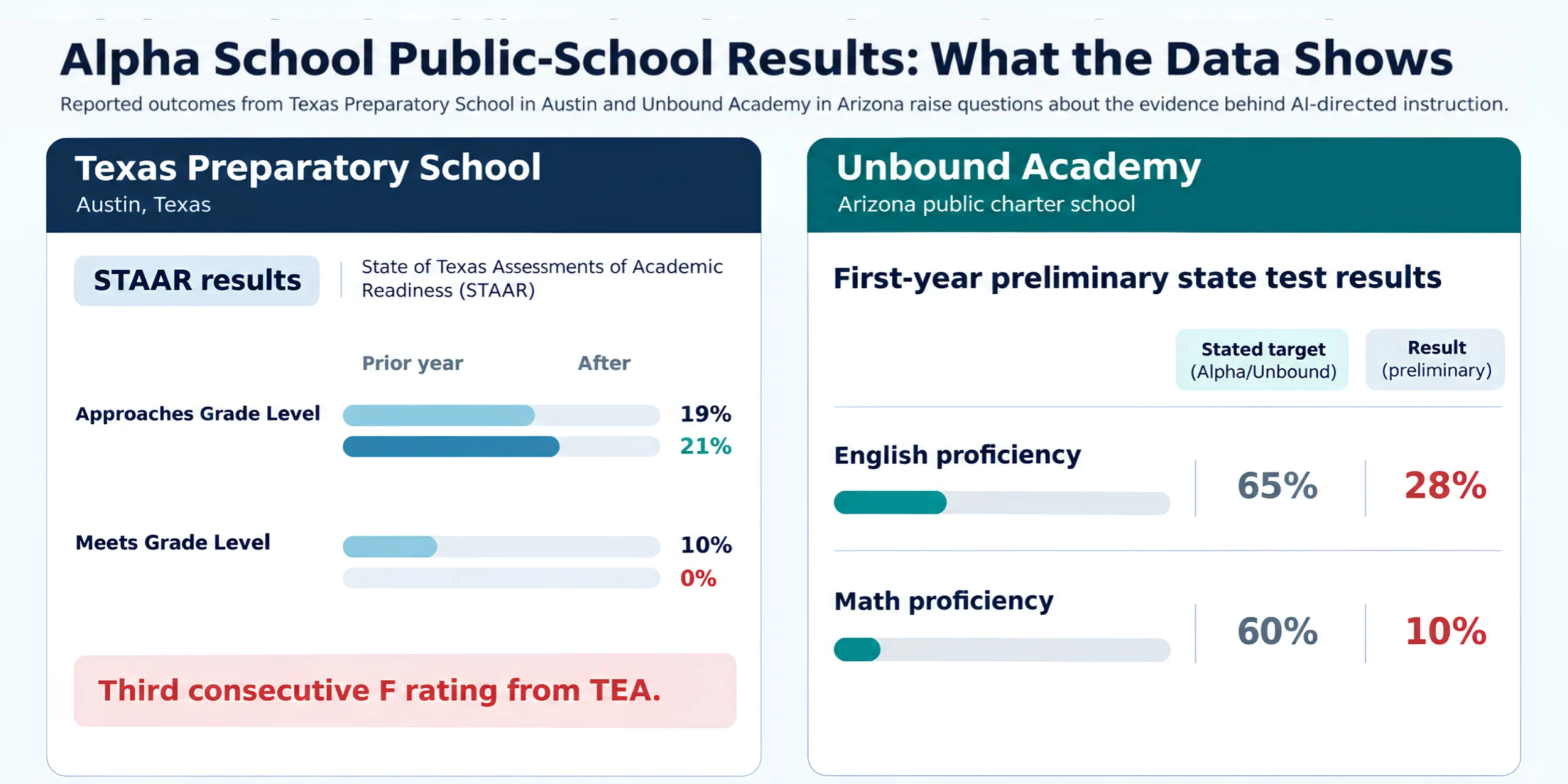
Reported academic results from Texas Preparatory School in Austin and Unbound Academy in Arizona. These comparisons do not establish that Alpha School’s instructional model caused the outcomes.
Source: The Texas Tribune/ProPublica, September 2026.
These are not mixed results. They are negative public-school results that fell far short of the promises.
Yet HISD says its pilot will determine whether the model accelerates student growth, despite the negative results to date. In other words, Houston children are being used as guinea pigs to test an unproven vendor model.
Takeaway: The Alpha Schools model has not produced positive public-school results. Texas Prep remained an F-rated school, and Unbound Academy missed its own proficiency targets by enormous margins.
How Did Mike Morath Bring the Alpha Schools System Into Texas Schools?
In June 2025, the elected Texas State Board of Education voted 10-3 against allowing Alpha Schools leaders to open a Texas charter school.
Board members raised concerns about screen time, AI-delivered instruction and the company’s unsupported academic claims.
Mike Morath did not let that stop him.
Emails obtained by ProPublica and The Texas Tribune show that Morath and TEA officials visited Alpha Schools campuses, helped prepare information for districts, approached at least 10 school systems and connected Alpha Schools leaders with local superintendents. [19]
Morath personally offered to connect Alpha Schools leaders with Mike Miles, the superintendent Morath installed during the state takeover of HISD.
At least three districts, Houston ISD, Aldine ISD and Fort Davis ISD, subsequently launched pilots. HISD says its pilot is free, but it asked the Texas attorney general to allow the district to withhold the contract from the public.
The appointed HISD Board of Managers is different from the elected State Board of Education. The elected state board rejected the charter. Morath and TEA then helped the same system enter Texas public schools through district pilots that did not require the state board’s approval.
Takeaway: The elected State Board of Education said no. Mike Morath found another route.
Conclusion: Keep the Data, Keep the Teachers
Houston ISD should preserve the strongest part of NES: rigorous lessons, frequent checks for understanding, immediate reteaching and serious instructional coaching.
It should abandon the coercive excesses that damaged trust with teachers and families.
Most importantly, HISD Future 2 schools should not replace teacher-led instruction with a vendor-controlled AI system that has no positive public-school track record, no independent validation and no meaningful local oversight.
The choice is not between human teaching and artificial intelligence.
The choice is between using technology to strengthen educators and using technology to remove educators from the center of learning.
At Classwork, we have long believed that AI is for educators. As of November 2026, Texas has new leadership that shares that philosophy, and we are thankful for it.
Students deserve skilled teachers who know them, understand their misconceptions and can respond in the moment. Technology can help teachers in their work. It should never be used to replace them.
References
- Is Houston ISD’s NES a Model for America’s Schools? Classwork.
- HISD plans to expand Future 2 to 25 more campuses, Houston Chronicle.
- HISD will use the Alpha Schools platform at two schools, Houston Chronicle.
- Academic Interventions for Elementary and Middle School Students With Low Socioeconomic Status, Review of Educational Research, 2017.
- Embedding Formative Assessment, Education Endowment Foundation.
- Leadership and Instructional Foundations for Texas and LASO Cycle 4 LIFT overview, Texas Education Agency.
- The Power of Differentiation: Data in the Moment, George W. Bush Presidential Center.
- Incentives Matter in Schools, National Bureau of Economic Research.
- Robert B. Green Elementary 2024 National Blue Ribbon application .
- Texas districts facing possible state takeover in 2027, The Texas Tribune.
- Alpha Schools guide and instructional model FAQ, Alpha Schools.
- From Classroom Aides to Certified Teachers, Houston ISD.
- Texas Education Code §25.111 .
- How much are Mike Miles’ changes costing HISD?, Houston Chronicle.
- Socratic AI Tutoring in Primary School Mathematics, MIT, July 2025.
- Tutor CoPilot: A Human-AI Approach for Scaling Real-Time Expertise, Stanford University.
- One Click Away: AI Tutoring with Khanmigo in a Two-Year School Experiment, NBER, August 2026.
- Alpha Schools public-school results in Texas and Arizona, The Texas Tribune and ProPublica.
- How Mike Morath’s agency helped get an AI tool into Texas public schools, The Texas Tribune and ProPublica.
- AI Is for Educators, Classwork, January 25, 2025.
About the Author
Laura Bresko is the Co-Founder and CEO of Classwork.com.
Frequently Asked Questions
Is Houston ISD replacing teachers with artificial intelligence?
Houston ISD says its Alpha School pilot does not replace classroom teachers. However, the pilot raises important questions about who controls instruction when software delivers lessons, assesses understanding, and determines what students learn next. The distinction between AI assisting teachers and AI directing instruction is central to the debate.
What is the difference between HISD Future 2 Schools and Alpha School?
Future 2 is a broader Houston ISD initiative that combines elements of the New Education System with additional learning opportunities and future-ready skills. Two Future 2 campuses are also piloting Alpha School’s AI-based instructional technology. Not every Future 2 school uses the Alpha system.
Why is Mike Morath’s involvement controversial?
After the elected Texas State Board of Education rejected an Alpha-related charter proposal, reporting by The Texas Tribune and ProPublica revealed that Mike Morath and Texas Education Agency officials helped connect Alpha School representatives with public school districts. The controversy centers on whether the technology received sufficient independent evaluation, transparency, and oversight before reaching public school students.
Has the Alpha School model been proven effective in public schools?
The public-school results examined in this article raise significant concerns. Reported outcomes at Texas Preparatory School and Unbound Academy fell short of expectations, and the article identifies a lack of positive, independently verified public-school results. Claims of academic success should be evaluated against transparent, independently validated student achievement data.
Should artificial intelligence be used in Texas classrooms?
Yes, when it strengthens teaching rather than replacing educators’ professional judgment. AI can help teachers develop materials, analyze student performance, identify misconceptions, and personalize instruction. The essential question is whether teachers remain responsible for interpreting evidence and deciding how best to support their students.