Some teaching strategies come and go.
A new framework gains popularity, fills conference sessions for a few years, and quietly disappears when the next idea arrives.
The I Do, We Do, You Do instructional strategy has done the opposite.
For decades, teachers have relied on this instructional framework because it reflects something fundamental about how people learn. Before students can successfully work independently, they need to see expert thinking, practice with support, receive meaningful feedback, and experience success while the stakes are still low.
That idea is just as true today as it was when the framework was first introduced.
In today’s classrooms, students learn with laptops, adaptive technology, artificial intelligence, and instant digital feedback. These tools can help teachers create lessons faster, provide immediate insight into student understanding, and personalize learning in ways that were once impossible. But they do not replace the progression that great teachers have always understood: students need support before they are expected to succeed independently.
Students still need to see expert thinking, practice with support, receive timely feedback, and experience success before they are ready to work independently.
The I Do, We Do, You Do framework—often called the Gradual Release of Responsibility Model—provides that progression. It gives teachers a simple structure for modeling new learning, guiding practice, and gradually building the confidence students need to become independent learners.
At its heart, the framework reminds us of one simple truth:
Students become independent because they experience success repeatedly, receive meaningful feedback, and begin believing, “I can do this.” Confidence comes first. Independence follows.
Whether you’re a first-year teacher learning the framework or an instructional leader supporting teacher growth across a campus, this guide explores how the I Do, We Do, You Do model works, why it remains one of education’s most effective instructional strategies, explores practical classroom examples, avoid common implementation mistakes, and discover how modern technology can strengthen each phase without changing the heart of great teaching.
Every year, education introduces new initiatives, new technology, and new instructional priorities.
Yet one framework continues to prove its value in classrooms of every grade level and subject area: I Do, We Do, You Do.
Not because it is familiar.
Because it reflects how people naturally learn.
People rarely master something the first time they see it demonstrated.
Whether learning to ride a bike, solve an algebra problem, analyze a historical document, or write a persuasive essay, the learning process follows a familiar pattern.
We first observe someone with expertise.
We practice with guidance.
Then we apply the learning independently.
The I Do, We Do, You Do framework intentionally mirrors that progression inside the classroom.
Rather than asking students to work independently before they are ready, teachers intentionally reduce support as understanding and confidence grow.
This process is often called scaffolding, but its purpose goes beyond providing temporary support. Effective scaffolding allows teachers to identify misconceptions early, provide timely feedback, and ensure students experience success before moving forward.
More importantly, it helps students develop something much deeper than procedural knowledge.
Students are learning far more than a procedure or a process. They are learning how experts think. When teachers model their reasoning, guide productive conversations, and gradually release responsibility, students aren’t simply completing today’s assignment. They’re developing ways of thinking they can apply long after today’s lesson is over.
Ultimately, the framework isn’t about moving students through three instructional steps as quickly as possible. It’s about recognizing when students are truly ready to move forward.
 What the Research Shows
Current educational research continues to reinforce what effective teachers have practiced for decades: students learn best when instruction moves from expert modeling to guided practice before independent application.
Recent guidance from the NSW Centre for Education Statistics and Evaluation (CESE) identifies “I do (modelling), we do (guided), you do (independent)” as a widely recognized framework for explicit teaching. The guide also emphasizes that effective teachers move flexibly between phases based on student readiness, providing additional modeling or guided practice when needed rather than treating the framework as a rigid sequence.
This research reinforces one of the central ideas of this guide: students become independent at different times. Great teaching isn’t moving every student through the same three steps at the same pace—it’s recognizing when each learner is truly ready to move forward.
Most descriptions of the I Do, We Do, You Do framework describe the goal as independent learning.
While that is certainly the outcome, it is not where great teaching begins.
Students rarely become independent because they are simply told to work on their own.
They become independent because they have experienced enough success to believe they can succeed without constant support.
Every successful We Do experience builds understanding.
Every successful You Do experience builds confidence.
Eventually, students stop relying on the teacher because they have begun relying on themselves.
That transition doesn’t happen all at once.
It happens one successful learning experience at a time.
Not every student crosses that bridge at the same pace.
Some students need one guided example.
Others need five.
Some are ready for independent practice after a few minutes.
Others benefit from additional modeling, discussion, and feedback.
Neither approach is better.
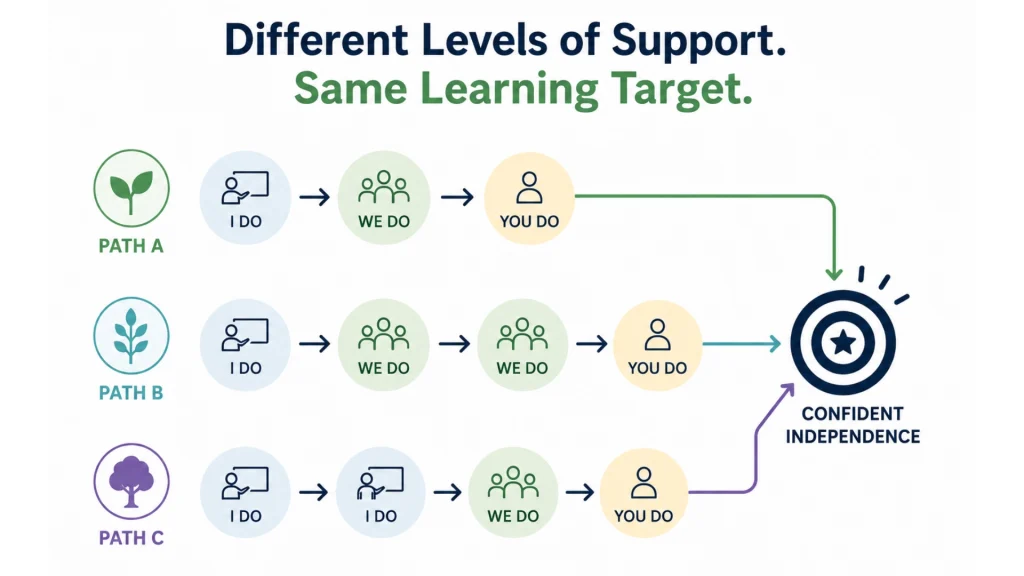
They are simply different paths toward the same destination.
Great teaching isn’t moving every student through the same instructional sequence at the same speed.
It’s recognizing when each student has experienced enough success to take the next step.
That is why the I Do, We Do, You Do framework has endured for decades.
It isn’t a checklist.
It is a way of thinking about learning.
The I Do phase is where learning begins.
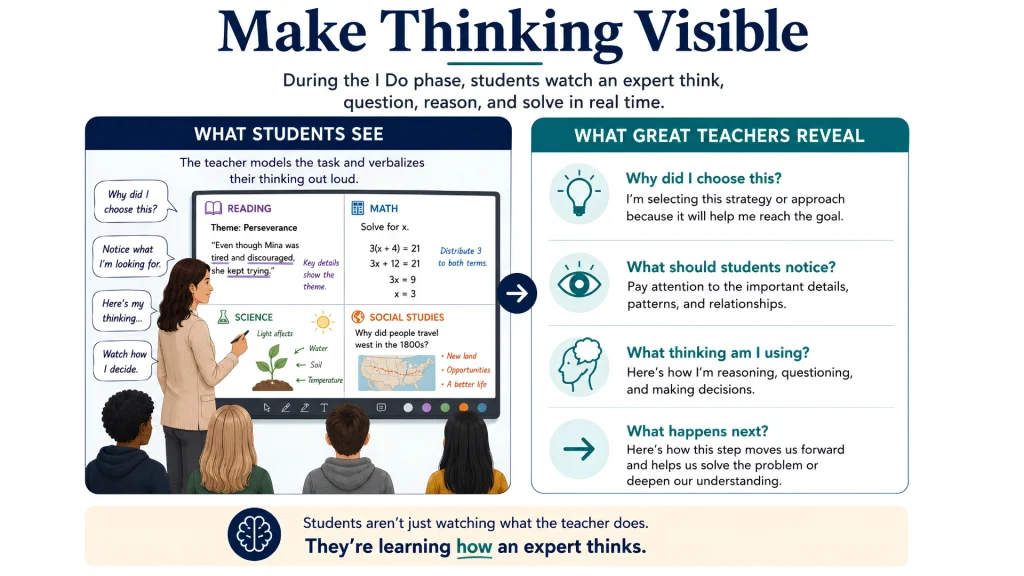
This is more than a teacher explaining information or demonstrating a procedure. It is where students observe the thinking, decisions, and reasoning of an expert before attempting the task themselves.
Effective teachers make their thinking visible.
Rather than showing students what to do, they explain why they are doing it.
When solving a math problem, they verbalize each decision. When analyzing a text, they explain why they highlighted certain evidence. When writing, they model how ideas are organized and revised. Students aren’t just watching what the teacher does—they’re learning how an expert thinks through a problem.
This process, often called explicit instruction or a think-aloud, reduces unnecessary cognitive load by allowing students to focus on understanding rather than guessing.
Students aren’t simply learning a procedure—they’re learning how an expert approaches unfamiliar problems. That understanding allows them to transfer their learning to new situations instead of memorizing a single example.
One common mistake is ending the I Do phase too soon.
Teachers often ask, “Any questions?”
The room is silent.
Silence doesn’t always mean understanding.
It often means students haven’t yet processed what they just observed.
Before moving to guided practice, ask students to explain why a step was taken, predict what comes next, or identify the reasoning behind a decision.
Those responses reveal far more than a room full of quiet nods.
A teacher may understand the process after years of experience, but students are seeing it for the first time. The goal is not simply to finish the explanation—it is to ensure students understand both the process and the reasoning behind it before moving on.
Technology can strengthen the I Do phase by helping teachers deliver clearer instruction and respond to student learning more effectively. Digital lessons, interactive modeling, real-time formative data, automatic standards alignment, AI-assisted feedback, and instructional insights can all help teachers identify misconceptions sooner and make more informed decisions about when students are ready to move forward.
The best technology doesn’t replace expert teaching—it makes expert teaching more effective. Students still need to see an expert question, reason, make decisions, and solve problems in real time. The teacher remains the instructional model.
If the I Do phase introduces learning, the We Do phase transforms it into understanding.
This is where teachers and students work together to apply new learning while support is still available.
Questions are asked.
Misconceptions are corrected.
Thinking becomes visible.
Students receive immediate feedback before misunderstandings become habits.
If more than one-third of your class struggles during independent practice, resist the urge to simply move on.
Instead, return to another We Do example while support is still available.
Guided practice isn’t a detour. It’s where misconceptions are corrected, confidence is built, and understanding grows.
Great teachers don’t see that as going backward.
They see it as giving students another opportunity to succeed.
Many educators describe We Do as guided practice.
That is true.
But guided practice is only part of its purpose.
The real purpose of the We Do phase is confidence.
Students begin discovering that they can successfully complete the task—not because someone gives them the answer, but because they receive just enough support to continue moving forward.
One student may need only a single guided example.
Another may need several.
Great teaching recognizes the difference.
This is also where technology has transformed instruction.
Instead of waiting until papers are collected, teachers can now see student understanding as learning happens. Immediate visibility allows teachers to pause, reteach, ask better questions, or provide additional guided practice before students move to independent work.
The question is no longer,
“Did they get it?”
The better question is,
“Who is ready to move forward, and who still needs another We Do?”
That shift changes everything.
The You Do phase is often described as independent practice.
More accurately, it is independent confirmation.
This is where students demonstrate that guided practice has become genuine understanding.
Students are no longer practicing because the teacher hopes they understand.
They are practicing because the teacher has intentionally prepared them to succeed.
If students become confused the moment support is removed, the problem usually isn’t the independent task.
It’s that they weren’t quite ready to leave the We Do phase.
This distinction matters because independent practice serves two important purposes.
When students repeatedly experience failure during independent work, confidence declines.
When students experience success, confidence grows.
Every lesson ends with one important instructional decision:
Are students ready to move forward, or do they need another We Do moment?
Over time, students begin relying less on teacher support because they have developed confidence in their own thinking.
That confidence transfers to future learning, making students more willing to tackle unfamiliar problems, ask thoughtful questions, and persist through challenges.
Independence was never about removing the teacher.
The goal has always been to develop confident learners.
During independent practice, don’t just ask:
“Did students finish?”
Ask yourself:
Those observations often tell you more than the completed assignment itself.
One of the greatest misconceptions about the I Do, We Do, You Do framework is that every student should move through each phase at the same pace.
Effective classrooms rarely work that way.
Some students become confident after one guided example.
Others benefit from additional discussion, more practice, or another teacher model before they are ready to work independently.
Differentiation doesn’t mean changing the destination.
It means adjusting the amount of support students receive on the journey.
Some students need another question.
Others need another example.
Some simply need another opportunity to succeed.
The destination stays the same. The path doesn’t have to.
Great teaching isn’t treating every student the same.
It’s ensuring every student receives the support they need to experience success.
Technology makes this process easier because teachers no longer have to guess who is ready for the next step. Instead of waiting until assignments are graded, teachers can identify misconceptions in real time, provide additional support when needed, and confidently move students forward when they are ready.
Technology doesn’t differentiate instruction for teachers. It gives teachers better information to differentiate instruction themselves.
Imagine a fourth-grade mathematics lesson introducing equivalent fractions.
The teacher models how to determine whether two fractions are equivalent, thinking aloud through each decision rather than simply demonstrating the procedure.
As students watch, they hear questions such as:
“Why did I multiply both the numerator and denominator?”
“How do I know these fractions still represent the same value?”
Students aren’t just watching the teacher solve a problem—they’re learning how an expert reasons through unfamiliar situations.
Next, the class works through several new examples together.
Students explain their thinking, compare strategies with classmates, and respond to teacher questions that reveal misconceptions before they become habits.
As understanding grows, the teacher gradually steps back, allowing students to take more ownership of the mathematical reasoning while remaining ready to provide support when needed.
Finally, students solve new equivalent fraction problems independently.
The teacher doesn’t simply collect papers.
Instead, they observe student work, identify who is ready to move forward, and recognize who may benefit from another We Do experience before introducing more challenging concepts.
Because students have already experienced success during guided practice, independent work becomes an opportunity to demonstrate understanding rather than guess what to do.
The framework changes very little.
Only the learning task changes.
Even experienced teachers can unintentionally weaken the effectiveness of the framework.
The most common mistakes include:
The framework works best when teachers respond to student understanding rather than simply following a sequence.
The I Do, We Do, You Do framework has remained effective for decades because it is built on sound instructional practice—not on a particular technology.
Today’s classrooms, however, give teachers something previous generations never had:
Immediate visibility into student thinking.
Technology should never replace expert teaching.
It should help teachers make better instructional decisions while learning is still taking place.
During 🟦 I Do, digital tools can make expert thinking more visible through interactive lessons, embedded examples, and immediate checks for understanding.
During 🟩 We Do, real-time student responses allow teachers to identify misconceptions, ask better questions, provide another guided example, or adjust instruction before confusion becomes frustration.
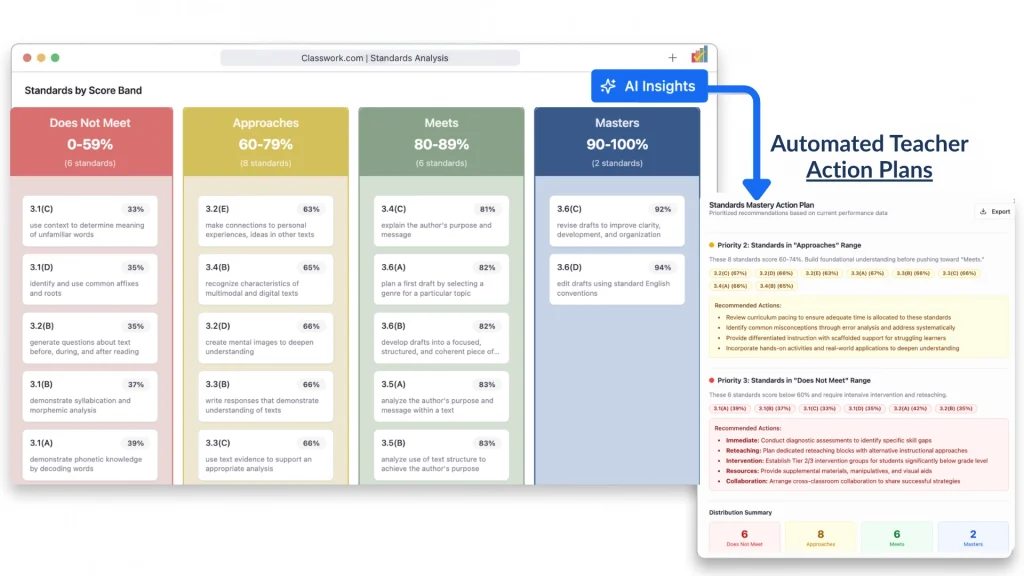
During 🟨 You Do, teachers no longer have to wait until assignments are graded to know who is ready to move forward. Real-time reporting, AI-assisted grading of open-response questions, automatic standards alignment, and instructional insights provide immediate evidence of student understanding.
The result isn’t less teacher involvement.
It’s better teacher decision-making.
When technology helps teachers see learning more clearly, respond more quickly, and provide support more intentionally, the I Do, We Do, You Do framework becomes even more powerful.
Throughout this guide, one idea has remained constant.
The I Do, We Do, You Do framework isn’t simply a sequence of instructional steps.
It’s a way of thinking about learning.
Students learn best when they observe expert thinking, practice with meaningful support, and gradually assume responsibility as their understanding grows.
Not every student reaches independence at the same pace.
Some need another example.
Some need another conversation.
Some simply need one more opportunity to experience success.
Great teaching recognizes those differences and responds intentionally.
Technology gives teachers better visibility into student learning than ever before, making it easier to identify misconceptions, provide timely support, and recognize when students are truly ready for the next step.
But technology doesn’t replace great teaching.
It strengthens it.
After all, the goal of the I Do, We Do, You Do strategy has never been to move students through three steps as quickly as possible.
The goal has always been to develop learners who are confident enough to think independently, solve problems, and continue learning long after the lesson has ended.
Great teaching isn’t measured by how quickly students become independent.
It’s measured by how confidently they get there.
See how Classwork helps teachers strengthen every phase of the I Do, We Do, You Do framework with real-time instructional insights, AI-assisted grading, and meaningful data that supports confident instructional decisions.
What is the core philosophy of the “I Do, We Do, You Do” strategy? The core philosophy is the Gradual Release of Responsibility. It is a scaffolding framework designed to shift the cognitive load from the teacher to the student. By starting with explicit modeling (I Do), moving to collaborative practice (We Do), and ending with independent mastery (You Do), students build the necessary confidence and skill set to succeed without constant teacher intervention.
What specific techniques are used during the “I Do” phase? In the “I Do” phase, the teacher is the primary focus. Beyond just demonstrating a task, effective teachers use think-alouds to make their internal thought processes visible. This might involve explaining why a certain step was taken in a math problem or how they chose a specific annotation during a close reading exercise.
How does the “We Do” phase prevent student misconceptions from taking root? The “We Do” phase serves as a safety net. It is a collaborative stage where the teacher provides guided practice. By working through problems together as a class or in small groups, the teacher can provide scaffolding and immediate correction. This ensures that students are practicing the correct methods before they are expected to perform them alone.
In what ways can technology like Classwork’s “Slide View” enhance this strategy? Technology transforms the “We Do” and “You Do” phases by providing instant visibility. With “Slide View,” a teacher can embed interactive questions directly into their presentation slides. Instead of waiting to grade papers, the teacher sees student responses in real-time. This allows for an “immediate reteach” if the data shows that students aren’t ready for the “You Do” (independent) phase yet.
Can the Gradual Release strategy be applied outside of core academic subjects? Yes. The strategy is highly versatile and applies to any skill-based learning. In Physical Education, a coach might model a drill (I Do), lead the team through it (We Do), and then observe individual performance (You Do). Similarly, in Art or Music, a teacher demonstrates a technique or piece before students practice together and eventually perform or create independently.
Research note: This article combines foundational research on the Gradual Release of Responsibility model with current evidence and guidance on explicit teaching published through 2025.
NSW Centre for Education Statistics and Evaluation (2025). What Works Best 2025: Explicit Teaching.
