
The TEA LIFT Grant
From Bureaucratic Maze to Classroom Reality
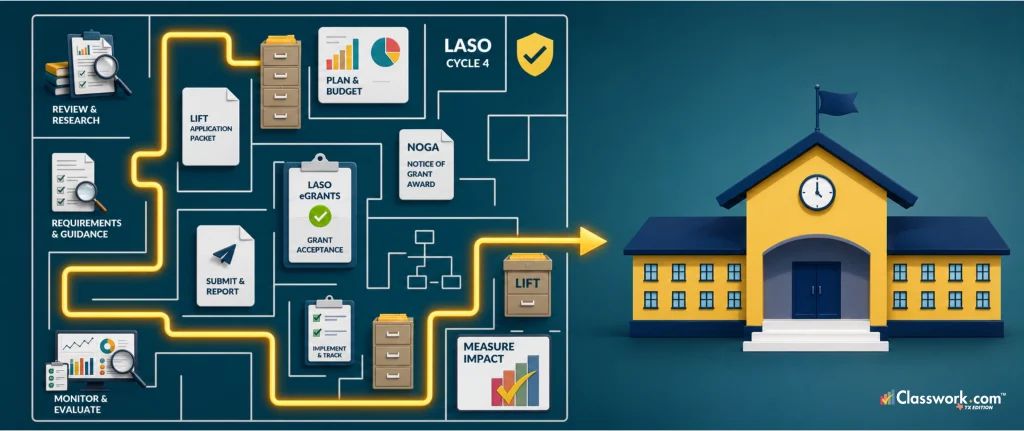
Learn how Texas school districts are using the TEA Leadership and Instructional Foundations for Texas (LIFT) Grant to successfully implement Bluebonnet Learning™, High-Quality Instructional Materials (HQIM), instructional coaching, and sustainable districtwide systems.
The Texas Education Agency (TEA) Leadership and Instructional Foundations for Texas (LIFT) Grant is helping school districts implement High-Quality Instructional Materials (HQIM), strengthen instructional leadership, and improve student outcomes through sustainable instructional systems.
Whether your district is preparing for a future LASO LIFT grant cycle, implementing a recently awarded grant, accepting its Notice of Grant Award (NOGA), or searching for approved technical assistance providers, implementation partners, or instructional technology that supports High-Quality Instructional Materials (HQIM), understanding how instructional systems fit within the LIFT framework is essential.
Rather than simply funding curriculum, LIFT is designed to help districts build a sustainable district instructional framework that ensures High-Quality Instructional Materials (HQIM) are implemented with fidelity across every campus. The grant emphasizes leadership development, instructional coaching, Professional Learning Communities (PLCs), Research-Based Instructional Strategies (RBIS), lesson internalization, and continuous instructional improvement across every campus.
Many Texas educators are already familiar with pieces of the LIFT framework because it builds upon several statewide initiatives, including:
- Strong Foundations
- Texas Instructional Leadership (TIL)
- Texas Lesson Study (TXLS)
- Professional Learning Communities (PLCs)
- Research-Based Instructional Strategies (RBIS)
Instead of treating curriculum adoption as a one-time purchase, LIFT provides districts with a multi-year framework for supporting teachers, instructional coaches, campus administrators, and district leaders as they implement High-Quality Instructional Materials like Bluebonnet Learning™.
This guide serves as a practical TEA LIFT Grant implementation guide for Texas school districts planning, launching, or strengthening High-Quality Instructional Materials (HQIM) initiatives.
LASO Cycle 5 LIFT Applications Open September 23
TEA’s 2026–27 LASO Cycle 5 application includes Leadership & Instructional Foundations for Texas (LIFT), a three-year districtwide initiative supporting HQIM implementation and instructional leadership systems.
Application Window: September 23–December 1, 2026 at 5:00 p.m. CT
Cycle 5 LIFT Award Range: $365,000–$1.5 million
Anticipated Awards: 15–63 school systems
Program Duration: 3 years
Districts can enter LIFT through a planning or implementation pathway depending on their instructional readiness and current HQIM adoption.
Understanding the TEA LIFT Grant Framework
The Texas Education Agency (TEA) designed the Leadership and Instructional Foundations for Texas (LIFT) Grant to help districts move beyond simply adopting new instructional materials. Instead, the framework focuses on building sustainable instructional systems that improve teaching, strengthen leadership, and accelerate student achievement over multiple years.
At the heart of the grant are two interconnected priorities:
High-Quality Instructional Materials (HQIM)
Districts are encouraged to implement SBOE-approved High-Quality Instructional Materials (HQIM), including SBOE-approved Bluebonnet Learning™ instructional materials, that are aligned to the Texas Essential Knowledge and Skills (TEKS). These research-based instructional materials provide a consistent foundation for classroom instruction while helping ensure every student has access to rigorous, standards-aligned learning experiences.
Leadership Foundations
High-quality curriculum alone does not improve outcomes. The LIFT framework emphasizes instructional leadership through principal support, coaching, Professional Learning Communities (PLCs), Research-Based Instructional Strategies (RBIS), lesson internalization, and continuous teacher feedback. These leadership structures help districts implement curriculum with fidelity across every campus while creating a culture of ongoing instructional improvement.
Together, these two pillars create a sustainable implementation model that supports teachers in the classroom while providing district leaders with greater visibility into instructional practices, curriculum implementation, and student progress.
For LASO Cycle 5, districts may enter LIFT through one of two entry points based on instructional readiness. The Planning Entry Point is designed for school systems preparing to select and implement SBOE-approved HQIM, while the Implementation Entry Point is for school systems that have already adopted Bluebonnet Learning™ and are preparing for or beginning implementation.
The LIFT Implementation Lifecycle
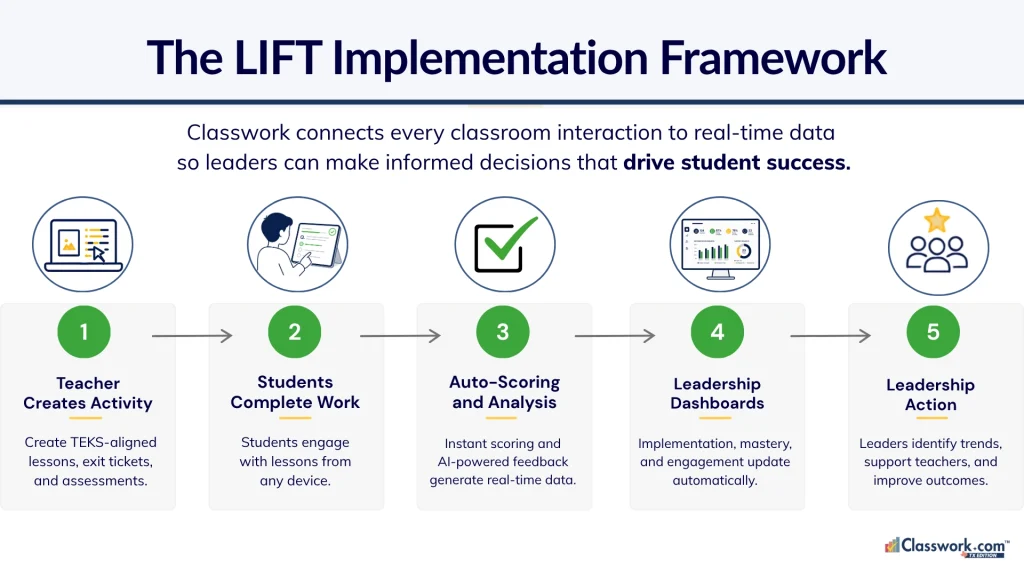
Successfully implementing the Texas LIFT Grant is not defined by a single deadline or professional development session. It requires thoughtful planning, instructional leadership, continuous coaching, and meaningful data throughout the school year.
Districts that see the greatest success view implementation as a continuous cycle rather than a one-time initiative. Each phase builds on the previous one, helping teachers, instructional coaches, principals, and district leaders create a sustainable instructional system that improves student learning year after year.
TEA begins LIFT participation with a needs assessment to determine each school system’s instructional needs and appropriate support pathway.
Phase 1: Planning & Implementation Readiness
Before classrooms can benefit from High-Quality Instructional Materials (HQIM), districts must prepare the systems that support successful implementation.
Primary Focus
Evaluate your instructional ecosystem and determine how teachers, instructional coaches, and administrators will collaborate throughout implementation.
Many districts discover they are still relying on disconnected spreadsheets, paper observation forms, shared drives, and multiple software platforms to manage lesson planning, coaching, and instructional data.
Leadership Goal
Develop a clear implementation plan that supports Bluebonnet Learning™, lesson internalization, Professional Learning Communities (PLCs), instructional coaching, and leadership visibility from the first day of school.
Phase 2: Professional Learning & Internalization
Summer and back-to-school professional learning provide the opportunity for teachers and instructional leaders to build confidence before students arrive.
Primary Focus
Help teachers deeply understand both the curriculum and the instructional practices expected through the LIFT framework.
Districts should also establish:
- Lesson internalization routines
- Research-Based Instructional Strategies (RBIS)
- Leadership observation processes
- Professional Learning Community expectations
- TEKS mastery reporting
- Data review protocols
Preparing these systems before implementation begins allows instructional improvement to become part of everyday practice instead of another initiative layered onto teachers’ workloads.
Classroom Implementation & Continuous Feedback
As students begin engaging with High-Quality Instructional Materials, districts need continuous visibility into both student learning and instructional implementation.
Primary Focus
Collect meaningful classroom evidence that supports timely instructional decisions.
Rather than waiting for benchmark assessments or end-of-unit testing, districts can use daily instructional evidence through:
- Readiness Checks™
- Lesson Checks
- Exit Tickets
- Formative assessments
- AI-assisted scoring
- TEKS mastery reporting
This ongoing feedback helps teachers adjust instruction while giving campus leaders and instructional coaches immediate insight into implementation across classrooms.
Continuous Improvement & Sustainability
The final phase is where the true value of the LIFT framework begins to emerge.
Primary Focus
Use implementation data to strengthen instruction, support teachers, and improve student outcomes over time.
District leaders should continuously evaluate:
- Curriculum implementation
- TEKS mastery trends
- Student growth
- Coaching effectiveness
- Professional Learning Community outcomes
- Leadership observation data
- Campus implementation consistency
The ultimate goal of the LIFT Grant is not compliance—it is building sustainable instructional systems that continue improving teaching and learning long after the grant period ends.
What District Leaders Are Really Funding
One of the biggest misconceptions about the Texas LIFT Grant is that it simply funds the purchase of new instructional materials. While High-Quality Instructional Materials (HQIM)—including Bluebonnet Learning™—are central to the initiative, the long-term success of the grant depends on how effectively districts implement and sustain those materials.
Successful implementation requires more than curriculum. It requires instructional systems that support teachers, campus leaders, instructional coaches, and district administrators throughout every stage of the implementation process.
As districts develop their implementation plans, many invest in tools and resources that help streamline and support:
- High-Quality Instructional Materials (HQIM) implementation
- Bluebonnet Learning™ lesson planning tools and lesson internalization
- Research-Based Instructional Strategies (RBIS)
- Professional Learning Communities (PLCs)
- Instructional leadership observation and coaching cycles
- TEKS mastery analysis and student readiness monitoring
- Districtwide instructional dashboards
- Implementation tracking and instructional reporting
The goal is not simply to introduce new curriculum—it is to build sustainable instructional practices that improve teaching, strengthen leadership, and accelerate student achievement over time.
Why Sustainable Instructional Systems Matter
One of the recurring themes throughout the LIFT framework is sustainability. Districts are expected to build instructional systems that continue supporting teachers and students well beyond the initial rollout of High-Quality Instructional Materials.
Without a centralized approach, implementation responsibilities often become scattered across paper observation forms, spreadsheets, shared drives, disconnected applications, and manual reporting processes. This not only increases administrative workload but also makes it difficult for district leaders to monitor implementation consistently across campuses.
Sustainable instructional systems help districts:
- Provide teachers with consistent instructional resources
- Support lesson internalization and collaborative planning
- Strengthen Professional Learning Communities (PLCs) that support continuous school improvement
- Improve leadership coaching and feedback cycles
- Monitor TEKS mastery and student growth in real time
- Reduce administrative tasks through centralized reporting
- Create greater consistency across schools and grade levels
When curriculum, instructional data, leadership feedback, and classroom evidence work together in one connected system, district leaders gain clearer visibility into implementation while teachers spend more time focused on instruction rather than paperwork.
Supporting Bluebonnet Learning™ in the Classroom
Implementing High-Quality Instructional Materials (HQIM) is only the beginning of a successful LIFT initiative. Districts also need practical tools that help teachers deliver instruction, instructional coaches provide meaningful feedback, principals monitor implementation, and district leaders measure progress over time.
Classwork Texas Edition was built to support these instructional goals by bringing curriculum, classroom activities, instructional data, leadership visibility, and reporting together in one connected platform. Rather than adding another system for teachers to learn, Classwork helps simplify daily instruction while providing district leaders with the information they need to support continuous improvement.
Whether your district is implementing Bluebonnet Learning™, strengthening Professional Learning Communities (PLCs), or expanding Research-Based Instructional Strategies (RBIS), Classwork helps connect classroom instruction with districtwide implementation goals.
The Classwork.com Texas Edition
Built Specifically for Bluebonnet Learning™
Classwork.com’s Texas Edition helps districts connect High-Quality Instructional Materials, classroom instruction, leadership coaching, and districtwide visibility within one connected platform. Rather than relying on disconnected systems, districts can manage instructional materials, classroom evidence, coaching, implementation tracking, and reporting within one connected platform.
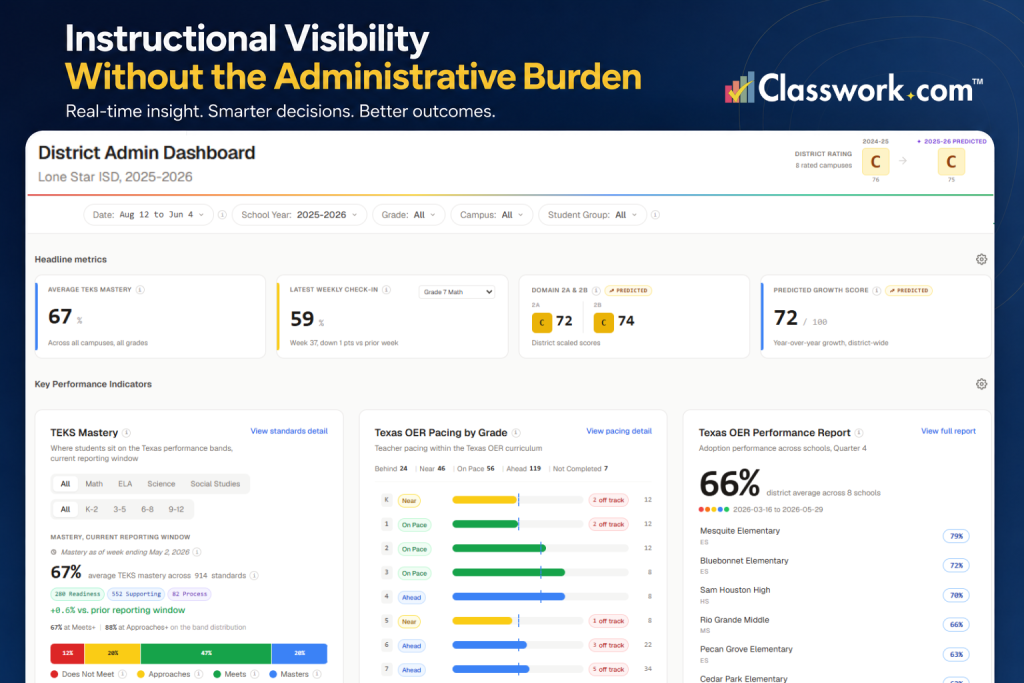
The Classwork Texas Edition provides district leaders with real-time visibility into TEKS mastery, student readiness, instructional implementation, coaching cycles, and campus performance—all from one centralized dashboard.
For Teachers
Teachers gain ready-to-use instructional tools that reduce preparation time while providing immediate insight into student learning.
- Bluebonnet Learning™ lesson-aligned instructional activities
- Readiness Checks™, Lesson Checks, and formative assessments
- AI-assisted scoring for open-response questions
- Real-time TEKS mastery insights
- Interactive digital lessons that fit naturally into the Bluebonnet Learning™ lesson sequence
For Instructional Coaches & Campus Leaders
Instructional leaders need more than classroom observations—they need consistent documentation, actionable feedback, and visibility into implementation across every campus.
Classwork supports coaching and instructional leadership through:
- Lesson Internalization Forms Lesson Logs that document implementation and instructional priorities
- Coaching & Observation Logs that streamline walkthroughs and feedback conversations
- Leadership dashboards that provide visibility into classroom implementation
- Professional Learning Community (PLC) support through shared instructional evidence and TEKS mastery trends
For District Leadership
District leaders need reliable data to monitor implementation, support campuses, and make informed instructional decisions.
Classwork provides:
- Districtwide TEKS mastery dashboards
- Campus and classroom performance trends
- Student readiness monitoring
- Leadership visibility across schools
- Implementation tracking that supports continuous instructional improvement
- Flexible Roles & Permissions that allow teachers, instructional coaches, principals, curriculum leaders, and district administrators to access the tools and reporting most relevant to their responsibilities
Continue Exploring LIFT & Bluebonnet Learning™
Implementing High-Quality Instructional Materials is about more than selecting curriculum. Explore our Leadership Guide to learn how Classwork supports Bluebonnet Learning™, instructional leadership, coaching, classroom implementation, and districtwide visibility throughout every stage of the LIFT framework.

One of the most common questions districts ask is whether LIFT funding can support digital platforms that help implement High-Quality Instructional Materials (HQIM).
While each district is responsible for following current Texas Education Agency (TEA) guidance and local procurement requirements, the LIFT framework emphasizes building sustainable instructional systems—not simply purchasing curriculum. As districts plan implementation, many invest in digital tools that strengthen instructional planning, leadership coaching, classroom evidence, and districtwide visibility.
Technology is most valuable when it directly supports the goals of the LIFT framework, including:
- Implementing High-Quality Instructional Materials (HQIM)
- Supporting Bluebonnet Learning™ classroom instruction
- Strengthening Professional Learning Communities (PLCs)
- Documenting lesson internalization and instructional coaching
- Monitoring TEKS mastery and student readiness
- Providing instructional leaders with meaningful implementation data
- Supporting continuous improvement across campuses
Rather than functioning as stand-alone technology, these systems become part of the district’s overall instructional strategy, helping educators reduce administrative workload while giving leaders the information they need to support teachers throughout implementation.
Bringing the LIFT Framework to Life
The Texas LIFT Grant is more than a funding opportunity—it is an investment in sustainable instructional improvement. Success depends on more than selecting high-quality curriculum. It requires systems that connect classroom instruction, leadership coaching, instructional data, and continuous support into one cohesive implementation strategy.
Whether your district is preparing for its next implementation phase, strengthening Professional Learning Communities, or expanding the use of Bluebonnet Learning™, Classwork Texas Edition helps educators simplify instruction while providing leaders with the visibility needed to support long-term success.
Every district’s LIFT implementation journey is different. Whether you’re evaluating Bluebonnet Learning™, planning your implementation strategy, or exploring how Classwork can support your district’s instructional goals, we’d be happy to show you what’s possible.
Ready to Support Your LIFT Implementation?
See how Classwork Texas Edition helps districts streamline Bluebonnet Learning™, instructional coaching, TEKS mastery reporting, and leadership visibility—all within one connected platform designed for Texas schools.
Ready to see the Classwork.com Texas Edition in action?
Just want to see how it works for teachers? Explore our Texas OER Edition Features here.
Official Texas LIFT Grant Resources
For the latest guidance, implementation requirements, and grant information, the Texas Education Agency (TEA) provides the following official resources.
📘 Leadership and Instructional Foundations for Texas (LIFT)
Learn about the LIFT framework, implementation pathways, instructional leadership supports, and High-Quality Instructional Materials (HQIM).
Resource:
Leadership and Instructional Foundations for Texas (LIFT)
📄 LASO Grant Programs
The Learning Acceleration Support Opportunities (LASO) portal provides information about current grant cycles, eligibility, application guidance, timelines, and program updates.
Resource:
Learning Acceleration Support Opportunities (LASO) Cycle 5
💻 Texas eGrants
Awarded districts use the TEA eGrants system to accept awards, manage budgets, submit required documentation, and administer grant activities.
Resource:
TEA eGrants Portal
📚 Bluebonnet Learning™
Explore Texas’ state-developed High-Quality Instructional Materials (HQIM), implementation resources, and curriculum information for Bluebonnet Learning™.
Resource:
Bluebonnet Learning™ Resources
📖 Strong Foundations Implementation
Learn how Strong Foundations supports high-fidelity implementation of Bluebonnet Learning™, professional learning, instructional coaching, and technical assistance for participating districts.
Resource:
Strong Foundations Implementation
📋 Instructional Materials Review & Approval (IMRA)
Learn more about the Instructional Materials Review and Approval (IMRA) process and how Texas evaluates High-Quality Instructional Materials.
What does LIFT stand for?
LIFT stands for Leadership and Instructional Foundations for Texas, a Texas Education Agency initiative designed to help districts implement High-Quality Instructional Materials (HQIM) while strengthening instructional leadership, coaching, and continuous improvement.
What are High-Quality Instructional Materials (HQIM)?
High-Quality Instructional Materials (HQIM) are research-based instructional resources that are aligned to the Texas Essential Knowledge and Skills (TEKS) and support rigorous classroom instruction. Bluebonnet Learning™ is one example of SBOE-approved HQIM available to Texas school districts.
Is Bluebonnet Learning™ required for the LIFT Grant?
LIFT includes different entry points based on a district’s instructional readiness. School systems entering the Planning Entry Point may begin by selecting SBOE-approved High-Quality Instructional Materials (HQIM). School systems entering the Implementation Entry Point have already adopted Bluebonnet Learning™ and are preparing for implementation. TEA notes that districts selecting HQIM other than Bluebonnet Learning after the planning year transition out of LIFT.
Can LIFT funds support instructional technology?
Districts should follow current TEA grant guidance, approved-provider requirements, and local procurement rules when determining allowable LIFT expenditures. Technology platforms may support broader district HQIM implementation efforts by helping districts manage instructional resources, classroom evidence, coaching, TEKS mastery, and implementation data; however, districts should verify whether a specific expenditure is allowable under their current grant award and budget.
What are Research-Based Instructional Strategies (RBIS)?
Research-Based Instructional Strategies (RBIS) are evidence-based teaching practices that improve student learning through consistent instructional routines, effective questioning, collaborative learning, formative assessment, and ongoing instructional feedback.
What are Professional Learning Communities (PLCs)?
Professional Learning Communities (PLCs) are collaborative teams of educators who regularly analyze student learning, review instructional practices, and make data-informed decisions to improve classroom instruction and student outcomes.
How does Classwork support LIFT implementation?
Classwork Texas Edition supports districts throughout the implementation process by providing Bluebonnet Learning™ lesson-aligned activities, Readiness Checks™, AI-assisted scoring, Lesson Internalization Forms, Lesson Logs, Coaching & Observation Logs, TEKS mastery dashboards, leadership reporting, and districtwide implementation visibility—all within one connected platform.
How do TEKS mastery dashboards support instructional leadership?
TEKS mastery dashboards provide district leaders, principals, and instructional coaches with real-time visibility into student learning trends, curriculum implementation, and instructional priorities. This information helps guide coaching conversations, Professional Learning Communities (PLCs), and data-informed instructional decisions.
Why is instructional visibility important during LIFT implementation?
Successful implementation requires more than distributing curriculum. District leaders need ongoing visibility into classroom instruction, coaching cycles, implementation progress, and student learning so they can provide timely support, celebrate successes, and address challenges before they become larger issues.
How do I find Texas LIFT Grant approved providers?
Districts participating in the Texas LIFT Grant should begin by reviewing the current Texas Education Agency (TEA) guidance for their LIFT or LASO grant cycle. TEA identifies approved Technical Assistance (TA) providers and implementation requirements as part of the grant program. Districts should work with their assigned Education Service Center (ESC), review official TEA grant resources, and follow current procurement and funding guidance when selecting implementation partners and instructional support services.
When can districts apply for LASO Cycle 5 LIFT funding?
The LASO 2026–27 Cycle 5 application opens September 23, 2026 and closes December 1, 2026 at 5:00 p.m. CT. TEA lists LIFT as a three-year school-system initiative with Cycle 5 awards ranging from $365,000 to $1.5 million. Districts should consult TEA’s current LASO Cycle 5 guidance for eligibility, application requirements, webinars, and updates.
Legal Disclaimer
STAAR® and BLUEBONNET LEARNING™ are trademarks owned by the Texas Education Agency and the appearance of those trademarks on this website implies no association. Classwork.com and its goods and services are not sponsored by, affiliated with, or approved by the Texas Education Agency.
For more information on the Bluebonnet Learning™ Curriculum, please visit the Texas Education Agency’s official page.
Classwork.com is a digital platform provider that facilitates the interactive delivery, approval, and reporting of instructional materials, including state-adopted High-Quality Instructional Materials (HQIM) such as the Bluebonnet Learning™ (BBL) curriculum.
Classwork.com does not own, modify, or sell the Bluebonnet Learning™ curriculum or any other State of Texas Open Educational Resource (OER) materials. All BBL content remains under the State of Texas OER license, and its use within the Classwork.com platform is subject to district compliance with applicable licensing requirements.
Intellectual Property & Proprietary Rights
Classwork.com’s software, interactive overlays, item banks and activities, AI and auto-scoring technology, approval workflows, and reporting tools are proprietary intellectual property, protected under U.S. copyright law (17 U.S.C. § 102), trade secret protections, and the Digital Millennium Copyright Act (DMCA, 17 U.S.C. § 512). The use of these features within the Classwork.com platform is governed by our Terms of Service, and no aspect of our proprietary technology may be copied, distributed, or reverse-engineered without explicit authorization.
DMCA Compliance & Safe Harbor Protection
Classwork.com acts as a service provider under the DMCA and is not responsible for district or teacher-created content uploaded to the platform. If you believe that any content hosted within Classwork.com violates copyright or licensing agreements, please submit a formal DMCA takedown request.
By using Classwork.com, users acknowledge that:
– All instructional materials remain under the control of the respective copyright or OER license holders.
– Classwork.com’s role is to provide a technology infrastructure for digital instructional material delivery, not to modify or resell OER curriculum content.
– Districts are responsible for ensuring their use of OER materials complies with Texas Education Agency (TEA) guidelines and licensing terms.
For more information, please review our Terms of Service, Privacy Policy, and DMCA Compliance Procedures accessed via the footer on this page.