
Texas Education Freedom Accounts (TEFA): Is ESA Expansion Worth It?
Executive Summary
As of May 4, 2026, over 100,000 students have been awarded Texas Education Freedom Accounts (TEFA), siphoning approximately $1 billion in state funds. Proponents often cite parental choice. However, data from Indiana, Louisiana, and Wisconsin reveals a different story. Students often face significant achievement loss inside the voucher “Black Box.”

Why is the 2026 Texas TEFA Rollout a National Turning Point?
Arizona, Florida, and Oklahoma pioneered “universal” Education Savings Accounts (ESAs). These programs ignore income levels. However, Texas has launched the most impactful prioritized program to date. In the inaugural 2026 cycle, demand reached a staggering 274,000 applications, forcing a random lottery for the majority of Tier 2 and Tier 3 applicants.
However, for public school leaders, “participation” is a poor proxy for “performance.” Private and home schools in TX, FL, and AZ are not required to report outcomes or take state tests. They do not adhere to the same transparency mandates as public districts. We have officially entered the era of the Accountability Black Box.
As administrators, you are managing a dual crisis. First is the fiscal impact of siphoning Average Daily Attendance (ADA) dollars. Second is the operational burden of a new mandate to track students you no longer serve. Is ESA expansion worth it? For the public system, the data suggests the cost is much higher than the sticker price.
How Does Texas Education Freedom Accounts (TEFA) Compare to Universal Models in FL and AZ?
Texas attempted to avoid the immediate fiscal “firestorm” seen in states like Arizona—which faced a $400 million budget deficit following its universal expansion—by implementing a tiered system. Yet, the fiscal hit to Texas public districts remains severe. Empty subscription seats in a software contract are trivial compared to the $10,474 basic allotment lost when a student exits.
Because school funding is built on the fixed costs of buildings, buses, and staff, the loss of ADA funding creates “stranded costs” that must be absorbed by the remaining students. In Florida, the “universal” model led to a massive influx of families who were already in private schools, essentially turning the voucher into a state-funded tuition coupon. Texas is seeing a similar trend: early data suggests over 75% of applicants were already outside the public system.
2026 Voucher Accountability Comparison: TX, FL, AZ
| Accountability Feature | Texas Education Freedom Accounts (TEFA)) | Florida (Universal) | Arizona (ESA) |
|---|---|---|---|
| 2026-27 Award Amount | $10,474 / Up to $30,000 (SPED) | ~$8,000 | ~$7,500 - $8,000 |
| Eligibility Model | Tiered Priority | Universal | Universal |
| Outcome Testing | None Required (Black Box) | None Required | None Required |
| District Role | APEX-ESA Portal (Mandatory) | Minimal | Minimal |
| Achievement Reality | 0% Reported (Black Box) | No Data Reported | No Data Reported |
Educational Attainment: The Achievement Loss Data
While the Texas Education Freedom Accounts (TEFA) rollout is new, the outcomes of similar programs elsewhere are well-documented. If we cannot find data in Texas or Florida, we must look to states that require voucher students to take state tests: Indiana, Louisiana, and Wisconsin. The results are “shockingly bad” and should give every Texas taxpayer pause.
1. The Louisiana Math Collapse
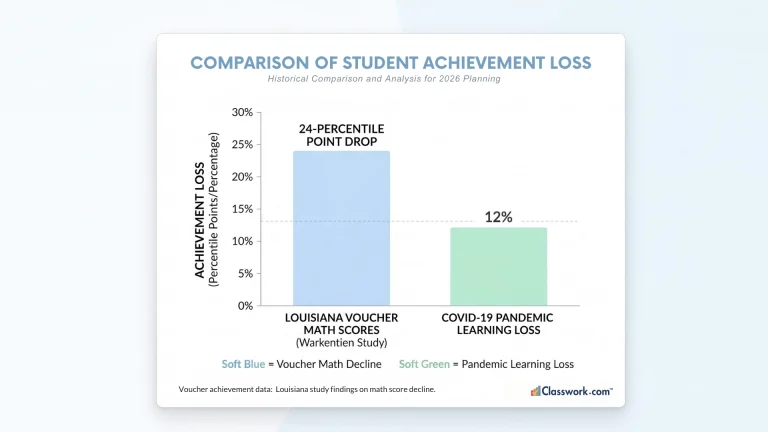
The Warkentien Study is the most cited voucher research. It followed students moving to private schools in Louisiana. These students saw a 24-percentile point drop in math scores within just one year. This decline is roughly double the size of the learning loss seen during the COVID-19 pandemic.
2. Indiana’s Persistent Achievement Gap
Indiana, often touted as a “gold standard” for vouchers, has provided some of the most damning data. Multiple studies from the University of Notre Dame and others found significant achievement loss in mathematics that persisted for more than four years after students entered the private system. The “choice” did not lead to mastery; it led to a measurable regression.
3. Wisconsin’s Lack of Transparency
In Wisconsin, where a limited form of testing is required, the results are equally concerning. Recent data shows that nearly half of voucher-participating schools were unable to be fully rated or assessed due to missing data or low participation. In short, even when laws require testing, the private market excels at maintaining the “Black Box.”
The APEX-ESA Burden: Texas Education Freedom Accounts (TEFA) Accountability Without Authority
To add insult to injury, Texas public schools are currently tasked with the “unpaid labor” of the APEX-ESA portal. When a student leaves a district for a Texas Education Freedom Accounts (TEFA) award, the public school remains the “official source of truth” for documentation.
Districts are required to track these students at the time of departure, verify their eligibility for special education services, and upload key records like IEPs into the state portal. You are essentially serving as the unpaid data validator for your own competition. This is the definition of “Accountability without Authority.” Staff must manually verify records for a competing private system while managing the fiscal deficit created by that student’s exit.
The SSO Illusion: Why "One Click" Isn't a Strategy
As districts nationwide prepare to compete with the voucher narrative, many point to their tech stacks as proof of readiness. “We have Clever or ClassLink,” the logic goes. “Our teachers are tech-forward.”
But in 2026, we have realized that Single Sign-On (SSO) only solves access; it ignores labor. It is like having a universal remote for a TV that still requires you to get up and change the channel manually. You’ve solved the login, but you’ve ignored the workflow.
When teachers are forced to toggle between 14 open tabs and a “Junk Drawer” of 1,400+ disconnected apps, the resulting “Workflow Friction” makes the “simple” private school model look attractive—even if that model is a “Black Box” for achievement. To compete, public schools must move beyond the “Junk Drawer” and toward a Unified Instructional Operating System that proves student growth in real-time.
Conclusion: The Value of Transparency
Is ESA expansion worth it? The next three years will determine the fate of the public education model in the United States. While the Texas Education Freedom Accounts (TEFA) program offers families a ‘coupon economy,’ it often comes at the cost of instructional clarity.
Public education’s greatest strength has always been its accountability. While private schools thrive in the “Black Box,” public districts can thrive in the light. By consolidating tools and unifying workflows, you can prove that the best place for a child isn’t behind a “coupon”—it’s in a public classroom that is data-rich, teacher-led, and audit-ready.
Question: What is the Texas Education Freedom Account (TEFA) award amount for 2026?
Answer: The base award for Texas Education Freedom Accounts (TEFA) is $10,474 for the 2026–27 school year, with students in special education eligible for up to $30,000 to cover approved educational expenses.
Question: Is Texas Education Freedom Accounts (TEFA) a universal voucher program?
Answer: No, unlike the universal models in Florida and Arizona, Texas Education Freedom Accounts (TEFA) currently operates under a tiered priority lottery system that favors low-income families and students with disabilities.
Question: How much ADA funding do Texas districts lose per TEFA student?
Answer: Texas public school districts lose approximately $10,474 in Average Daily Attendance (ADA) funding for every student who exits the system to utilize a Texas Education Freedom Account (TEFA).
Question: Does TEFA require private school testing or accountability?
Answer: Currently, Texas Education Freedom Accounts (TEFA) do not require private schools or home-school providers to report student achievement data or participate in state-mandated testing, creating what researchers call an “Accountability Black Box.”
Question: Is the lack of achievement data a Texas-specific issue or a national ESA trend?
Answer: The “Accountability Black Box” is a significant national trend. In 2026, most states with universal or expanded Education Savings Accounts (ESAs)—including Arizona, Florida, and Oklahoma—do not require private or home-school providers to report standardized test scores or participate in state accountability systems. This has led to a national data vacuum where billions in public funds are being spent without measurable evidence of student growth.
Question: How does TEFA’s impact on public school budgets compare to other state models?
Answer: Nationally, the fiscal impact varies by how the “vouchers” are funded. While some states use separate scholarship funds, Texas Education Freedom Accounts (TEFA) directly impact district budgets by siphoning $10,474 in ADA funding for every student who leaves. This mirrors the “Universal ESA” crisis seen in Arizona, where unanticipated demand from families already enrolled in private schools led to a massive state budget deficit and significant cuts to public education resources.
Fact-Check & Reference Research
Texas Education Agency: APEX-ESA Portal Documentation 2026: Official state guidelines detailing the $1.047 billion TEFA funding allocation and the mandatory reporting requirements for Texas school districts.
University of Notre Dame / JPAM: Indiana Voucher Achievement Research: A peer-reviewed longitudinal study published in the Journal of Policy Analysis and Management confirming significant math achievement loss for students transitioning to private vouchers.
National Bureau of Economic Research: The Impacts of the Louisiana Scholarship Program: A multi-year federal audit revealing that voucher recipients fell 34% of a standard deviation behind their public school counterparts within the first three years.
Wisconsin Watch: Private School Choice Transparency Report: A 2026 investigative report highlighting that 43% of voucher-funded private schools lack sufficient data to be scored under state accountability standards.