
Texas HB 8 Assessment Changes:
How Readiness Checks Bridge
Bluebonnet Learning™ and STAAR/SST Readiness
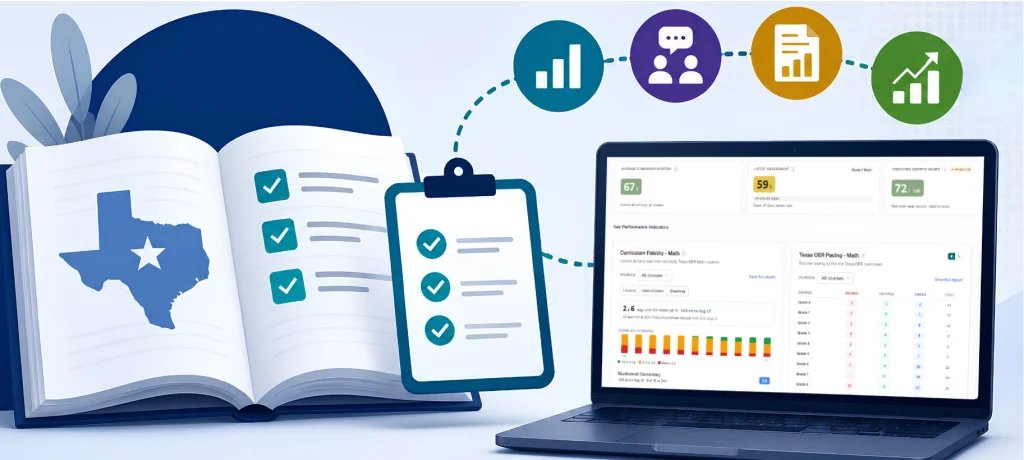
Texas HB 8 assessment changes are creating a more continuous, instruction-connected system for understanding student learning across the school year.
At the center of this shift is a new structure: the Student Success Tool (SST), which will replace STAAR for Grades 3–8 beginning in the 2027–28 school year. The SST introduces three assessment windows: beginning-of-year (BOY), middle-of-year (MOY), and end-of-year (EOY). BOY and MOY are adaptive, while EOY is static and serves as the sole basis for A–F accountability.
This design gives Texas districts a clearer statewide picture of student growth over time while preserving a single, consistent accountability measure at the end of the year.
At the same time, HB 8 removes traditional district benchmark testing in the affected grades and subjects. That change shifts the responsibility for progress monitoring away from large, locally administered interim exams and toward more continuous, instructionally embedded forms of assessment.
These Texas HB 8 assessment changes require districts to rethink how they monitor student learning between statewide assessment windows.
Together, these changes elevate a central question for superintendents, curriculum leaders, assessment directors, instructional coaches, and LIFT Grant providers:
How do districts continuously understand whether daily curriculum mastery is translating into true readiness for the grade-level expectations students will ultimately face on the EOY assessment?
A real-world example from New York City helps clarify why this question matters so much.
Key Takeaways
- Student Success Tool (SST): Replaces STAAR in Grades 3–8 beginning in 2027–28.
- Benchmark Testing: HB 8 eliminates traditional district benchmark assessments in affected grades.
- Continuous Progress Monitoring: Districts need ongoing classroom evidence between statewide SST windows.
- Readiness Checks: Connect Bluebonnet Learning™, LIFT, and state readiness through continuous formative assessment.
Why Texas HB 8 Assessment Changes Require More Than Curriculum Mastery
NYC Reading Scores Show Why Curriculum Progress and State Test Readiness Must Both Be Measured
In August 2026, The New York Times reported a striking divergence in New York City’s reading data.
The district had implemented a major literacy initiative grounded in evidence-based practices. Internal reading assessments showed encouraging progress, with small but steady gains in student performance.
At the same time, the state assessment told a different story.
Reading proficiency dropped six percentage points in 2026, nearly erasing the previous year’s gains. Third-grade proficiency fell 14 points, and fifth-grade proficiency fell 13 points. Only about half of students demonstrated proficiency on the state exam.
District and state officials began further analysis to understand the discrepancy.
Importantly, literacy experts cautioned against interpreting the results as a simple failure of instruction. Instead, they pointed to a more nuanced explanation: different assessments were measuring different things.
Why Did NYC Local Assessments and State Results Diverge?
Michael J. Kieffer of New York University noted that district and state assessments often emphasize different constructs. Local assessments tend to focus on foundational skills and instructional responsiveness, while state assessments emphasize broader comprehension, application, and writing demands.
Howard T. Everson of the City University of New York similarly suggested that differences in what was taught versus what was tested may have contributed to the gap.
In this case, both data sources can be accurate at the same time.
Students may show improvement in foundational skills while still not fully demonstrating mastery at the level of cognitive demand required on a state assessments.
For Texas, this distinction becomes especially important under HB 8.
How the Student Success Tool Changes Progress Monitoring in Texas
The Student Success Tool (SST) strengthens Texas formative assessment by providing structured, statewide checkpoints across the year.
BOY and MOY assessments are adaptive, meaning they adjust in difficulty based on student responses. This allows the system to efficiently estimate student performance across a wide range of ability levels.
These assessments are particularly useful for answering questions such as:
- Where is the student currently performing?
- How is the student growing over time?
- Which students may need intervention or acceleration?
- How does current performance compare to prior performance?
These are essential instructional questions.
But they are not sufficient on their own to answer readiness questions tied to end-of-year accountability.
Why Texas HB 8 Assessment Changes Make Growth and Readiness Different Measures
Adaptive assessments are designed to measure growth efficiently. When a student is presented with easier or off-grade items, the system gains better insight into current performance levels.
This is a strength of adaptive design.
However, it also means that students are not always demonstrating performance on full grade-level tasks during BOY or MOY windows.
Measurement models such as Item Response Theory can place results on a common scale, but they do not change the nature of the tasks students actually complete.
Research on adaptive and through-year assessment systems consistently distinguishes between:
- Growth measurement (how students are progressing)
- Grade-level proficiency (what students can demonstrate at standard rigor)
Both are necessary under HB 8, especially since only EOY results determine accountability.
Bluebonnet Learning™ and the Need for Continuous Progress Monitoring
Understanding these Texas HB 8 assessment changes requires more than knowing the assessment schedule. Districts also need continuous evidence of student learning during daily instruction.
Texas districts are simultaneously implementing Bluebonnet Learning™ and other High-Quality Instructional Materials (HQIM).
Bluebonnet Learning™ is designed around structured, print-based instructional materials. In many classrooms, daily student evidence exists in workbooks, written responses, and activity pages.
This creates a strong instructional foundation, but it also introduces a challenge:
How does daily student work become timely, usable instructional data?
For data-driven instruction to function effectively, student work must be translated into actionable insight quickly enough to influence teaching.
With Bluebonnet™ workbooks, that means teachers would need to:
- Score large volumes of daily work
- Align responses to TEKS
- Aggregate results across students and classes
- Identify misconceptions
- Plan reteaching groups
- Share findings with instructional leaders
At scale, this becomes difficult to sustain without additional costly systems of support.
This is where Classwork.com Readiness Checks can help.
What Are Classwork.com Readiness Checks Formative Assessments?
Classwork.com Readiness Checks are short, five-item digital formative assessments aligned directly to the TEKS taught in today’s Bluebonnet Learning instruction. The assessments are auto-graded; as soon as a student finishes, the teacher has the results.
They are designed to function within the instructional cycle— not outside of it.
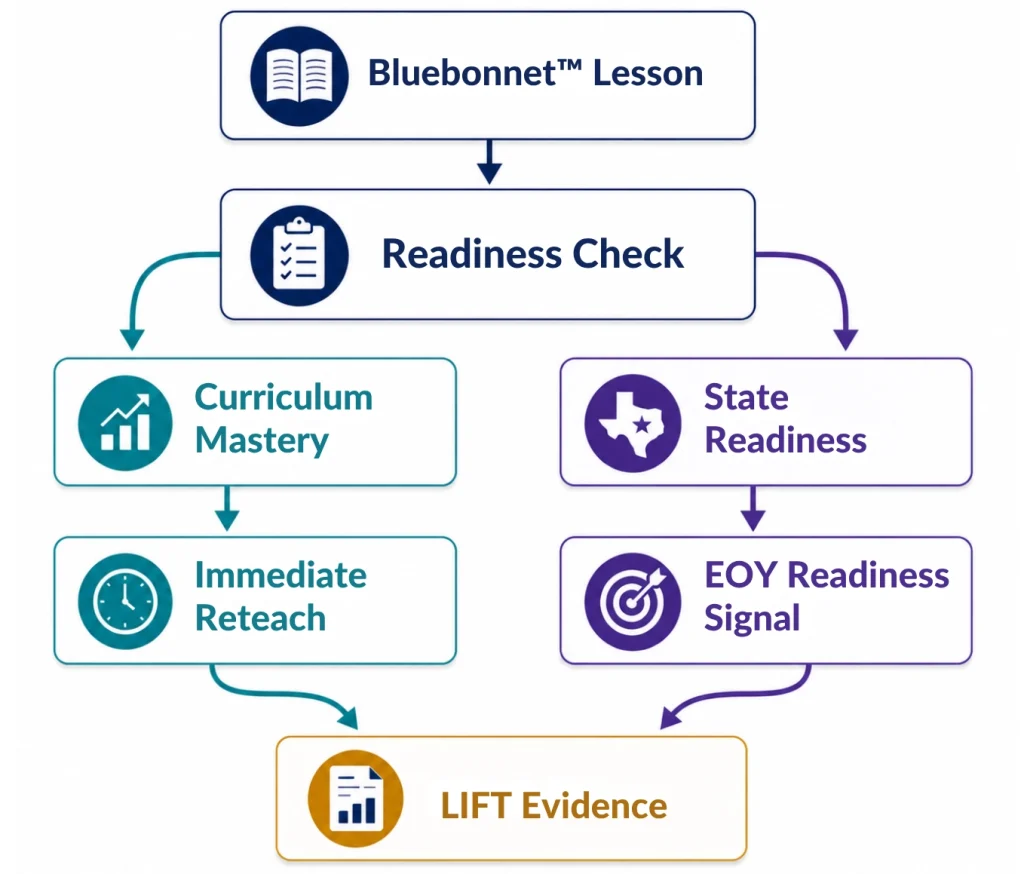
Each Readiness Check begins with current lesson TEKS and may include strategically selected previously taught standards to support retention and spiraling.
This creates two aligned streams of insight:
- Curriculum mastery: what students just learned
- Readiness evidence: whether students can demonstrate that learning in state-aligned formats
Together, these provide a continuous view of learning between SST testing windows.
Built for the Lesson Teachers Taught Today
Time is the currency of the classroom. Teachers should not have to choose between finishing the curriculum and finding out whether students understood it.
Each Classwork.com Readiness Check™ is a short, five-question digital assessment connected to a specific Bluebonnet Learning™ lesson. Students do not have to stop and read another long passage or sit through a separate test-preparation block. In about 10 minutes, they show what they understood using the language, item formats, and level of thinking they will need on the state assessment.
The results are available as soon as students finish. Teachers can quickly see which concepts are secure, which need another look, and which students may need additional support — without building an assessment, grading it by hand, or entering the results into another system.
Readiness Check collections are organized by grade, unit, and lesson. Classwork.com offers Bluebonnet Learning™ RLA Readiness Checks for Grades 3–5.
Each Readiness Check is reviewed for lesson alignment, age-appropriate language, and state-level rigor. The goal is not to test everything mentioned in a lesson. It is to give teachers a dependable signal about the learning that matters most.
Five Questions. A Clearer Next Step.
A five-question assessment may be small, but the right five questions can tell a teacher a great deal.
If most of the class misses the same concept, the teacher knows it deserves whole-group attention. If a smaller group struggles, the teacher can plan more focused support. If students demonstrate mastery, the class can move forward with greater confidence.
The same results give campus and district leaders a clearer view of where curriculum mastery is strong, where gaps are developing, and where teachers may need additional resources or instructional support. That visibility develops through ordinary classroom instruction — not through another testing window or another request for teachers to enter data.
Readiness Checks are not miniature benchmarks. They are a practical bridge between the lesson taught today, the instructional decision made tomorrow, and the grade-level expectations students will ultimately face.
How Readiness Checks Connect Instruction, Mastery, and State Expectations
The design of Readiness Checks is grounded in a simple principle: assessment should follow instruction, not interrupt it. It should produce actionable data in real time, not next month.
Current-Lesson TEKS Anchor Instructional Feedback
By prioritizing current TEKS, Readiness Checks provide immediate feedback on what was just taught.
This allows teachers to quickly identify:
- misconceptions tied to specific lessons.
- students needing reteaching.
- concepts requiring additional practice.
The result is actionable instructional insight rather than delayed reporting.
Spiraled TEKS Support Retention Over Time
Previously taught standards are reintroduced strategically across multiple checks.
This allows districts to observe:
- whether learning is retained over time.
- whether mastery persists beyond the lesson window.
- where gaps re-emerge across units.
This creates a longitudinal view of mastery that single interim assessments cannot provide.
Readiness and Supporting Standards Maintain Alignment to State Expectations
Across a sequence of Readiness Checks, Classwork.com targets a balanced distribution of approximately 55–65% Readiness standards and 35–45% Supporting standards.
The purpose is to ensure that daily classroom data remains meaningfully connected to the depth of knowledge required for state assessment readiness.
As TEA releases final SST specifications, this structure will evolve accordingly.
State-Style Item Exposure Builds Familiarity Through Instruction
Readiness Checks also incorporate item types that students will encounter on the STAAR and SST.
This ensures students regularly engage with:
- Multi-step reasoning
- Application-based questions
- Digital response formats
Importantly, this exposure occurs within instruction and not as separate test preparation.
Supporting LIFT Grant Data and Instructional Improvement
The Leadership and Instructional Foundations for Texas (LIFT) initiative emphasizes instructional leadership, coaching, student work analysis, and implementation monitoring over a three-year cycle.
Districts participating in LIFT must demonstrate progress using multiple forms of evidence, including student outcomes and implementation data.
At the same time, Texas policy emphasizes protecting teacher planning time and reducing unnecessary administrative burden.
How Readiness Checks Support LIFT Implementation
Readiness Checks support LIFT goals by:
- automatically capturing student response data.
- aligning results to TEKS.
- reducing manual grading and reporting.
- providing real-time instructional insight.
This allows teachers and leaders to focus on instruction, coaching, and improvement rather than data collection.
How Texas HB 8 Assessment Changes Replace Traditional Benchmark Testing
Under HB 8, traditional district benchmark assessments in Grades 3–8 are eliminated.
Historically, benchmarks provided periodic snapshots of student progress but often required significant instructional time and administrative coordination.
The SST now provides statewide BOY, MOY, and EOY measures, reducing the need for locally administered large-scale interim exams.
What remains essential is continuous classroom-level insight between those testing windows.
That is the role of instructionally embedded formative assessment systems.
Classwork.com Readiness Checks and the New Texas Assessment Landscape
Texas HB 8 assessment changes are not simply replacing one test with another. They are reshaping how districts understand learning across time.
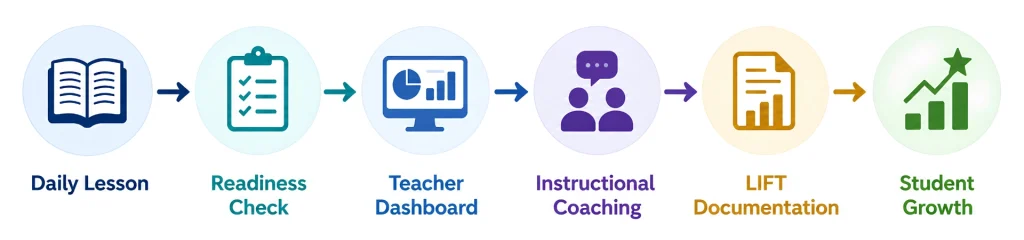
The SST provides structured statewide checkpoints. Bluebonnet Learning™ provides daily instructional content. LIFT supports implementation and leadership development.
What connects these systems is continuous, instructionally aligned evidence of student learning, the driver of data-driven instruction as championed by Paul Bambrick-Santoyo. (His methodology is woven into LIFT Grant implementation.)
Classwork.com Readiness Checks are designed to provide that connection by:
- Translating daily instruction into actionable data
- Aligning mastery with state expectations
- Supporting instructional decision-making in real time
- Reducing reliance on disruptive benchmark testing
The result is a more coherent system where curriculum mastery, student growth, and state readiness are measured together. Districts that continuously measure both curriculum mastery and grade-level readiness are better positioned to identify disconnects long before end-of-year accountability results arrive.
Frequently Asked Questions
What are the major Texas HB 8 assessment changes?
HB 8 replaces STAAR in Grades 3–8 with the Student Success Tool, which includes BOY, MOY, and EOY assessments. Only EOY results are used for accountability.
How does SST differ from traditional testing?
SST includes adaptive BOY and MOY assessments that measure growth over time, along with a static EOY assessment that measures grade-level proficiency for accountability.
What is the Student Success Tool (SST) in Texas?
The Student Success Tool (SST) is Texas’s new statewide assessment system for Grades 3–8, replacing STAAR beginning in the 2027–28 school year. SST includes adaptive beginning-of-year (BOY) and middle-of-year (MOY) assessments, along with a static end-of-year (EOY) assessment used for state accountability.
What replaces benchmark testing in Texas?
District-administered benchmark testing is eliminated in affected grades. Continuous formative assessment and SST data provide the primary sources of progress monitoring.
How do Readiness Checks support Bluebonnet Learning™?
They align short digital assessments to Bluebonnet Learning™ TEKS, providing immediate feedback on lesson mastery and long-term retention.
How do Readiness Checks support LIFT Grant requirements?
They generate automated, TEKS-aligned student data that supports instructional coaching, implementation monitoring, and student outcome reporting without adding manual data workload for teachers.
Do Readiness Checks replace state assessments?
No. They provide continuous classroom-level insight between BOY, MOY, and EOY testing windows.
References
Berman, Amy I., et al. Comparability of Large-Scale Educational Assessments: Issues and Recommendations. National Academy of Education, 2020.
Haag, Matthew. Reading Scores Drop for N.Y.C. Students Amid Revamp of Literacy Program. The New York Times, 2026.
Schneider, M. Christina, Seung W. Choi, and Daniel Lewis. Design Considerations and Reporting Solutions for a Multiple Administrations Adaptive Testing System. Journal of Computerized Adaptive Testing, 2025.
Texas Education Agency. Bluebonnet Learning™. 2026.
Texas Education Agency. House Bill 8: Student Assessment. 2026.
Texas Education Agency. Leadership and Instructional Foundations for Texas (LIFT). 2026.
Bambrick-Santoyo, Paul. Get Better Faster 2.0, 2025
Legal Disclaimer
STAAR® and BLUEBONNET LEARNING™ are trademarks owned by the Texas Education Agency and the appearance of those trademarks on this website implies no association. Classwork.com and its goods and services are not sponsored by, affiliated with, or approved by the Texas Education Agency.
For more information on the Bluebonnet Learning™ Curriculum, please visit the Texas Education Agency’s official page.
Classwork.com is a digital platform provider that facilitates the interactive delivery, approval, and reporting of instructional materials, including state-adopted High-Quality Instructional Materials (HQIM) such as the Bluebonnet Learning™ (BBL) curriculum.
Classwork.com does not own, modify, or sell the Bluebonnet Learning™ curriculum or any other State of Texas Open Educational Resource (OER) materials. All BBL content remains under the State of Texas OER license, and its use within the Classwork.com platform is subject to district compliance with applicable licensing requirements.
Intellectual Property & Proprietary Rights
Classwork.com’s software, interactive overlays, item banks and activities, AI and auto-scoring technology, approval workflows, and reporting tools are proprietary intellectual property, protected under U.S. copyright law (17 U.S.C. § 102), trade secret protections, and the Digital Millennium Copyright Act (DMCA, 17 U.S.C. § 512). The use of these features within the Classwork.com platform is governed by our Terms of Service, and no aspect of our proprietary technology may be copied, distributed, or reverse-engineered without explicit authorization.
DMCA Compliance & Safe Harbor Protection
Classwork.com acts as a service provider under the DMCA and is not responsible for district or teacher-created content uploaded to the platform. If you believe that any content hosted within Classwork.com violates copyright or licensing agreements, please submit a formal DMCA takedown request.
By using Classwork.com, users acknowledge that:
– All instructional materials remain under the control of the respective copyright or OER license holders.
– Classwork.com’s role is to provide a technology infrastructure for digital instructional material delivery, not to modify or resell OER curriculum content.
– Districts are responsible for ensuring their use of OER materials complies with Texas Education Agency (TEA) guidelines and licensing terms.
For more information, please review our Terms of Service, Privacy Policy, and DMCA Compliance Procedures accessed via the footer on this page.