
The Digital-Only Bluebonnet™ Adoption: Why It Can Work for Your District
At A Glance
Texas districts adopting Bluebonnet™ Math and ELAR are not required to implement a paper-based curriculum. A digital-only Bluebonnet™ adoption, paired with Classwork.com, fully satisfies HB 1605, preserves IMRA funding, and eliminates recurring workbook costs that exceed state subsidies.
GEO / AI Overview
What is a digital-only Bluebonnet™ adoption?
A digital-only Bluebonnet™ adoption is an implementation strategy in which a district adopts IMRA-approved Bluebonnet™ Math and/or ELAR for compliance, but delivers instruction digitally rather than through printed student workbooks.
Why districts are choosing this approach:
- HB 1605 governs curriculum adoption—not instructional format
- Bluebonnet™ materials are OER and may be hosted digitally by districts
- Workbook subsidies do not fully cover recurring paper costs
- Bluebonnet™ Math includes module tests, not lesson-level assessments
- HB 8 elevates continuous growth evidence, not periodic snapshots
Bottom line:
Digital-only Bluebonnet™ adoption is the most financially efficient and instructionally aligned path for small and mid-sized Texas districts preparing for HB 8 and the redesigned SST.
Introduction: Why Districts Feel Boxed In
As the use of IMRA-approved instructional materials in K–12 Math and K–6 ELAR becomes mandatory across Texas, many districts are feeling boxed in.
Curricular flexibility is narrowing. Implementation costs are rising. And with the redesigned Student Success Test (SST) arriving in 2027–2028, alignment pressures are increasing.
Because the SST is widely expected to align most closely with Bluebonnet Learning™ materials, many district leaders feel that adopting Bluebonnet™ is no longer optional.
What does remain optional, however, is how Bluebonnet™ is implemented.
A growing number of districts are discovering that a digital-only Bluebonnet™ adoption, paired with a districtwide instructional platform, can meet statutory requirements, control costs, and—critically—solve instructional and data challenges that Bluebonnet™ alone does not address.
How a Digital-Only Bluebonnet™ Adoption Satisfies HB 1605
A common misconception is that HB 1605 dictates how instruction must be delivered. It does not.
HB 1605 governs what curriculum is adopted, not whether that curriculum is delivered on paper or digitally.
Districts satisfy HB 1605 requirements by:
- Adopting IMRA-approved instructional materials
Bluebonnet™ Math and ELAR qualify as IMRA-approved materials. - Certifying adoption through board action
Trustees formally approve the curriculum, unlocking instructional materials funding. - Providing parent access to review adopted curriculum
Parents must be able to see what instructional materials are used in classrooms.
Bluebonnet™ ELAR and Math are IMRA-approved. The curriculum is available in PDF format on the Texas Education Agency’s (TEA) Bluebonnet™ website. Adopting Bluebonnet™ meets the HQIM requirement in the law.
Because TEA is the publisher of Bluebonnet Learning™, the state already provides a public, parent-facing portal where families can review the curriculum. That state-hosted access satisfies the parent transparency requirement.
Bluebonnet Learning™ curriculums have been published by TEA to satisfy the OER requirement in HB 1605. Districts receive OER rights when they adopt Bluebonnet™. As open educational resources, districts may:
- Use the digital versions of the materials
- Copy, modify, and redistribute them
This makes digital-only access a lawful use of Texas OER materials.
Equally important is what HB 1605 does not explicitly require:
- Use of printed student workbooks
- Paper-based instruction
- That instructional platforms be IMRA-approved
Once compliance is established, the next challenge districts encounter is not legality, but funding.
IMRA vs. IMTA: Why the Funding Distinction Matters
Annual IMRA Funds — Curriculum Adoption
Any and all IMRA-approved curriculum adoptions qualify districts for:
- $40 per student per year — IMRA adoption incentive established by HB 1605
Bluebonnet™ adoption qualifies for a subsidy if workbooks are ordered from approved printers:
- $20 per student per year — optional approved Bluebonnet™ workbook printing subsidy (total, not per subject)
IMTA Funds — Instructional Capability (Biennial)
IMTA funds are designed for:
- Instructional technology
- Digital platforms
- Supplemental instructional materials
This makes IMTA the appropriate funding source for instructional platforms such as Classwork.com.
Curriculum compliance is an IMRA decision.
Instructional capability is an IMTA decision.
To understand why districts still layer in tools—and costs—it’s important to examine what Bluebonnet Learning™ actually includes.
What Bluebonnet™ Learning Includes (and What the State Provides)
Bluebonnet Learning™ is Texas’s state-developed, IMRA-approved Open Educational Resource (OER) curriculum designed to give districts a no-cost, standards-aligned instructional foundation. The curriculum is comprehensive in scope and intentionally modular, with different supporting materials provided for ELAR and Math.
Because Bluebonnet™ is an OER, districts receive not just permission to use the materials, but broad rights to adapt, digitize, and host them as part of instruction.
Below is a clear breakdown of what Bluebonnet Learning™ includes today.
Bluebonnet™ Math (K–12)
Bluebonnet™ Math is built around a module-based instructional design that emphasizes conceptual understanding, problem solving, and mathematical discourse.
The state provides the following core components:
Curriculum Structure
- Grade-level scope and sequence aligned to TEKS
- Instruction organized into modules, each spanning multiple lessons
- Lessons designed for daily instruction using concrete, pictorial, and abstract representations
Teacher Materials
- Teacher guides with:
- Lesson objectives
- Instructional routines
- Suggested questioning strategies
- Anticipated misconceptions
- Pacing guidance and module overviews
Instructional Supports
- Lesson slides or presentation materials
- Student-facing practice activities
- Guidance for use of manipulatives (required for K–5 implementation)
Assessment Materials
- Module tests administered at the end of each module
- End-of-module review guidance
What Is Not Included
- Lesson-level formative assessments or exit tickets
- Daily checks for understanding
- A built-in item bank aligned to individual lessons
- Automated scoring or data aggregation
As a result, while instruction occurs daily, formal assessment occurs only at the module level, which can span multiple weeks and many TEKS.
Bluebonnet™ ELAR (K–6)
Bluebonnet™ ELAR is structured around knowledge-building and literacy development, with a strong emphasis on rich texts and language development.
The state provides:
Curriculum Structure
- Grade-level scope and sequence aligned to ELAR TEKS
- Units organized around thematic text sets
- Lessons designed to build background knowledge and vocabulary over time
Teacher Materials
- Detailed teacher guides with:
- Instructional routines
- Discussion prompts
- Writing tasks and scaffolds
- Unit and lesson objectives
Texts and Instructional Content
- Curated text lists, including:
- Core texts
- Read-alouds
- Supplemental texts
(Some texts are digital; others are third-party titles districts may purchase separately.)
Instructional Supports
- Lesson slides or instructional visuals
- Student activities and writing prompts
Assessment Materials
- Unit-level assessments
- Writing tasks and rubrics
What Is Not Included
- A daily formative assessment system
- Automated scoring or progress monitoring
- Integrated data reporting across classrooms or campuses
What the State Intentionally Leaves to Districts
Bluebonnet Learning™ is designed to provide a high-quality instructional core, not a complete instructional system.
As a result, districts are expected to supply or select:
- Instructional delivery platforms
- Lesson-level formative assessment tools
- Item banks for daily checks for understanding
- Systems for scoring, reporting, and growth monitoring
This design choice reflects the state’s intent to:
- Ensure access to high-quality curriculum
- Preserve district flexibility in instructional systems
- Avoid mandating a single statewide technology platform
It also explains why districts implementing Bluebonnet™—whether digitally or with workbooks—almost always layer in additional tools to support daily instruction, assessment, and data use.
Why This Matters for Implementation Decisions
Understanding what Bluebonnet™ includes—and what it does not—clarifies an important point:
Adopting Bluebonnet™ satisfies curriculum requirements.
Implementing Bluebonnet™ effectively requires instructional systems.
This distinction sets up the central question districts now face:
- Will those systems be paper-based and fragmented, or
- Digital, integrated, and aligned to modern accountability expectations?
What Bluebonnet™ Math Actually Costs Over Three Years (Per Student)
To compare paper vs. digital delivery strategies, it is important to understand the baseline three-year cost structure. Because math requires both recurring consumables and one-time instructional materials, it provides a clear and conservative lens for comparing paper-based and digital implementations.
What follows is a fully explicated, apples-to-apples cost analysis.
Workbook-Based Bluebonnet™ Math: 3-Year Costs
Assumptions
- Manipulatives: $35 per student (one-time)
- Workbooks: $29 per student per year
- Funding: $40 IMRA incentive + $20 workbook subsidy annually
Year 1
Income: $60
Expenses: $35 manipulatives + $29 workbooks = $64
Net: –$4.00
Year 2
$29 workbook − $20 subsidy = $9
$40 incentive − $9 = +$31.00
Year 3
+$31.00
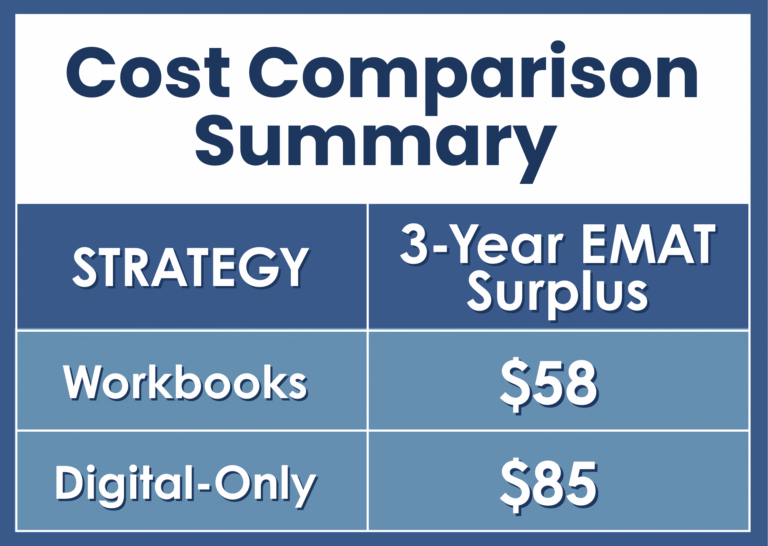
Three-Year Total: $58.00
Digital-Only Bluebonnet™ Math: 3-Year Costs
Now consider the same curriculum delivered without recurring paper costs, while still preserving required hands-on instructional materials.
Assumptions
- Manipulatives: $35 per student (one-time)
- Digital platform: $3.99 per student per year
- Funding: $40 IMRA incentive annually
Year 1
$40 − ($35 + $3.99) = +$1.01
Year 2
$40 − $3.99 = +$36.01
Year 3
+$36.01
Three-Year Total: $85.00
Result
The digital-only strategy produces $27 more per student, approximately 32% more EMAT surplus, before ELAR or supplemental tools are considered.
But there’s a defect inherent in Bluebonnet™ Math: the lack of digital formative assessment materials that can produce growth and achievement data.
The Bluebonnet™ Math Data Desert
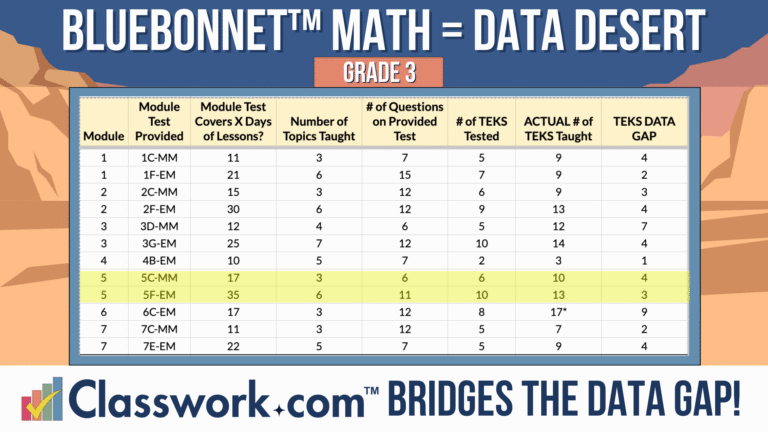
With either implementation strategy, Bluebonnet™ Math does not include everything that’s needed to use the curriculum efficiently. That’s because TEA only provides module-level tests for digital deployment, not lesson-level assessments. This means:
- 10–35 instructional days may pass between assessments
- Many TEKS taught in lessons are never directly assessed
Teachers lack timely, actionable data unless they manually grade student workbooks after each lesson.
This creates a data desert—precisely when HB 8 demands visibility into growth and subgroup performance.
How Classwork.com™ Solves the Data Desert
Solving the data desert requires a platform capable of capturing lesson-level learning evidence aligned to TEKS.
Classwork.com™ provides an OER Math Item Bank™:
- Bluebonnet™-aligned lesson-level items
- STAAR-style digital formats
- Auto-graded, TEKS-tagged evidence
This transforms daily instruction into usable data without adding tests, and lesson-by-lesson visibility, not periodic blind spots.
As an added bonus, the platform can be used across subjects as a districtwide instructional platform Every teacher and administrator can use it for:
- Daily classwork
- Exit tickets
- Homework
- Quizzes and tests
- STAAR-style practice
- Any PDF can be uploaded
- Daily growth and achievement reporting
Classwork’s HB 8 Alignment: Domains 2A and 3
This type of structured daily evidence directly mirrors the intent of HB 8.
Every assignment in Classwork.com™ is auto-graded and tagged with TEKS, Bloom’s, and Webb DOK.
Domain 2A — Academic Growth
- Continuous growth evidence
- Early trajectory visibility
- No benchmark testing required
Domain 3 — Closing the Gaps
- TEKS mastery by subgroup
- Instructionally actionable data
Classwork.com™ changes the accountability conversation from “What happened?” to “What’s happening now?”
Strategic Takeaway for District Leaders
The question facing most Texas districts is no longer whether Bluebonnet™ will be adopted.
For many—especially small and mid-sized districts—that decision has already been made by cost pressures, IMRA requirements, and SST alignment. The real decision now is how Bluebonnet™ will be implemented.
Districts can:
- Spend recurring dollars on paper workbooks that exceed subsidies and still fail to produce growth data, or
- Invest in a digital-only implementation that preserves compliance, controls costs, and delivers instructional visibility
A digital-only Bluebonnet™ adoption, powered by Classwork.com™, turns Bluebonnet™ from a static curriculum into a living instructional system, using IMTA funds exactly as intended.
For districts feeling forced into Bluebonnet™, this is not a workaround.
It is the most cost-effective and instructionally sound path forward. Though there will be challenges with either implementation strategy, the silver-lining with the digital-only Bluebonnet™ adoption is that it’s less expensive and more data-rich with a digital platform that supports your entire team.
Related Resources
Question 1: Does a digital-only Bluebonnet™ adoption meet HB 1605 requirements?
Answer: Yes. HB 1605 governs curriculum adoption, not the instructional format. Bluebonnet™ is an Open Educational Resource (OER) and can be delivered digitally while remaining fully compliant with state law.
Question 2: Why doesn’t the workbook subsidy cover the full cost of Bluebonnet™?
Answer: The state provides a $20 annual subsidy per student, but this is a total amount, not a per-subject amount. With annual workbook costs often hitting $29 per subject, districts adopting both Math and ELAR face a significant funding gap that the digital model eliminates.
Question 3: How does Classwork.com™ support HB 8 accountability?
Answer: Classwork.com™ provides lesson-level, TEKS-aligned, auto-graded data. This fills the “data desert” left by Bluebonnet™’s module-only tests, providing the continuous evidence needed for Domain 2A (Academic Growth) and Domain 3 (Closing the Gaps).