
AI Is for Educators
Protect Student Thinking and Save Teacher Time
Artificial intelligence is no longer merely the newest classroom technology. It is becoming an argument about the purpose of education.
Large language models can draft an essay, solve a problem, summarize a reading, generate a lesson, and answer a question in seconds. That makes them powerful productivity tools. It also creates a serious educational problem: the finished product can look thoughtful and be correct, even when the person producing it has no knowledge of the topic.
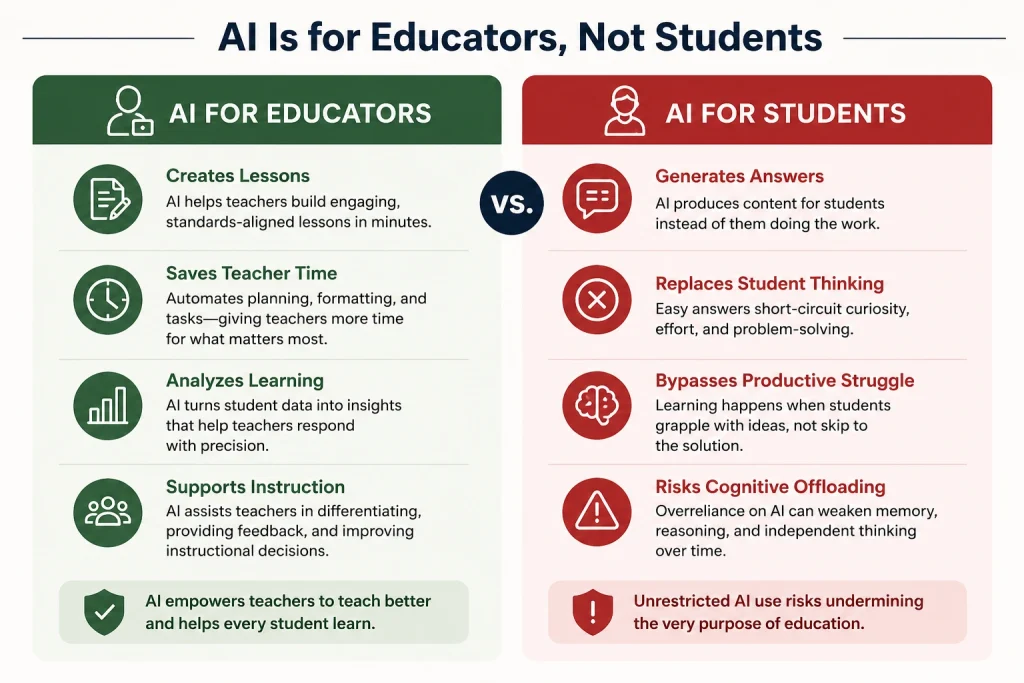
That distinction matters. Schools are not simply in the business of producing answers. They are responsible for developing the knowledge, judgment, memory, persistence, and reasoning students will need to produce answers on their own. This is why we believe AI Is for Educators: it should enhance teacher productivity rather than replace student thinking.
For that reason, Classwork.com takes a deliberately conservative position on student use of generative AI. AI is enormously useful in the hands of trained educators. Open-ended AI that performs students’ intellectual work is a different matter. Children should first learn to read, write, calculate, reason, and make connections without a machine doing those things for them.
Put simply: a student should know how to think before regularly using a machine that mimics thinking.
Why Is AI in Education Facing a Backlash?
The first wave of enthusiasm treated AI adoption as inevitable and resistance as a failure to embrace innovation. The public conversation has changed.
During 2026 commencement ceremonies, college graduates from Arizona to Florida loudly rejected speeches that presented AI as an uncomplicated social good. Former Google CEO Eric Schmidt was repeatedly booed while discussing AI at the University of Arizona. Other speakers encountered similar reactions when they compared AI with the Industrial Revolution or told anxious graduates simply to adapt.
Those protests were driven partly by fears about jobs, corporate power, and the value of a college degree. They show that students are not experiencing the technology as a neutral classroom tool. Many see it as something being imposed on their education and their future before its consequences have been honestly and thoroughly examined.
NPR’s 1A captured this shift in its August 2026 discussion, “What AI Means for the Future of American Education.” The program did not reduce the issue to cheating or ask only how schools can use the newest technology. It raised the more fundamental question: What is school actually for when a machine can produce so much of the visible work?
That is the right question.
What Is Cognitive Offloading, and Why Does It Matter for Student Learning?
Cognitive offloading occurs when a person shifts mental work to an external tool. People have always done this. Calendars help with memory. Calculators handle computation. Search engines retrieve information. A useful tool can free mental capacity for more complex work.
The educational concern is not offloading by itself. It is offloading a skill before the skill has been developed.
A calculator can be useful after a student understands number relationships and mathematical operations. It is far less helpful if it prevents those understandings from forming. You won’t find calculators in use in most elementary and middle schools. Spell-check can catch an adult’s typo without replacing the adult’s ability to write. But spell-checkers have been turned off on most K12 devices for decades. An LLM is broader than either tool. It can supply the idea, structure, language, reasoning, and final response all at once.
That breadth makes it unusually difficult to separate assistance from substitution. If AI drafts the argument, chooses the evidence, organizes the paragraphs, and supplies the sentences, the student may submit a polished paper without having practiced the thinking that writing is intended to develop.
Immediate task completion is not the same as durable learning. In fact, the ease of the finished task may conceal the loss of the learning opportunity.
What Did the MIT “Your Brain on ChatGPT” Study Actually Find?
A 2025 MIT Media Lab study brought the phrase “cognitive debt” into the AI and education debate. Researchers assigned 54 adults, ages 18 to 39, to write essays in one of three conditions: with an LLM, with a search engine, or without digital assistance. Eighteen participants completed a fourth session in which some conditions were reversed. Researchers examined EEG connectivity, the essays, participant interviews, memory, and participants’ sense of ownership over their work.
The LLM group showed the weakest overall neural connectivity during the writing task. Participants using the LLM also had more difficulty quoting from essays they had just produced and reported less ownership of their work. When prior LLM users later wrote without the tool, researchers observed signs of continued under-engagement compared with participants who had previously worked without it.
Those findings deserve attention, but they must not be overstated. The researchers explicitly caution against claiming that LLMs make people “dumber” or cause brain damage.
The study does not settle the scientific question. It does, however, reinforce a reasonable educational concern: when a tool performs more of the intellectual task, the user may engage less deeply with it. Schools should not need proof of permanent harm before protecting children from avoidable dependence. The findings reinforce why we believe AI Is for Educators, where it enhances professional practice instead of replacing student thinking.
What Does the Stronger High School Evidence Show About AI and Learning?
A large randomized field experiment published in the Proceedings of the National Academy of Sciences provides more direct evidence about student learning. Researchers studied nearly 1,000 high school students in mathematics classes and compared three conditions:
- Students used a standard GPT-4 interface.
- Students used a specially designed AI tutor (guarded) with teacher-developed solutions, common misconceptions, and instructions to provide hints rather than answers.
- Students received no generative AI assistance.
Access to either AI tool improved students’ performance while the tool was available. The standard GPT interface raised assisted practice performance by 48%, while the guarded tutor raised it by 127%.
Then the AI was taken away.
On the unassisted exam, students who had used the standard GPT interface scored 17% lower than students who had received no AI help. Interaction data showed that students often used the unrestricted version as a crutch, asking for answers and copying solutions. The guarded tutor largely eliminated the negative effect. Why? Because it required students to show work and offered limited, teacher-designed hints instead of ChatGPT’s complete solutions.
This is the distinction school leaders need to understand. AI makes student performance look better while it is present but can leave the student less capable when it is gone. A high score produced with an LLM does not represent mastery.
Why Classwork.com Designs AI for Educators, Not Students
Educators and children occupy fundamentally different positions. Educators have already spent years building content knowledge, professional judgment, and instructional expertise. AI can help them apply that expertise more efficiently. Students are still developing the underlying knowledge and cognitive habits.
Classwork.com’s generative AI is therefore teacher-facing. Students do not prompt it to write their responses, solve their problems, or complete their assignments.
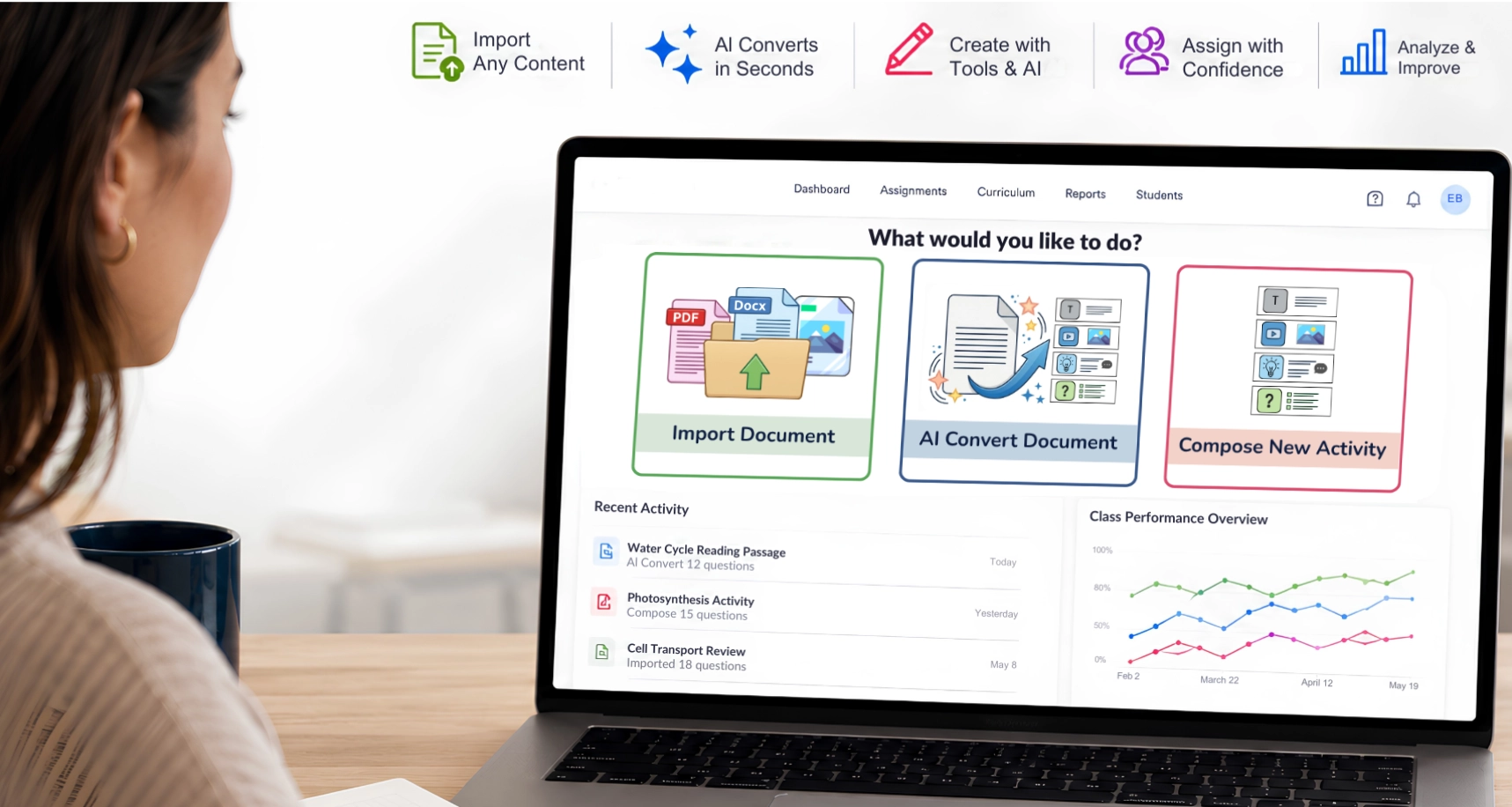
Teachers can use the AI in Classwork.com to:
- generate a first draft of a passage or set of questions;
- transform existing text into an interactive digital activity;
- create or refine multiple-choice, multiselect, true-or-false, and open-response items;
- add media and interactive elements to existing instructional content;
- analyze test data; and
- reduce repetitive preparation time while retaining control over accuracy, rigor, and appropriateness.
The educator reviews, revises, and approves the content before it reaches students. The students then complete the actual intellectual work. Classwork.com can auto-grade objective items and deliver immediate results, but it does not generate student answers. It can analyze student responses but does not ever create the responses for the student.
This is an important division of labor. AI handles appropriate production work for a qualified adult. Educators supply professional judgment. Students read, recall, write, calculate, reason, and solve.
At Classwork.com, AI Is for Educators isn’t just a slogan. It’s a design principle that guides every AI feature we build.
What Is a Responsible Standard for Student Use of Generative AI?
There is no settled scientific consensus establishing a universally safe age, frequency, or set of uses for student-facing generative AI. In the absence of that evidence, schools should favor protection of cognitive development over rapid adoption.
A prudent standard would include the following:
- No open-ended generative AI for routine academic work before high school. Elementary and middle school students need sustained practice with foundational knowledge and skills.
- Limited, teacher-directed use in high school. Any use should have a defined instructional purpose, clear boundaries, and adult oversight.
- Student effort before AI assistance. Students should attempt the task, show their reasoning, and identify where they are stuck before receiving help.
- Hints rather than completed answers. Assistance should prompt another step in the student’s thinking, not end the thinking.
- Independent verification of learning. Students should demonstrate the skill later without any AI assistance.
- Transparency. Teachers should know when and how AI was used, and students should identify any assistance received.
- Human accountability. A teacher, not an algorithm, remains responsible for instructional decisions, feedback, and evaluation.
This approach does not confuse caution with hostility to technology. It simply recognizes that adults use tools to apply established expertise, while students must first acquire expertise.
Can AI Tutoring for Students Ever Be Effective?
Yes, under narrow and carefully designed conditions.
A 2025 randomized controlled trial involving 194 Harvard undergraduates found that students using a carefully structured AI physics tutor achieved greater learning gains in less time than students in an active-learning classroom lesson. The tutor did not function like an unrestricted chatbot. It incorporated expert-developed content, detailed solutions, sequential scaffolding, targeted feedback, and pedagogical instructions intended to keep students actively engaged.
That study demonstrates genuine promise, but it does not justify giving children general-purpose chatbots– or even unconstrained AI tutors. It involved college students, two physics lessons, expert-built prompts, and a tightly structured system. The researchers themselves warned against using AI as a shortcut around critical thinking.
For K-12 schools, AI-assisted tutoring should remain supplemental, infrequent, curriculum-bound, and designed to preserve productive struggle. A responsible tutor should:
- ask the student to explain prior work;
- diagnose a specific misconception;
- provide the smallest useful hint;
- avoid supplying the final answer;
- rely on educator-approved content and solutions;
- give teachers complete unaltered visibility into the interaction; and
- require a later demonstration of independent mastery.
Used this way, AI may extend a teacher’s capacity to provide targeted feedback. Used as an always-available answer machine, it can quietly replace the very thinking school is supposed to cultivate. This distinction illustrates why we believe AI Is for Educators: AI should support teachers, not do students’ thinking for them.
AI for Educators Creates a Better Division of Labor
RAND reported that 54% of students and 53% of English language arts, mathematics, and science teachers used AI for school in 2025. Yet only 22% of district leaders agreed that greater AI use could harm students’ critical-thinking skills, compared with 61% of parents, 48% of middle school students, and 55% of high school students.
That gap should concern school leaders and policy makers. Adoption decisions are moving faster than the evidence and, in most cases, faster than the comfort of the families and students schools serve. In public K12 systems where budgets are tight and teachers are overworked, the allure of offloading some of the work to AI systems is powerful, but must be resisted.
However, the answer is not to rule out AI usage completely. It is to place it where the benefits are clearest and the developmental risks to students are lowest.
Classwork.com uses AI to help educators create high-quality digital classwork in minutes, convert existing content into interactive assignments, and reduce time-consuming administrative tasks. Teachers remain the authors, reviewers, and decision-makers. Students encounter the approved lesson, not the generative engine behind it.
AI can save educators time. It should not save students from thinking.
We believe AI Is for Educators because technology should strengthen teaching without replacing the thinking students come to school to develop.
Try It Now: Explore the Classwork.com teacher experience and see how educators can create interactive, auto-graded classwork while keeping generative AI out of students’ hands.
For school and district leaders: Schedule a demo to explore Classwork.com’s administrator dashboards, enterprise reporting, and systemwide instructional insights using representative data.
Is AI bad for student learning?
The scientific evidence is not settled, and effects depend heavily on the tool, task, student, and design. However, current studies show a meaningful risk that unrestricted generative AI can improve assisted performance while reducing independent learning. Schools should proceed cautiously, especially with younger students.
What is cognitive offloading in education?
Cognitive offloading means shifting mental work to an external tool. It can be useful when the learner already possesses the underlying skill. It becomes educationally risky when the tool replaces the reading, writing, reasoning, memory, or problem-solving practice the student is supposed to develop.
Do students use Classwork.com’s generative AI?
No. Classwork.com’s generative AI tools are designed for educators. Teachers use them to draft, convert, and refine instructional materials. Students complete the teacher-reviewed assignments without asking AI to generate their answers.
Should K-12 students use ChatGPT or other LLMs for schoolwork?
Classwork.com supports a conservative approach, so our answer is no; no routine, open-ended generative AI use before high school, followed by limited and teacher-directed use when there is a clear instructional purpose. Students should attempt work first and later demonstrate mastery without AI. Every instructional day, 1000s of educators make their students show what they know within Classwork.com without any AI assistance. Teachers can rely on the data, knowing no chatbots provided the answers.
Can AI tutoring be effective?
As shown in the 2025 study of HS math students, carefully designed AI tutoring can help. Strong systems use educator-approved content, require students to show their work, provide graduated hints instead of answers, and verify learning without AI afterward. General-purpose chatbots do not automatically meet those standards.
How does Classwork.com’s AI save teachers time?
The AI tools help educators generate or transform content into interactive assignments. Teachers retain responsibility for reviewing accuracy, rigor, and alignment, while auto-grading and instant data reduce repetitive work after students submit their own responses. AI is also used to analyze data, another time-consuming process that Classwork.com assists with.
What does “AI Is for Educators” mean?
At Classwork.com, AI Is for Educators is more than a slogan. It is the design principle behind every AI feature we build. Our AI helps teachers create lessons, convert existing instructional materials into interactive activities, analyze student data, and reduce repetitive tasks. Students complete the learning themselves without using generative AI to produce answers, ensuring teachers can trust the data and students develop lasting knowledge and skills.
Why does Classwork believe AI Is for Educators?
We believe AI Is for Educators because teachers already have the professional knowledge and judgment to use AI responsibly. Students, however, are still learning to read, write, reason, solve problems, and think independently. AI should strengthen teaching by saving educators time, not replace the cognitive work students need to do in order to learn.
References
Bastani, Hamsa, et al. Generative AI Without Guardrails Can Harm Learning: Evidence from High School Mathematics. Proceedings of the National Academy of Sciences, 2025.
Doss, Christopher Joseph, et al. AI Use in Schools Is Quickly Increasing but Guidance Lags Behind: Findings from the RAND Survey Panels. RAND Corporation, 2025.
Kestin, Greg, et al. AI Tutoring Outperforms In-Class Active Learning: An RCT Introducing a Novel Research-Based Design in an Authentic Educational Setting. Scientific Reports, 2025.
Kosmyna, Nataliya, et al. Your Brain on ChatGPT: Accumulation of Cognitive Debt When Using an AI Assistant for Essay Writing Task. MIT Media Lab and arXiv, 2025.
NPR’s 1A. AI: What AI Means for the Future of American Education. Aug. 6, 2026.
PBS NewsHour Classroom. 2026 Graduates Boo Commencement Speeches on AI. May 27, 2026.