
Building Instructionally Supportive Systems:
From Daily Data to District Strategy
Originally published November 2025 · Updated September 2026
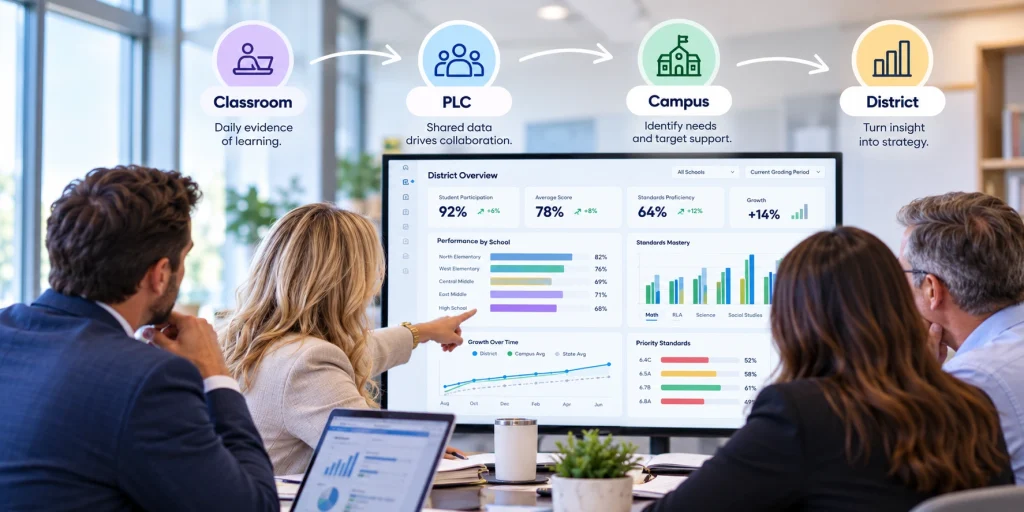
The Vision: Connect the System Around Student Learning
District leaders have access to more student data than ever.
The challenge isn’t simply collecting more of it. It’s creating a coherent system in which curriculum, instruction, assessment, professional learning, and leadership work together around a shared understanding of student learning.
That’s the promise of instructionally supportive systems.
Through-year assessments can provide important checkpoints across the school year. Classroom evidence provides a much closer view of learning as it happens. School and district leaders need ways to connect those different sources of information without asking every assessment to serve the same purpose.
Strong assessment systems create coherence among curriculum, instruction, assessment, and the decisions educators make at every level.
Step One: Start With Purpose, Not Data
Before adding another assessment, dashboard, or report, districts should ask:
What decision are we trying to make—and what evidence would actually help us make it?
Teachers may need evidence to determine whether students understood today’s lesson.
PLCs may need evidence to identify patterns across classrooms.
Principals may need to understand where instructional support is needed.
Curriculum leaders may need to know whether students are struggling with particular standards or shared resources.
District leaders may need a broader view of progress across schools and student groups.
Instructionally supportive systems recognize that these are different questions requiring different kinds of evidence.
Step Two: Build From the Classroom Up
The most immediate evidence of student learning comes from the work students are doing every day.
Checks for understanding, assignments, written responses, practice activities, quizzes, and other classroom work can reveal misconceptions while there is still time to respond.
For that evidence to become useful beyond an individual classroom, districts need some common structure around:
- Standards
- Curriculum
- Shared instructional resources
- Assessment practices
- Reporting
The goal isn’t to standardize every instructional decision.
It’s to create enough coherence that classroom evidence can contribute to a larger understanding of student learning.
Step Three: Connect Evidence Across the System
A district doesn’t need every assessment to do the same job.
Classroom formative practices can support immediate teaching and learning. Common or interim assessments can help educators examine performance across classrooms, standards, or periods of instruction. State and through-year assessments can provide broader progress-monitoring and accountability information.
The value comes from understanding what each source can—and cannot—tell you.
Strong assessment systems are built around coherence, comprehensiveness, continuity, efficiency, and utility—not simply a prescribed mix of tests.
A district-level system should help educators connect these different perspectives without confusing a monitoring tool with an instructional one.
Step Four: Give PLCs Evidence They Can Act On
Data becomes more valuable when educators can examine it together.
PLCs can use shared classroom evidence to ask:
Where are students struggling?
Are we seeing the same misconception across classrooms?
Which instructional approaches appear to be working?
What should we reteach or approach differently?
What evidence should we collect next?
Curriculum teams can look across those patterns to determine whether shared resources, pacing, or instructional supports may need attention.
This creates an important connection:
Student Work → Teacher Response → PLC Learning → Curriculum Response
Step Five: Give School Leaders Instructional Visibility
Principals and instructional leaders need more than another dashboard.
They need information that helps them understand where support may be needed.
When evidence is connected across classrooms and standards, leaders can begin asking more useful questions:
Where are teachers seeing similar learning gaps?
Which standards are consistently challenging?
Are there differences among classrooms or grade levels worth investigating?
Where might coaching, collaborative planning, or additional resources help?
The goal isn’t using data to evaluate every instructional move.
It’s using evidence to make leadership support more informed and more targeted.
Step Six: Connect Student Learning to Professional Learning
Professional development shouldn’t operate separately from evidence about student learning.
When recurring patterns emerge across classrooms, schools, or standards, leaders can use that information to help identify areas where teachers may benefit from additional resources, collaborative planning, or coaching.
That creates another feedback loop:
Student Evidence → Instructional Pattern → Leadership Insight → Teacher Support → New Evidence
Professional learning becomes more responsive to what is actually happening in classrooms.
Step Seven: Build the Infrastructure That Makes It Possible
A coherent instructional system requires more than assessments.
Districts need structures that connect:
Curriculum → Classroom Work → Student Evidence → PLCs → School Leadership → District Strategy
That includes shared curriculum and resources, standards alignment, assessment practices, reporting structures, professional learning, technology, and clear expectations for how information will—and will not—be used.
Technology can help connect those pieces, but technology alone doesn’t create coherence.
The system does.
From Classroom Evidence to Districtwide Instructional Intelligence
This is where Classwork can help.
Classwork is a district instructional platform that connects curriculum, classroom work, assessment, and reporting in one system.
District curriculum teams can create, organize, publish, and manage shared instructional resources and assessments. Teachers can create new activities or convert materials they already use—including PDFs, documents, and slides—into interactive student work. Student responses can be automatically scored or teacher-reviewed, aligned to standards, and incorporated into reporting.
As students complete that work, the resulting evidence can become visible beyond the individual assignment or classroom.
Teachers can understand their students. PLCs can examine common evidence. Curriculum teams can identify patterns connected to standards and shared resources. School and district leaders can gain broader visibility across classrooms, campuses, and student groups.
Instead of classroom data disappearing into disconnected tools, the system creates a connected flow:
Curriculum → Instruction → Student Evidence → Insight → Action
That’s the difference between simply collecting data and building districtwide instructional intelligence.
The Bottom Line
Instructionally supportive systems aren’t built by adding another assessment or dashboard.
They’re built by connecting the work already happening across a district.
Classroom evidence informs teaching. Shared evidence strengthens PLC conversations. Patterns help curriculum teams evaluate resources. School leaders can target support. District leaders gain a broader view of what students are learning and where the system may need attention.
Through-year assessments provide important checkpoints.
A coherent instructional system helps leaders see—and support—more of what happens between them.
Connect Classroom Evidence to District Strategy
See how Classwork gives teachers, PLCs, curriculum teams, and district leaders a more connected view of student learning—helping turn everyday classroom evidence into actionable instructional insight.
References
- Texas Education Agency. (2023). Effective Schools Framework.
- RAND Corporation. (2023). Coherent Instructional Systems.
- Center for Assessment. (2019). How to Plan for a Balanced Assessment System While Keeping Curriculum in Mind.
- Center for Assessment. (2025). Improving Balance in Assessment Systems: Let’s Learn Together.
Center for Assessment. (2026). Clarifying What Makes Assessment Instructionally Useful.
This article is part of the Classwork.com Through-Year Assessment Series.
Quick Summary & Common Questions
What are instructionally supportive systems?
Instructionally supportive systems connect curriculum, classroom evidence, assessment, reporting, professional learning, and leadership so educators at different levels can use appropriate evidence to support student learning.
How can districts build instructionally supportive systems?
Districts can begin by defining the decisions educators need to make, identifying the evidence appropriate for those decisions, and creating coherence among curriculum, instruction, assessment, reporting, and professional learning. The goal is not simply more data, but a clearer path from evidence to action.
How do instructionally supportive systems help principals and school leaders?
Connected evidence can help school leaders identify patterns across classrooms, standards, and grade levels. That visibility can inform conversations about instructional support, collaborative planning, coaching, resources, and professional learning.
What role do PLCs play in an instructionally supportive system?
PLCs help turn individual classroom evidence into collective learning. Teams can examine shared student work and assessment evidence, identify common misconceptions, compare instructional approaches, determine next steps, and then collect new evidence to see whether those responses helped.
Does every assessment need to provide immediate instructional information?
No. Different assessments serve different purposes. Classroom formative practices can directly support teaching and learning, while interim, through-year, and summative assessments may provide broader monitoring or evaluation information. A coherent system makes those purposes clear rather than expecting every assessment to do everything.
How does Classwork support instructionally supportive systems?
Classwork connects curriculum authoring and shared district resources with classroom activities, student evidence, standards alignment, assessment, and reporting. That gives teachers useful classroom information while helping PLCs, curriculum teams, school leaders, and district leaders see broader patterns across the instructional system.