
The Gen Z Cognitive Decline: A Leadership Blueprint for the Brain Rot Epidemic
Executive Summary: The Institutional Stake
A landmark 2025 Yale School of Medicine study has sounded a global alarm: self-reported cognitive disability among young adults (ages 18–34) has nearly doubled in a decade, rising from 5.1% to 9.7%. For school administrators, this isn’t just a health statistic—it’s an institutional crisis. This article explores the Gen Z cognitive decline in schools, the failed “beta test” of indiscriminate classroom digitization, and how leaders can reclaim student focus through “Cognition-First” strategies.
The Data Behind the Gen Z Cognitive Decline in Schools
The data is in. It isn’t pretty. We aren’t just talking about “brain rot” memes anymore. We are talking about a fundamental shift in human biology.
Associate professor of neurology Adam de Havenon of the Yale School of Medicine reported a doubling of cognitive issues in U.S. adults. While the overall increase was modest, the 18-to-34 cohort drove the majority of the surge.
If you lead a district, oversee a campus, or design a curriculum, those numbers should keep you up at night. This isn’t just a “kids these days” problem. It’s a direct threat to the mission of every educational institution in the country.
At Classwork.com, we’ve watched the shift from “digital natives” to “digital victims.” It’s time for a serious conversation about what happens when the next generation of leadership feels like their brains are “short-circuiting” before they even hit thirty.
Is the "Brain Rot Epidemic" a Clinical Reality?
Critics often argue that “brain rot” is a subjective social media exaggeration. They point out that the Yale study relies on “self-reporting” rather than structural brain scans.
But for a Superintendent or Principal, subjective report is objective reality. When 1 in 10 young adults says they have serious difficulty concentrating, remembering, or making decisions, the impact on your district is immediate:
- The Productivity Gap: Students require more time to complete simpler tasks.
- The Resilience Gap: Cognitive fatigue leads to higher rates of emotional dysregulation and classroom disruption.
- The Achievement Gap: If the internal “hardware” (the brain) can’t hold a thought, the “software” (the curriculum) cannot run.
Whether the brain is physically changing or just over-stimulated to the point of paralysis, the result is the same: a student body that is physically present but cognitively “offline.”
The Great Classroom Beta Test: Why Digitization Failed
How did we get here? Neuroscientist Jared Cooney Horvath recently testified before the U.S. Senate that cognitive development in children across the developed world has stalled—and in many areas, reversed.
He didn’t blame the students. He blamed the policy.
For twenty years, the American education system has been a massive laboratory for digital adoption.
- We incentivized large-scale digital adoption without demanding independent evidence of efficacy.
- We assumed “access to information” was the same as “attaining knowledge.”
- We prioritized “engagement” (screen time) over “cognition” (deep work).
The result? Gen Z is the first generation to score lower on standardized tests than the ones before them. We traded deep literacy for rapid-fire scrolling. We traded long-term memory for a search bar. We are now seeing the fallout of an unvetted, twenty-year experiment in classroom digitization.
Addressing the $1.3 Trillion Economic Threat
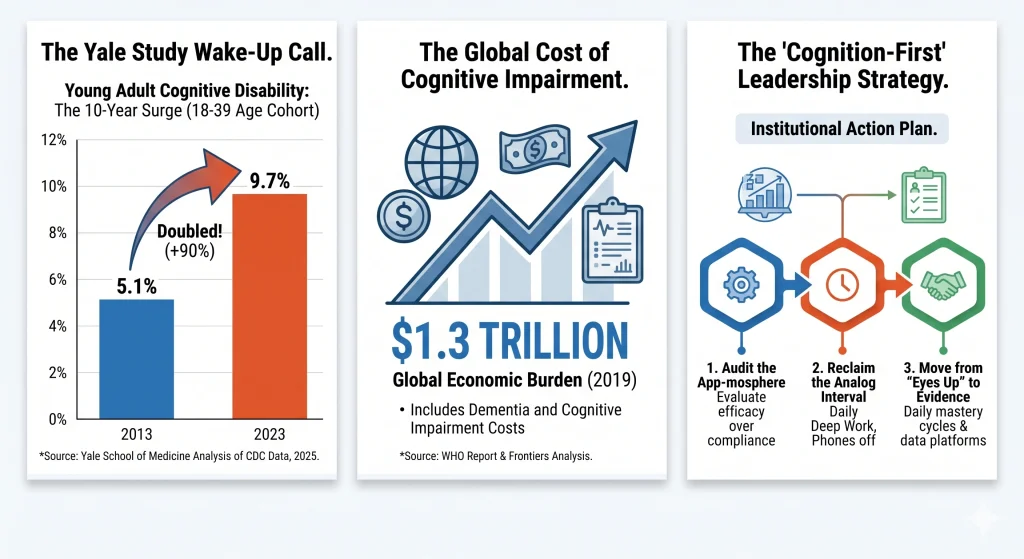
This isn’t just about grades; it’s about the global economy. A study published by the World Health Organization notes that dementia and cognitive impairment cost the global economy $1.3 trillion in 2019.
As an administrator, you are the front line of the workforce pipeline. If our graduates enter the workforce with the cognitive clarity of someone ten years their senior, the economic impact is catastrophic.
Innovation requires the ability to connect disparate ideas over long periods of time. You can’t do that if your brain is “rotting” from twelve hours of algorithmic stimulation per day.
The "Dumb Phone" Cure: Why Less is More
There is a silver lining. The damage may not be permanent, but the “cure” requires a massive pivot in administrative strategy.
A study tracking adults using a digital-blocking app showed that reducing screen time to under three hours a day saw gains in sustained attention equivalent to reversing a decade of age-related cognitive decline.
The Leadership Reality Check: The devices in our students’ hands are effectively aging their brains by at least 10 years. As leaders, we have spent billions to put these devices in their hands. Now, we must spend our leadership capital to create boundaries around them.
Tactical Implementation: While administrators set the vision for cognitive health, your teachers are on the front lines of the “battle for attention.” For a blueprint on how to handle the classroom transition, read our guide: [School Cellphone Bans Reclaim Attention. Now What?.]
Reclaiming the Mission: A "Cognition-First" Leadership Strategy
You cannot wait for federal policy to catch up. You cannot wait for Big Tech to self-regulate. Thought leadership for school admins requires a “Cognition-First” approach.
1. Audit the “App-mosphere”
More tech is not better tech. Most EdTech tools focus on “compliance” (finishing a task) rather than “cognition” (learning a concept).
- The Shift: Audit your district’s software stack. If a tool doesn’t have proven efficacy in building sustained attention, it is likely a distraction.
2. Reclaim the “Analog Interval”
We need to bake “Deep Work” into the institutional schedule.
- The Shift: Implement daily “Analog Hours” where the internet is off and phones are docked. This isn’t a punishment; it is Cognitive Physical Therapy. It trains the focus muscle that has been allowed to atrophy.
3. Move from “Eyes Up” to “Evidence of Learning”
A phone-free classroom is just an empty room if it isn’t filled with instruction. Administrators must provide teachers with tools that capture instructional data instantly.
The Shift: Don’t wait for state tests to see if your “Cognition-First” policy is working. Use Instructional Intelligence Platforms to see daily mastery.
The "Implementation Tax" and Parent Buy-In
Every administrator knows that a shift away from technology faces pushback. We call this the “Implementation Tax.”
Parents have been told for years that “tech-savviness” is the key to the future. You must re-educate your community. Move the conversation from “taking devices away” to “giving focus back.”
When you use instructional intelligence to show parents that their child is completing more mastery cycles in a phone-free room, the pushback disappears. It turns a “ban” into a “benefit.”
Conclusion: The Future of Learning is Focused
The Yale study is a warning shot. Our students are telling us they are struggling. They are reporting “difficulty making decisions” in a world that forces them to make a thousand micro-decisions a minute.
The future of education isn’t about who has the best AI. It’s about who still has the capacity to think for themselves.
At Classwork.com, we are building tools that respect the human brain. We don’t want to throw the laptops out the window—we want to shut the tabs that are closing our students’ minds. It’s time to move past the brain rot epidemic and back into the era of deep, meaningful learning.
Q: Is “Brain Rot” a medical diagnosis?
A: Not yet. The Yale cognitive study 2025 tracks “subjective cognitive disability.” However, the doubling of these reports suggests a massive decline in functional concentration that mirrors early-stage impairment.
Q: How do we handle the “Implementation Tax” during the first year of a ban?
A: Transparency is the best tool. Show the community the data on how much instructional time was lost to phones versus how much is now spent on active learning.
Q: Should we ban all screens in schools?
A: No. The goal is “alignment,” not “rejection.” The focus should be on removing indiscriminate classroom digitization and replacing it with tools that have proven efficacy for deep learning.
Q: How does this crisis affect teacher retention?
A: Significantly. Teachers are currently exhausted by the “battle for attention.” By prioritizing cognitive health at the leadership level, you reduce the behavioral management load on your staff, leading to higher retention.
Sources & References
- Yale News: A growing number of U.S. adults report cognitive disability (Sept 24, 2025).
- Fast Company: Gen Z reports early cognitive decline: The brain rot epidemic.
- World Health Organization (WHO): World failing to address dementia challenge.
- Internal Research: School Cellphone Bans Reclaim Attention. Now What?