
Instructionally Supportive Teaching Strategies
for Through-Year Assessment
Originally published November 2025 · Updated September 2026
Why Instructionally Supportive Teaching Matters
Through-year assessments provide important checkpoints across the school year. But the assessments themselves don’t create student growth. What educators do with evidence between those checkpoints matters.
That’s where instructionally supportive teaching strategies come in.
Rather than waiting for the next benchmark or progress-monitoring window, teachers can use evidence from everyday classroom work to identify misconceptions, provide feedback, adjust instruction, and determine what students need next.
Recent research continues to support the value of formative assessment. A 2024 meta-analysis examining 118 K–12 studies found a positive overall effect on student achievement across subjects and different types of formative assessment.
From Data-Driven Instruction to Instructionally Supportive Teaching
Data-driven instruction helped establish an important principle: student evidence should inform what educators do next.
But access to data alone doesn’t guarantee better instruction.
A large federal study of data-driven instruction found that providing schools with additional data coaching and professional development did not, by itself, significantly change teachers’ data use, instructional practices, or student achievement. The researchers suggested that educators may need greater support translating data into appropriate instructional strategies. Institute of Education Sciences
That’s an important distinction.
The goal isn’t simply to give teachers more data.
It’s to make evidence timely, understandable, and connected to actions teachers can take.
5 Instructionally Supportive Teaching Strategies
1. Use Frequent Checks for Understanding
Don’t wait for a major assessment to discover what students understand.
Exit tickets, short activities, written responses, practice questions, and other formative checks can provide evidence during the learning process.
The purpose isn’t more testing. It’s more visibility into learning.
2. Give Feedback Students Can Use
Useful feedback does more than tell students whether an answer is correct.
It helps students understand where they are, what needs improvement, and what they can do next.
Technology can make some feedback immediate, while teachers remain essential for interpreting student thinking and providing meaningful guidance—particularly with complex or open-ended work.
3. Reteach Based on Evidence
When classroom evidence reveals a misconception, teachers can respond before it becomes a larger learning gap.
That may mean:
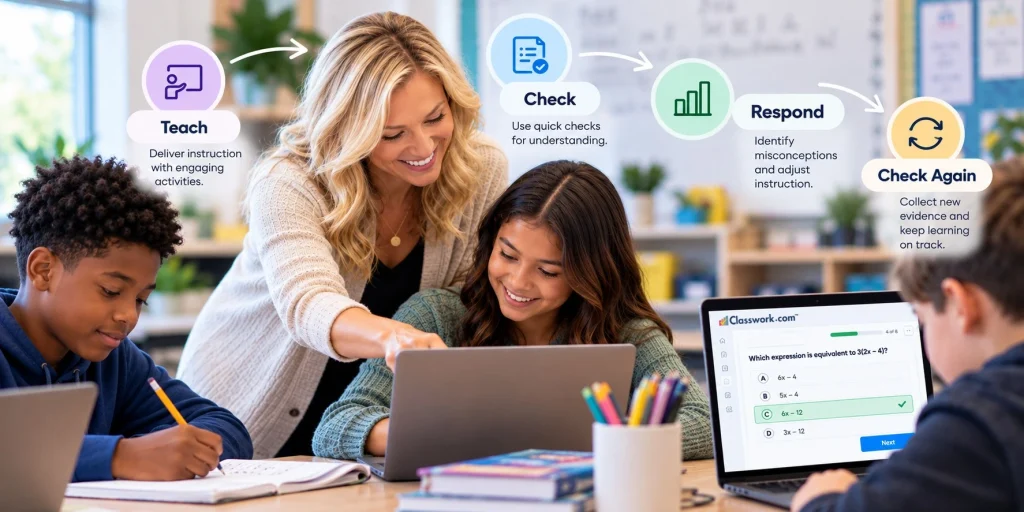
Evidence → Identify Misconception → Reteach → Check Again
This is where timely classroom evidence becomes especially valuable. Teachers don’t have to wait until the next formal assessment window to determine whether students need additional support.
4. Use Common Evidence in PLCs
Shared assessments and classroom activities can give PLCs something concrete to examine together.
Instead of asking only, “How did my class do?”, teams can ask:
Where are students struggling across classrooms?
Which standards need additional attention?
What instructional approaches appear to be working?
What should we try next?
Data use becomes more powerful when it supports collaborative instructional decision-making rather than simply reporting results.
5. Adjust Instruction—and Check Again
The instructional cycle shouldn’t end when teachers review the data.
Teachers can use evidence to adjust pacing, regroup students, provide additional practice, offer enrichment, or approach a concept differently.
Then they collect new evidence.
Teach → Check → Respond → Check Again
That’s what turns assessment from an event into part of the learning process.
Through-Year Assessment Needs the Learning Between the Checkpoints
Through-year assessment can provide a broader picture of student progress across the year.
But BOY, MOY, EOY—or any other formal assessment windows—still represent specific moments in time.
Students are learning every day between them.
Everyday classroom evidence helps fill those spaces, giving educators additional opportunities to understand student thinking and respond while instruction is underway.
Making Instructionally Supportive Teaching Practical
This is where technology can help.
Classwork is a district instructional platform that connects curriculum, classroom work, assessment, and reporting in one system.
Teachers can create new activities or convert materials they already use—including PDFs, documents, and slides—into interactive student work. Student responses can be automatically scored or teacher-reviewed, aligned to standards, and incorporated into reporting.
At the district level, curriculum teams can create, organize, publish, and manage shared instructional resources and assessments, helping schools work from common expectations while still giving teachers the flexibility to respond to their students.
That creates a connected flow:
Curriculum → Classroom Work → Student Evidence → Insight → Instructional Response
Teachers can see what’s happening with their students. PLCs can examine common evidence. Curriculum teams can connect shared resources with student performance. School and district leaders can identify broader patterns across classrooms, standards, and campuses.
The technology isn’t making the instructional decision.
It’s connecting the work of teaching and learning with evidence educators can use to decide what happens next.
The Bottom Line
Through-year assessments can show how student performance changes across important points in the school year.
Instructionally supportive teaching strategies help educators influence what happens between those points.
Frequent checks for understanding, useful feedback, evidence-based reteaching, collaborative analysis, and continuous adjustment turn student data into something more valuable than a report.
They turn it into part of teaching and learning.
Formal assessments provide the checkpoints. Everyday evidence helps educators decide what to do next.
Turn Student Evidence Into the Next Instructional Step
See how Classwork helps teachers capture everyday evidence of learning, identify patterns in student understanding, and respond with timely instructional support.
References
- Bambrick-Santoyo, P. (2010). Driven by Data: A Practical Guide to Improve Instruction. Jossey-Bass.
- Yao, Y., Amos, M., Snider, K., & Brown, T. (2024). The Impact of Formative Assessment on K–12 Learning: A Meta-Analysis. Educational Research and Evaluation, 29(7–8), 452–475. View the study Taylor & Francis Online
Institute of Education Sciences, U.S. Department of Education. (2019). Evaluation of Support for Using Student Data to Inform Teachers’ Instruction.
View the IES report
This article is part of the Classwork.com Through-Year Assessment Series.
What are instructionally supportive teaching strategies?
Instructionally supportive teaching strategies use evidence from student learning to help educators decide what to do next. Examples include frequent checks for understanding, useful feedback, targeted reteaching, collaborative analysis, and adjusting instruction based on student needs.
How do instructionally supportive teaching strategies support through-year assessment?
Through-year assessments provide checkpoints across the school year, while instructionally supportive strategies help teachers respond to learning between those checkpoints. Everyday classroom evidence can reveal misconceptions and progress while there is still time to adjust instruction.
Is data-driven instruction the same as instructionally supportive teaching?
They share an important principle: student evidence should inform instructional decisions. Instructionally supportive teaching places additional emphasis on connecting that evidence directly to actions such as feedback, reteaching, regrouping, additional practice, and checking for understanding again.
Why is formative assessment important?
Formative assessment gives teachers and students information about learning while instruction is underway. A 2024 meta-analysis of 118 K–12 studies found an overall positive effect of formative assessment on student achievement, although effects varied across studies and contexts.
How does Classwork support instructionally supportive teaching?
Classwork helps teachers turn everyday instructional materials into interactive student work, collect automatically scored and teacher-reviewed responses, align activities to standards, and use reporting to identify patterns in student understanding. This shortens the path between classroom evidence and instructional action.
Does technology make instructional decisions for teachers?
No. Technology can help collect, organize, score, and surface evidence more quickly, but educators determine what that evidence means in context and how instruction should respond.