STAAR uses multiple choice plus 14 newer question types, such as hot text, inline choice, drag and drop, graphing and constructed responses, and nearly all students take it online. Students do best when they practice each type during regular instruction, not just in the weeks before testing.
This guide explains each question type, shows how to practice it in Classwork, and covers what changes when STAAR becomes the Student Success Tool (SST) in 2027–28. The 2026–27 school year is the last year of STAAR testing.
Reviewed by the Classwork Curriculum and Assessment Team. Last reviewed: November 2026.
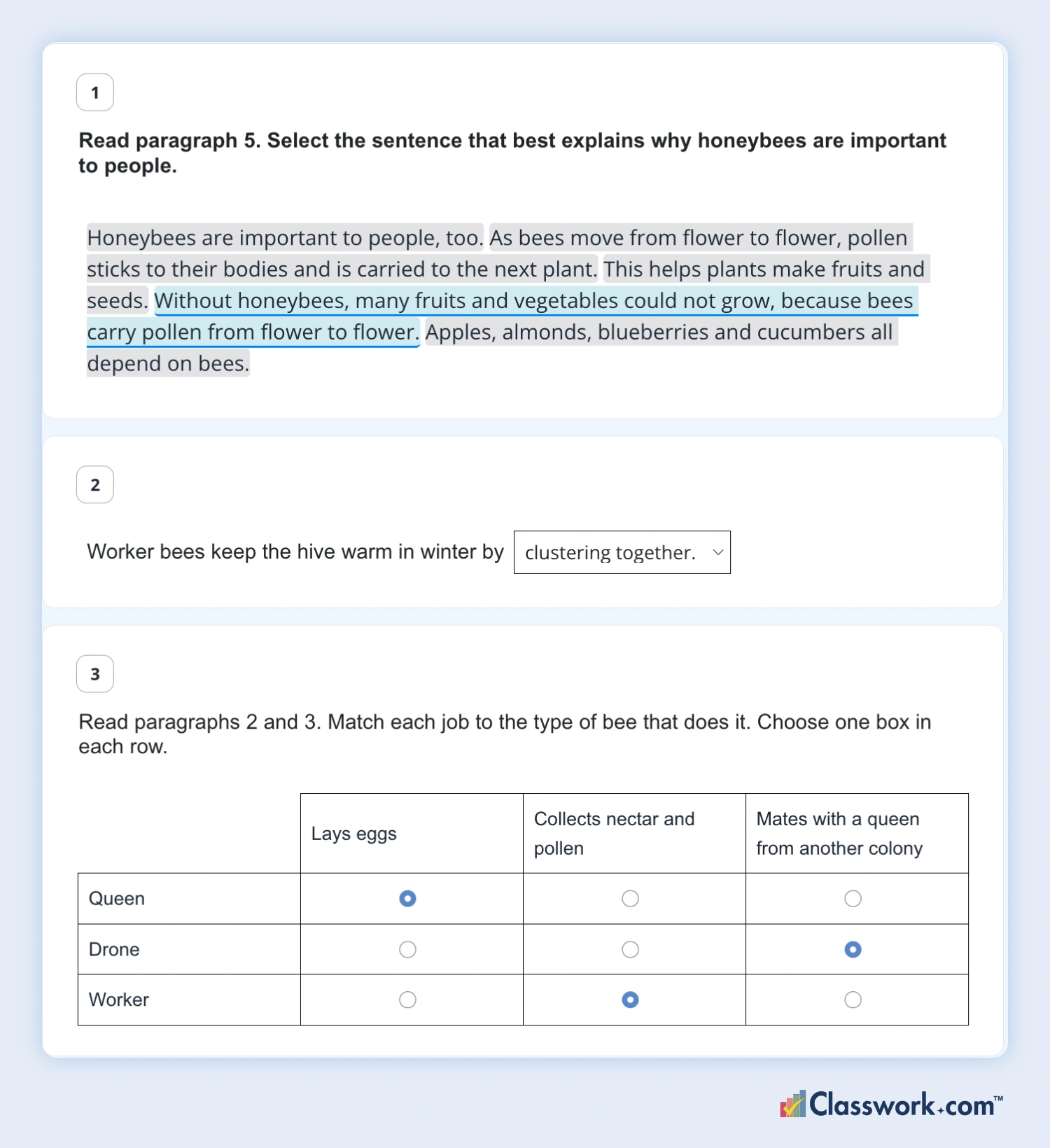
The STAAR redesign came from House Bill 3906, passed in 2019. It took full effect in the 2022–23 school year and brought three big changes:
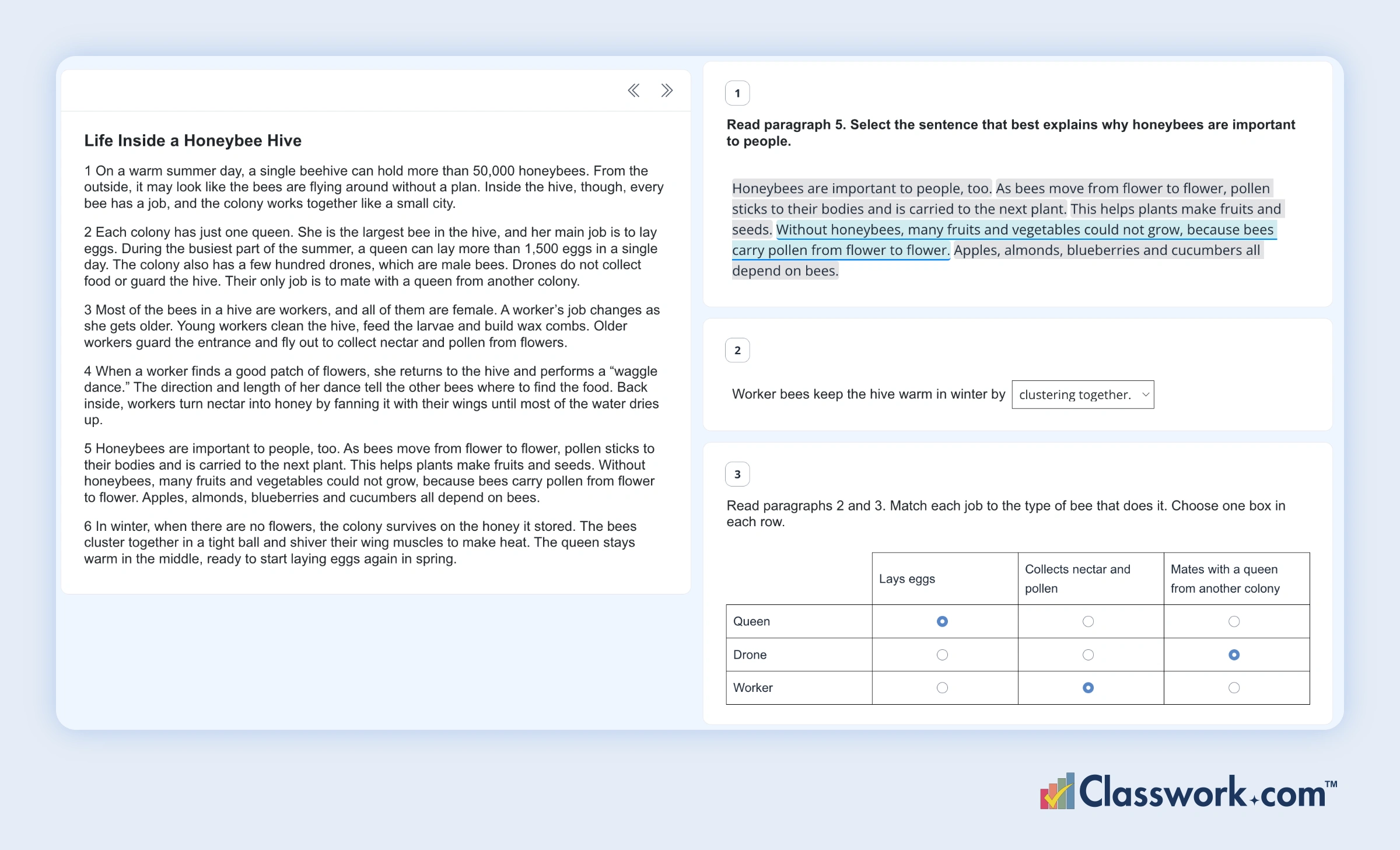
TEA added these question types so students can show what they know in more ways than multiple choice. Which ones appear depends on the grade and subject; TEA’s question types by grade and content chart lists them. Each one can be practiced in Classwork with the matching tool below.
| STAAR question type | What students do | Practice it in Classwork |
|---|---|---|
| Multiselect | Choose more than one correct answer. | Multi-Select |
| Inline choice | Pick an answer from a drop-down menu inside a sentence or passage. | Dropdown |
| Hot text | Select the words, phrases or sentences in a passage that answer the question. | Hot Text |
| Hot spot | Select an area of an image, graph, map or diagram. | Hot Spot |
| Drag and drop | Move words, numbers or images into the correct place. | Drag and Drop, plus inline drag and drop in the Flex Editor |
| Match table grid | Check boxes in a table to match each item to a category. | Match Table Grid |
| Text entry | Type a word, number or short phrase. | Short Answer |
| Equation editor | Build a numeric or algebraic answer with math symbols. | Math and algebra expression input |
| Graphing | Plot points, lines or bars on a graph. | Graphing tools |
| Number line | Place a point or value on a number line. | Number Line |
| Fraction model | Shade parts of a model to show a fraction. | Fraction tools |
| Multipart | Answer related questions, usually a Part A and a Part B. | Part A/Part B in the Flex Editor |
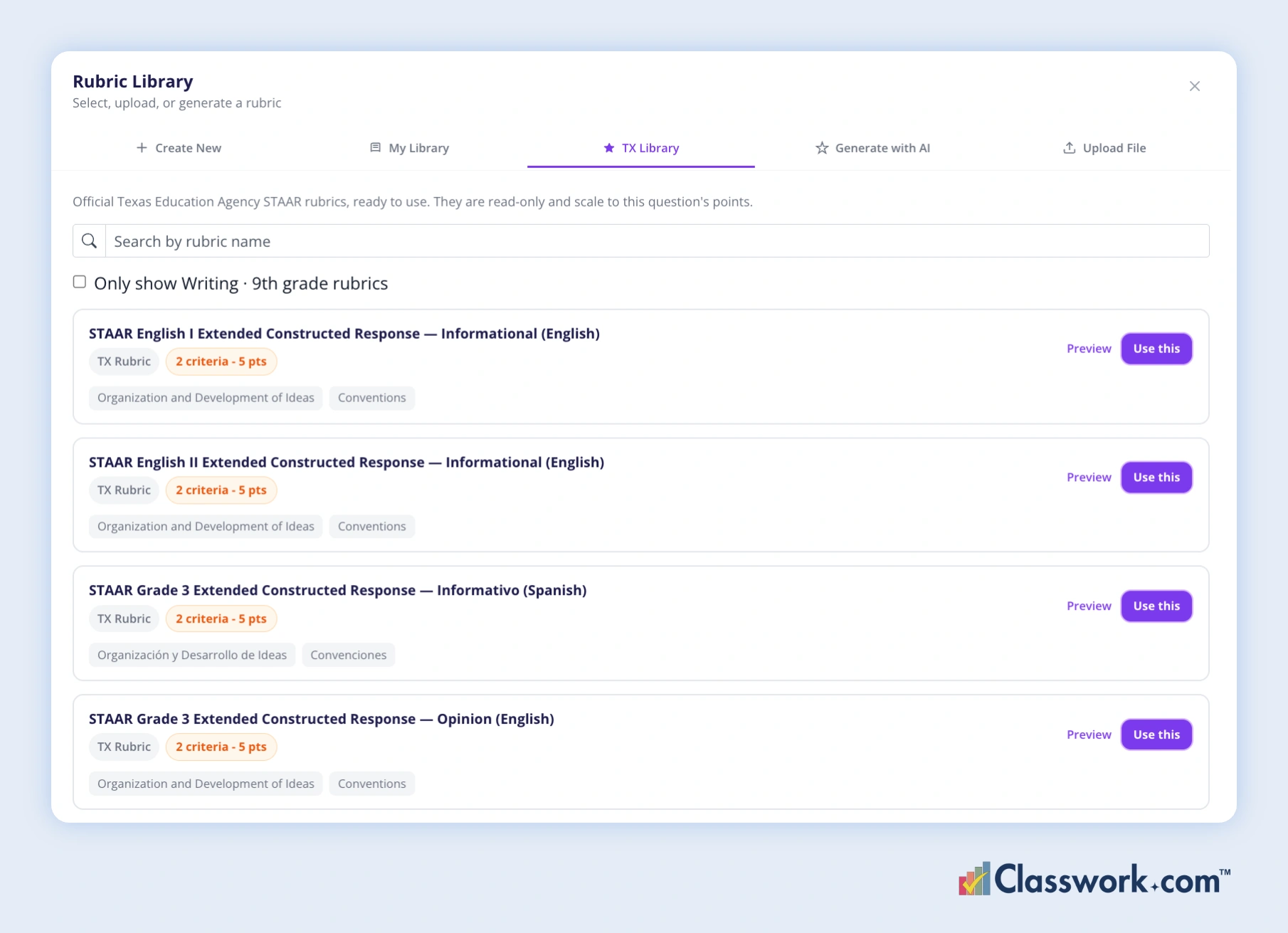
| Short constructed response | Write a brief answer, usually a few sentences, using evidence. | Open response with AI Scoring |
| Extended constructed response | Write a longer response, such as an essay, scored with a rubric. | Open response with AI Scoring using official STAAR rubrics |
Under House Bill 8, passed in 2025, Texas will replace STAAR with a through-year assessment starting in the 2027–28 school year. TEA calls it the Student Success Tool (SST). Instead of one test at the end of the year, students take three shorter tests:
According to TEA’s HB 8 FAQ, SST tests will use multiple choice, multiple select, inline choice and multipart items, and the RLA end-of-year test adds one extended constructed response. That is a narrower set than today’s STAAR, so those four item types and written responses deserve the most practice. TEA has posted SST blueprints and is still releasing details, so check its House Bill 8 page for updates.
For what this means for districts, read Texas HB 8 Benchmark Testing Limits: What Changes in 2027–28 and Texas SST Accountability.
Practice works best in small doses during regular lessons. Students get comfortable with each tool, and teachers see who needs reteaching long before a test window.
Classwork.com is not sponsored by, affiliated with, endorsed by, or approved by the Texas Education Agency (TEA). STAAR® is a registered trademark of TEA.
Teachers can try Classwork free for 30 days and build practice in every question type above. Texas districts can book a demo to see Texas Edition, Readiness Checks and the Bluebonnet Learning item banks.
STAAR includes 14 newer question types alongside multiple choice: multiselect, inline choice, hot text, hot spot, drag and drop, match table grid, text entry, equation editor, graphing, number line, fraction model, multipart, short constructed response and extended constructed response. Which ones appear depends on the grade and subject.
Under House Bill 3906, no more than 75% of the points on a STAAR test can come from multiple-choice questions. The rest come from the newer question types, including constructed responses on RLA tests.
Yes. Under House Bill 8, Texas replaces STAAR with a new through-year assessment, which TEA calls the Student Success Tool (SST), starting in the 2027–28 school year. The 2026–27 school year is the last year of STAAR testing.
Not all of them. TEA’s HB 8 FAQ says SST tests will use multiple choice, multiple select, inline choice and multipart items, and the RLA end-of-year test will include one extended constructed response. TEA is still releasing details, so check its House Bill 8 page for updates.
SST has three windows: beginning of year, between the fourth Monday in August and September 30; middle of year, between January 2 and February 21; and end of year, between May 1 and May 30, with the RLA writing component in April.
TEA posts current STAAR blueprints and released tests on its STAAR Resources page. SST blueprints are on TEA’s House Bill 8 Student Assessment page.
Yes. In Classwork, AI Scoring can score students’ extended constructed responses with official TEA STAAR rubrics, in English and Spanish, on organization and development of ideas and on conventions. Teachers review and can adjust every score before it counts.
Build short practice into regular lessons with the same interactions students see on the test. In Classwork, teachers can create hot text, inline choice, drag and drop, match table grid, multipart and math items, and use AI Scoring for constructed responses.
