
The Future of Through-Year Assessment:
Research, AI, and Real-Time Learning Data
Originally published November 2025 · Updated September 2026
Assessment Is Becoming a Year-Round Conversation
Through-year assessment is changing when schools receive information about student learning. But even three assessment windows are still only points in time.
Students are learning—and showing what they understand—every day in between.
The next evolution of assessment isn’t simply testing more frequently. It’s connecting formal assessment checkpoints with the evidence already being generated through everyday instruction, so teachers and leaders have useful information while there’s still time to respond.

What Happens Between Assessment Windows Matters
Through-year systems can give educators more timely checkpoints than a single end-of-year assessment.
But instruction doesn’t happen three times a year.
Every assignment, check for understanding, open response, exit ticket, and standards-aligned activity can provide evidence of what students know and where they may need support.
The opportunity for districts is to make that everyday evidence visible and useful—without adding another layer of testing.
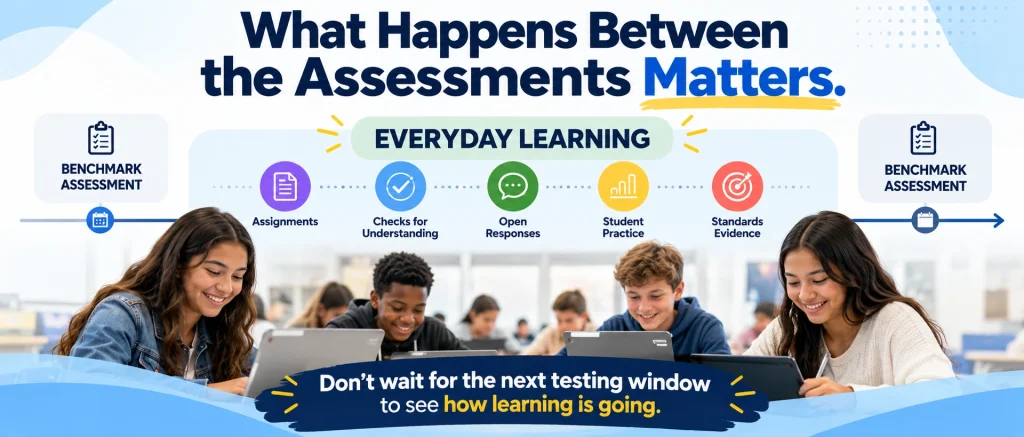
This is where district instructional systems can play an increasingly important role. When everyday classroom work is standards-aligned, digitally captured, and visible beyond an individual classroom, districts gain another layer of instructional evidence between formal assessment windows.
Classwork helps make that possible by turning everyday assignments and student responses into standards-aligned evidence that teachers, campus leaders, and district teams can use to better understand what is happening across classrooms
What’s Happening Across the Country
States across the country are rethinking how assessment can provide useful information throughout the school year—not only at the end of it. The approaches vary, but the broader movement is toward assessment systems that provide more timely information about student progress while maintaining statewide measures of achievement and accountability.
- Florida continues to use the Florida Assessment of Student Thinking (FAST), a statewide progress-monitoring system that measures student performance at multiple points during the school year. Florida’s 2026 reporting includes comparisons from Progress Monitoring 1 (PM1) through Progress Monitoring 3 (PM3), giving schools and districts information about performance and progress across the year. Florida Department of Education
- Texas is preparing for a significant change beginning in the 2027–28 school year. House Bill 8 replaces STAAR with the new Student Success Tool (SST), an instructionally supportive assessment program that includes beginning-, middle-, and end-of-year administrations. Texas’s earlier Through-year Assessment Pilot (TTAP) is currently paused until spring 2029 as the state moves forward with the SST transition. Texas Education Agency
- Other states continue to explore innovative assessment models through the federal Innovative Assessment Demonstration Authority (IADA). The program allows states to develop and evaluate innovative assessment systems intended eventually to meet federal statewide assessment and accountability requirements. Earlier participants have included North Carolina, Georgia, Massachusetts, New Hampshire, and others; more recently, Missouri received approval in 2025 and Kansas received approval in July 2026. U.S. Department of Education
These efforts don’t all follow the same model, and through-year assessment is still evolving. But they reflect a broader question facing states and districts: How can assessment provide information that is useful for instruction while learning is still happening?
For districts, that question extends beyond state testing. Even a beginning-, middle-, and end-of-year assessment system leaves weeks or months between formal checkpoints. During that time, students are continuously generating evidence through assignments, open responses, checks for understanding, and standards-aligned classroom work.
That is where district instructional systems become increasingly important. Platforms like Classwork can help districts connect everyday instructional evidence with a broader view of student learning—giving teachers timely information for instruction while helping campus and district leaders see patterns across classrooms, schools, and standards.
The opportunity isn’t simply to assess students more often. It’s to create a more connected picture of learning throughout the year, using formal assessment checkpoints alongside the evidence students are already producing every day.
What the Future Holds
AI-Enhanced Item Development
AI can accelerate the creation of standards-aligned assessment items, helping educators spend less time building and more time reviewing, refining, and validating quality.
Instructional Data Integration
The bigger opportunity is connecting formal assessment checkpoints with evidence from everyday instruction. District platforms like Classwork can help bring standards-aligned classroom evidence together across teachers, schools, and grade levels—giving instructional leaders a more continuous view of learning between assessment windows.
Dynamic Professional Learning
As instructional evidence becomes more timely, professional learning can become more responsive too—helping leaders identify patterns, focus coaching, and support teachers based on what is actually happening in classrooms. When leaders can see patterns across classrooms and standards, professional learning can be connected more closely to the instructional needs emerging across the district.
More Timely Growth Insights
More frequent evidence can help districts identify emerging patterns earlier, giving educators opportunities to respond before smaller learning gaps become larger ones.
Research Implications
Research and policy discussions increasingly point toward assessment and accountability systems that do more than measure and report performance. The Center for Assessment’s 2026 Reclaiming Accountability paper argues for accountability systems that extend beyond identification and measurement to support learning and continuous improvement. Center for Assessment
Through-year assessment is one part of that conversation. The Center for Assessment’s research on through-year assessment notes both its potential benefits and its significant design challenges—including how assessment systems relate to curriculum and instruction. Federal research on innovative state assessment systems has similarly examined the goal of making statewide assessment information more useful for classroom teaching while still meeting accountability requirements. Center for Assessment
But formal assessment alone cannot capture everything that happens during instruction. Districts also need ways to make the evidence students generate throughout the school year visible and useful.
That makes the connection between assessment, everyday instruction, and district-level visibility increasingly important.
From Everyday Classwork to Districtwide Instructional Intelligence
Through-year assessments can provide important checkpoints. Classwork helps districts understand more of what happens between them.
Teachers are already generating valuable evidence through assignments, checks for understanding, open-ended responses, standards-aligned activities, and everyday practice. Classwork turns that work into useful instructional evidence that can be used beyond a single assignment or classroom.
Teachers can create new activities or transform the materials they already use into interactive, standards-aligned Classwork. As students respond, Classwork captures evidence through auto-graded questions, open-ended responses, AI-assisted scoring, and standards-aligned activities—giving teachers timely information they can use to adjust instruction.
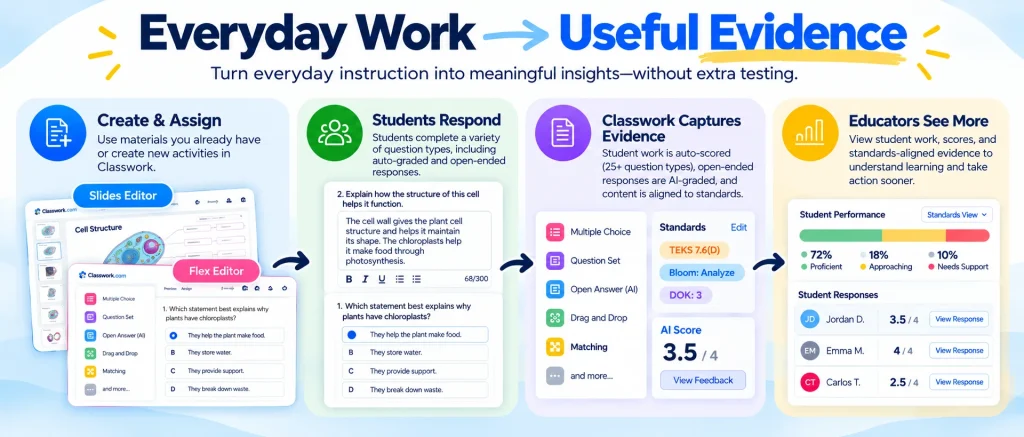
At the district level, that creates something especially valuable: visibility.
Classwork gives instructional leaders a clearer view of learning across classrooms, schools, teachers, and standards. District and campus leaders can use reporting and AI-powered insights to identify patterns, explore strengths and areas that may need attention, and better understand what is happening while there is still time to respond.
Classwork also connects the instructional side of the equation. District curriculum teams can create, organize, review, publish, and manage shared instructional resources across the district—helping create greater consistency between what is taught, what students are asked to demonstrate, and the evidence leaders can see.
Automatic standards alignment and reporting help connect everyday classroom work to a larger picture of student learning, while integrations and district-level management help make that process part of the systems schools are already using.
The result isn’t another testing system. It’s a districtwide instructional system that makes more of the learning already happening visible and useful.
Formal assessments provide important checkpoints. Classwork helps districts see more of the story in between.
Conclusion
The future of assessment isn’t simply about testing students more often. It’s about giving educators better information at the moments when they can still do something with it.
Through-year assessment can provide meaningful checkpoints across the school year. Everyday instructional evidence can help fill the space between them.
When those pieces work together, districts can build a more continuous picture of student learning—one that helps teachers respond sooner and gives campus and district leaders greater visibility into how learning is progressing across classrooms, schools, and standards.
Classwork is built to support that connection. By turning the work students already do every day into standards-aligned instructional evidence, Classwork helps districts connect curriculum, instruction, assessment, and reporting in one system—making learning more visible from the classroom to the district level.
Formal assessments provide important checkpoints. Classwork helps districts see more of the story in between.
Want to see what this could look like across your district?
This article is part of the Classwork.com Through-Year Assessment Series.
Quick Summary & Common Questions
What is through-year assessment?
Through-year assessment uses multiple assessment points across the school year to provide a more timely picture of student learning and growth. Rather than relying only on an end-of-year result, educators gain information at several points while instruction is still underway.
How is through-year assessment different from benchmark testing?
Both provide information during the school year, but through-year assessment is designed to connect multiple assessment points into a broader picture of student progress. Benchmark assessments may serve as important checkpoints, while through-year approaches focus on understanding growth across those checkpoints.
Why does everyday classroom evidence matter between assessment windows?
Students demonstrate what they know every day through assignments, checks for understanding, open-ended responses, and other classroom work. Making that evidence visible gives educators more opportunities to identify patterns, respond to student needs, and adjust instruction before the next formal assessment.
Does better assessment mean more testing?
Not necessarily. One of the biggest opportunities is to make better use of the evidence students are already producing. Connecting everyday instructional evidence with formal assessment checkpoints can provide a more continuous view of learning without simply adding more tests.
What role can AI play in assessment?
AI can help educators create standards-aligned activities, score certain student responses, identify patterns, and make large amounts of instructional information easier to interpret. Educators still play the critical role of reviewing results, applying professional judgment, and deciding how to respond.
How does Classwork support a more continuous view of student learning?
Classwork turns everyday instructional work into useful evidence. Teachers can create or convert activities, collect auto-scored and open-ended student responses, align work to standards, and use reporting to better understand performance. At the district level, Classwork helps leaders see patterns across classrooms, schools, and standards—connecting everyday instruction with a broader picture of student learning.